
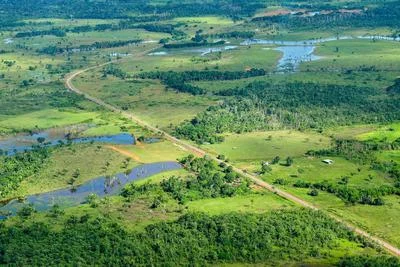
A recent study has revealed that small numbers of scattered trees on farmland surrounding forest patches can substantially enhance bird diversity, particularly at the edges of the Amazon rainforest. Researchers found that forest remnants embedded in agricultural landscapes with scattered trees support a far richer variety of bird species compared to isolated forest fragments surrounded by reservoirs.
The study, involving 58 scientists and covering fragmented landscapes not only in the Amazon but across the Americas, Africa, and Asia, analyzed the bird communities in over 1,000 forest remnants. Utilizing on-the-ground bird surveys, acoustic monitoring, and satellite imagery, the team assessed nearly 2,000 bird species in total.
Scientists compared bird diversity between two types of “forest islands”: those formed by deforestation with farmland around them and reservoir islands formed by damming rivers. Results showed that farmland fragments containing scattered trees supported more than twice as many bird species as forest fragments of the same size surrounded by water. Moreover, increasing tree presence on the farmland corresponded to even higher species richness.
This research challenges the prior assumption that only the size of forest patches and proximity to other forests drive conservation value. It highlights that the quality and composition of the surrounding matrix—specifically the presence of native trees on agricultural land—play a crucial role in maintaining biodiversity.
Why it matters
The findings have immediate implications for conservation and land management practices around tropical forests facing agricultural expansion. By planting native trees, restoring degraded vegetation, and managing farmland to be more hospitable to wildlife, farmers and conservationists can significantly improve bird biodiversity. This approach offers a practical, scalable way to support forest-dependent species without requiring large continuous forest areas.
Given that the Amazon and other tropical forests worldwide are under increasing pressure from deforestation and land-use change, these insights provide a valuable strategy to mitigate biodiversity loss. Supporting bird populations benefits ecosystem functions such as seed dispersal and pest control, which in turn sustain forest health and agricultural productivity.
Background
Forest fragmentation is a widespread phenomenon where large continuous forests become divided into smaller patches due to human activities like farming and dam construction. Traditionally, conservation science emphasized protecting large forest tracts, as smaller and isolated patches were thought to harbor fewer species.
This study, published in the Proceedings of the National Academy of Sciences, expands understanding of conservation dynamics by showing that not just the size and isolation matter, but also the nature of the land surrounding forest patches. The presence of scattered native trees on farms forms a permeability matrix that supports wildlife movement and habitat use.
These findings align with a growing body of ecological research advocating “land-sharing” approaches, which integrate biodiversity conservation into agricultural landscapes rather than segregating them into protected areas alone.
Read more Climate & Environment stories on Goka World News.