
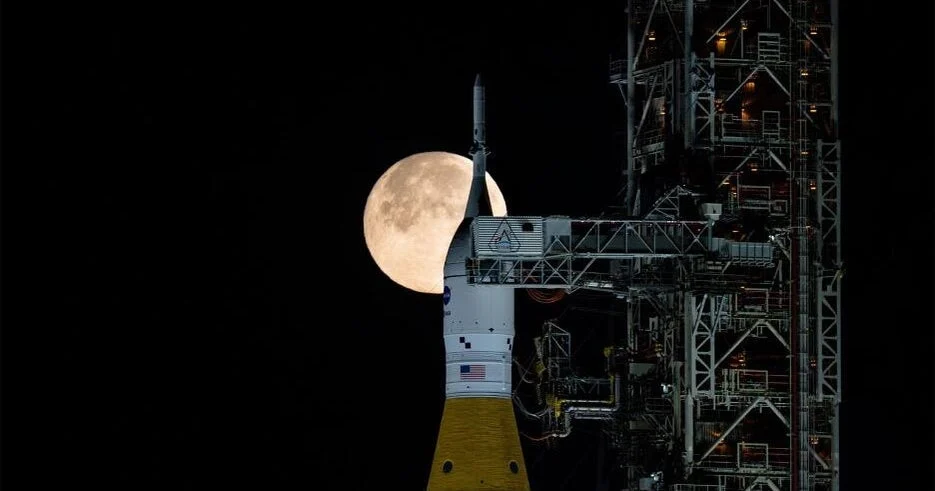
NASA is set to launch its Artemis II mission on Wednesday, April 1, marking the first crewed flight around the moon since Apollo 17 over five decades ago. The mission, featuring four astronauts—commander Reid Wiseman, pilot Victor Glover, astronaut Christina Koch, and Canadian astronaut Jeremy Hansen—is scheduled for liftoff at 6:24 p.m. EDT atop the Space Launch System (SLS) rocket, the most powerful operational booster in the world.
After weeks of delay caused by hydrogen fuel leaks and issues with the upper stage propellant pressurization system, NASA officials reported these problems have been resolved. Preparations include a carefully monitored countdown, with current weather forecasts indicating an 80% chance of favorable conditions.
Test flight of new deep space systems
The Artemis II mission will be a critical test of NASA’s Orion crew capsule, named Integrity, which is flying with astronauts for the first time. The SLS rocket, weighing 5.7 million pounds at launch, will propel the spacecraft to speeds of nearly 5 miles per second to escape Earth orbit. This mission aims to validate Orion’s life support, navigation, communication, and propulsion systems while on a complex trajectory around the moon.
The mission profile includes an initial orbit around Earth and a series of rocket firings to place the spacecraft on a “free return” trajectory around the moon, providing safe return capability without reliance on onboard propulsion systems if needed. During the roughly nine-day mission, the crew will perform maneuvers such as approaching and flying around the spent upper stage to simulate future docking maneuvers with lunar landers or the planned Gateway space station in lunar orbit.
Canadian astronaut Jeremy Hansen will become the first Canadian to fly beyond Earth orbit. The Artemis II crew will be the first humans to travel beyond low-Earth orbit since Apollo, circling the moon without landing and passing as close as 4,100 miles to the lunar surface.
Milestone in NASA lunar ambitions
Artemis II is a stepping stone toward NASA’s goal of returning astronauts to the moon’s surface by 2028, with a focus on long-term lunar presence rather than solely exploration. The agency plans to test moon landers in low-Earth orbit next year ahead of final moon landing missions. Funding for Artemis and related lunar infrastructure is estimated at $20 billion over seven years, according to NASA Administrator Jared Isaacman.
The crew’s activities will help ensure that Orion’s systems can support human health and safety on extended missions, including essentials like carbon dioxide removal, water supply, and waste management. Moreover, the mission will provide the first direct human observations of the moon’s far side illuminated by sunlight, an area typically unseen by astronauts on previous lunar flights.
The Artemis II astronauts, aware of the inherent risks, emphasize the mission’s test flight nature and the importance of continuing efforts regardless of outcome, reinforcing NASA’s commitment to sustainable lunar exploration.
Why it matters
Artemis II represents a crucial validation of new deep space crewed spacecraft and launch systems that will enable NASA to establish a sustained human presence on the moon. It reasserts human spaceflight capabilities beyond low-Earth orbit at a time of renewed international interest in lunar exploration and space competition.
Background
Following the uncrewed Artemis I test flight in 2022, which exposed vulnerabilities in the Orion heat shield, Artemis II uses a redesigned reentry trajectory to mitigate prior thermal risks. This mission’s success will clear the way for subsequent Artemis missions, including lunar landings near the moon’s south pole and the development of lunar bases for extended scientific research and technology demonstration.
Read more Climate & Environment stories on Goka World News.