
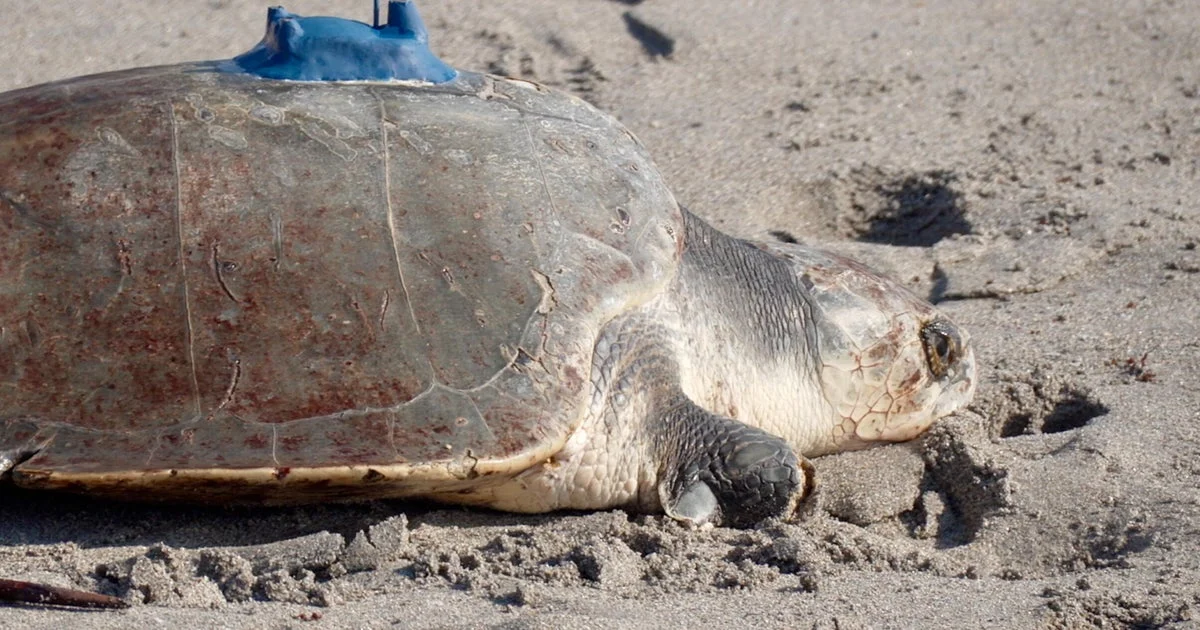
A Kemp’s ridley sea turtle named Amelie was released into the Atlantic Ocean off Juno Beach, Florida, after recovering from the loss of her right forelimb, a predator bite likely inflicted by a shark. The turtle is now being tracked via satellite in a collaborative effort between the Loggerhead Marinelife Center and the Smithsonian Conservation Biology Institute to study the survival and movements of injured sea turtles in the wild.
Amelie was rescued seven weeks earlier by the Inwater Research Group in Port St. Lucie, Florida. During her rehabilitation, she underwent surgery to clean and close the wound and received treatment for pneumonia before veterinarians considered her healthy enough for release. Before entering the ocean, researchers attached a satellite tracking device to her shell, allowing them to monitor her location and surfacing behavior.
The satellite tags used in the program contain a saltwater sensor that detects when the turtle surfaces to breathe, automatically transmitting location data to satellites with a 24-hour delay. An ultrasound also confirmed Amelie is developing eggs, providing an additional incentive to monitor her nesting behavior and migration patterns.
Andy Dehart, president and CEO of the Loggerhead Marinelife Center, noted the special significance of rehabilitating a Kemp’s ridley sea turtle in Florida, as this species is usually more common along Florida’s Gulf Coast. This release marks Amelie as the fourth amputee sea turtle being tracked by the center. Research director Sarah Hirsch highlighted another tracked amputee turtle, Pyari, who has traveled nearly 700 miles since her release in January.
Tracking these amputee turtles helps scientists understand their dive patterns and migratory routes after rehabilitation. “We do know that they can be successful in the wild because we have seen them on our nesting beaches,” Hirsch said, emphasizing the importance of this data in assessing long-term survival.
Why it matters
This satellite tracking initiative offers crucial insights into the ability of injured sea turtles to survive, migrate, and reproduce in the wild after medical intervention. Understanding these factors supports conservation efforts, especially for the Kemp’s ridley, the rarest sea turtle species, and informs best practices in rehabilitation and protection policies.
Background
The Loggerhead Marinelife Center in Florida has been at the forefront of sea turtle rescue and rehabilitation efforts. Satellite tracking technology has increasingly been used to monitor released animals, but this project is among the first to focus specifically on amputee sea turtles. The data collected will contribute to broader ecological research and species recovery programs.
Read more Climate & Environment stories on Goka World News.