
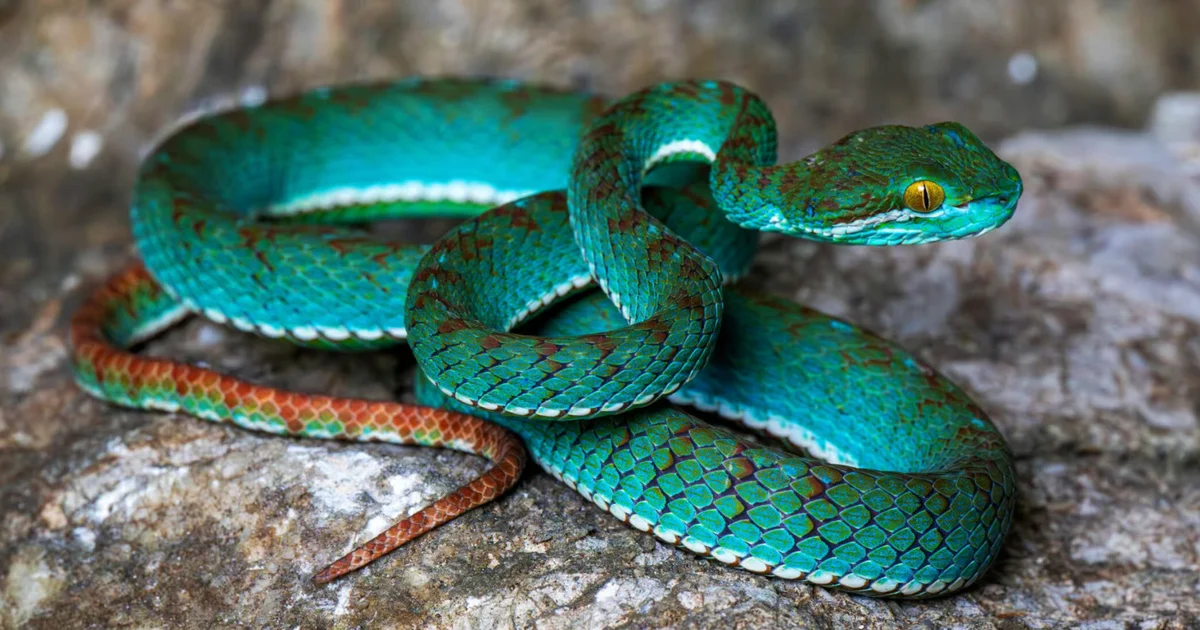
Researchers conducting a multi-year biodiversity survey in western Cambodia’s Battambang province have discovered multiple rare and new species inside previously unexplored limestone caves, including a vividly colored flying snake and a fluorescent turquoise pit viper. The findings were reported by Fauna & Flora Cambodia, which led the study alongside Cambodia’s Ministry of Environment.
The survey, conducted from November 2023 to July 2025, explored more than 60 caves across 10 hills in the region, known for its karst formations — limestone cliffs containing isolated caves and unique ecosystems. Fauna & Flora Cambodia described these karsts as “small islands of habitat” that have become isolated over time due to surrounding human activity, resulting in species found nowhere else on Earth.
Researchers entered the caves through narrow entrances, navigating dark tunnels often requiring crawling. Inside, they documented several rare species including the new pit viper, characterized by a triangular head and bright coloration. Although still undergoing formal classification, the pit viper is highly venomous and detects prey using heat-sensitive pits behind its nostrils. The study also identified camouflaged leaf-toed geckos and brightly colored, likely poisonous millipedes.
The team recorded various reptiles beyond the pit viper, such as reticulated pythons—the world’s longest snake—and the ornate flying snake, or golden tree snake, native to Southeast Asia. Other species observed included spot-legged tree frogs and brightly colored agamid lizards common to the area.
Lee Grismer, a biologist involved in the study, highlighted the karsts’ role as natural laboratories where isolated populations evolve independently, producing highly localized species — sometimes restricted to a single cave.
Why it matters
Karst ecosystems are among the least protected in the world, with only about 1% receiving legal safeguards globally. These habitats face ongoing threats from quarrying, unmanaged tourism, wildfires, logging, and hunting. Fauna & Flora Cambodia emphasized that destruction of these isolated limestone hills risks driving unknown species to extinction before they are even discovered. The survey’s results underscore the urgent need for conservation efforts to preserve these fragile and unique ecosystems.
Background
Cambodia’s karst formations have been historically under-studied despite hosting biodiversity hotspots. Limestone karsts are scattered and isolated by human development, creating unique evolutionary environments. Previous research has similarly revealed highly endemic species in other karst systems, highlighting their global ecological importance and vulnerability. The new discoveries contribute to ongoing efforts to map and protect Southeast Asia’s rich but imperiled biodiversity.
Read more Climate & Environment stories on Goka World News.