
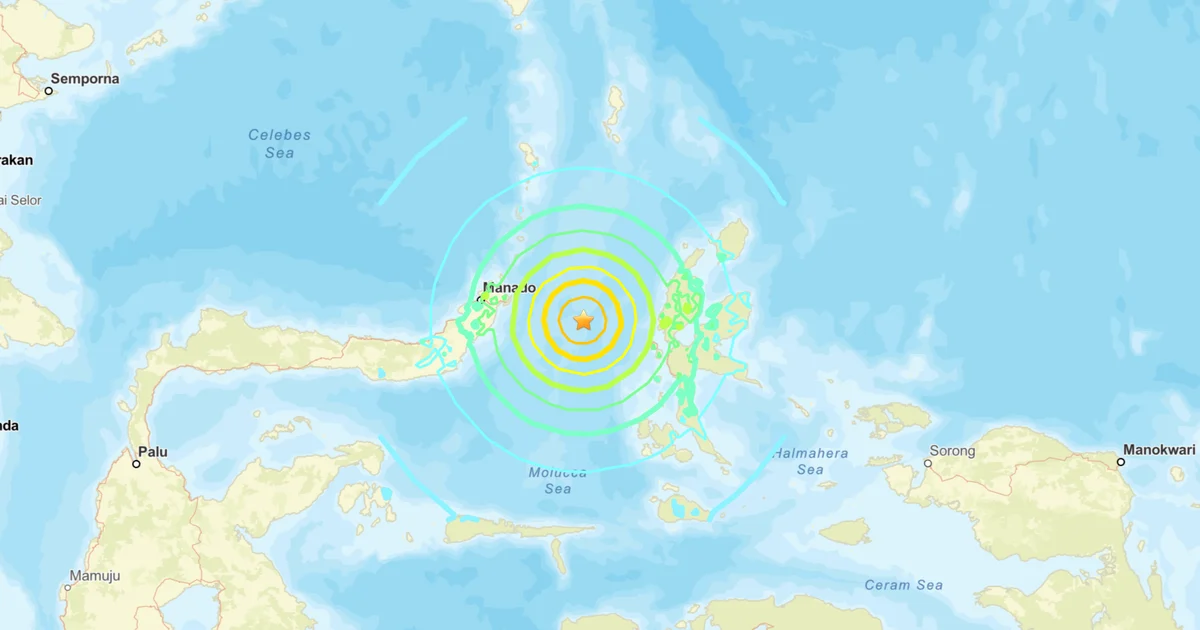
A magnitude 7.4 earthquake struck Indonesia’s Molucca Sea on April 1, 2026, causing structural damage, one death, injuries, and triggering a small tsunami warning that was lifted several hours later. The quake was strongly felt across parts of northern Indonesia, including North Sulawesi and North Maluku provinces.
The earthquake, centered in the Molucca Sea region, produced waves up to 30 inches above normal tide levels at monitoring stations about 30 minutes after the tremor. Indonesia’s meteorological agency quickly lifted the tsunami warning, and the Philippine Institute of Volcanology and Seismology confirmed that their country faced no destructive tsunami threat.
Damage and Casualties
Strong shaking lasting between 10 and 20 seconds was reported in Bitung city in North Sulawesi province and Ternate city in North Maluku province. Initial damage assessments in Ternate indicated varying degrees of destruction, including damage to a church and at least two houses. Damage evaluations were ongoing in Bitung.
Indonesia’s Search and Rescue Agency confirmed the death of a 70-year-old woman caused by a building collapse in Manado city, North Sulawesi. Several other people were injured, including at least three hospitalized in Ternate. Video footage from the rescue agency showed damaged and flattened buildings, while local media broadcast scenes of residents rushing outdoors to avoid collapsing structures.
Seismic Activity and Aftershocks
Nearly 50 aftershocks were recorded in the vicinity following the initial quake. The U.S. Geological Survey confirmed the earthquake’s magnitude and reported its location northeast of Indonesia in the Molucca Sea. The Pacific Tsunami Warning Center in Honolulu also noted the possibility of small tsunami waves in nearby countries such as Malaysia, the Philippines, Taiwan, and Papua New Guinea, but stated there was no threat to more distant Pacific islands including Hawaii and Guam.
Why it matters
Indonesia lies on the Pacific “Ring of Fire,” an area known for frequent and intense seismic activity due to tectonic plate boundaries. Earthquakes of this magnitude pose significant risks to its densely populated regions. This event highlights the ongoing vulnerability of the region to natural disasters, with recent history including deadly quakes such as the 2022 West Java earthquake that killed at least 602 people.
Background
Indonesia is one of the most seismically active countries in the world, regularly experiencing earthquakes and volcanic eruptions. It sits on multiple major fault lines and volcanic arcs spanning the Pacific Basin. The nation suffered devastating losses during the 2004 Indian Ocean earthquake and tsunami, which killed over 230,000 people across multiple countries, with the worst impact in Aceh province.
Read more World News stories on Goka World News.