
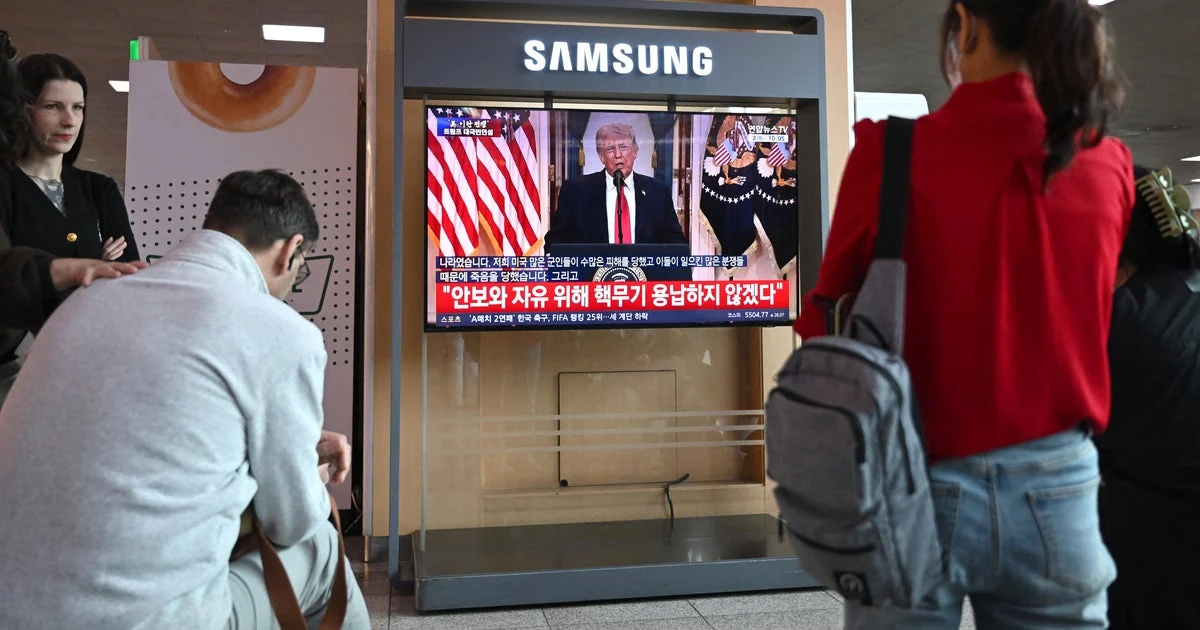
President Donald Trump announced Wednesday night that the United States will continue its military campaign against Iran for an additional two to three weeks, claiming U.S. objectives are close to completion but without providing details on how or when the conflict might end. Following his remarks, global oil prices surged sharply, reflecting market concerns over prolonged instability in the Middle East.
Trump declared in a nearly 19-minute prime-time address that the U.S. has achieved “overwhelming victories” and that Iran’s offensive capabilities are “essentially decimated.” He warned that unless Iran agrees to a deal, U.S. forces would continue targeting the country’s electric power plants and oil infrastructure. Despite his confident tone, Trump did not offer a clear timeline for reopening the Strait of Hormuz, a critical passage for global oil shipments currently disrupted by the conflict.
Oil and Markets React
Investors responded to the address with heightened concern. Brent crude, the global oil benchmark, jumped nearly 7% to over $108 per barrel early Thursday, while U.S. crude rose roughly 6.4% to $106.55. The surge in oil prices has added pressure on U.S. motorists, farmers, and delivery services already facing average gasoline prices above $4 per gallon. Market analysts noted the absence of concrete plans for ceasefire or conflict resolution fueled further volatility.
Stock markets also retreated amid the renewed uncertainty. Asian indexes, including Japan’s Nikkei, South Korea’s Kospi, and India’s Sensex, fell sharply, and U.S. futures declined ahead of Thursday trading. Market strategists cited Trump’s address as “far less than what the market expected,” particularly due to the lack of a clear pathway to ending hostilities.
Iranian Response and Regional Tensions
Iran’s military leadership dismissed Trump’s assessment as “incomplete” and vowed to continue fighting against U.S. and Israeli forces with “more crushing, broader and more destructive” attacks. Iran’s Khatam al-Anbiya central military headquarters spokesperson warned that U.S. intelligence underestimated Iran’s war capabilities, cautioning against assumptions that Tehran’s missile, drone, and air defense systems have been destroyed.
Iran and its proxy groups have maintained pressure on Israel and U.S. allies in the region. In the latest missile attacks on northern Israel, at least two people were wounded, and Saudi Arabia reported intercepting four Iranian drones early Thursday. The U.S. embassy in Baghdad also issued a warning of potential attacks by Iran-aligned militias within the next 24 to 48 hours, urging Americans to leave Iraq immediately.
Why it matters
The continuation of U.S. strikes against Iran amid unclear endgame prospects sustains regional instability with broad consequences. Rising oil prices directly affect global energy markets and consumer costs, contributing to inflationary pressures worldwide. The ongoing conflict threatens critical supply routes such as the Strait of Hormuz, heightening risks to global energy security. Furthermore, escalations by Iran and its proxies increase the possibility of a wider regional confrontation involving multiple states.
Read more World News stories on Goka World News.