
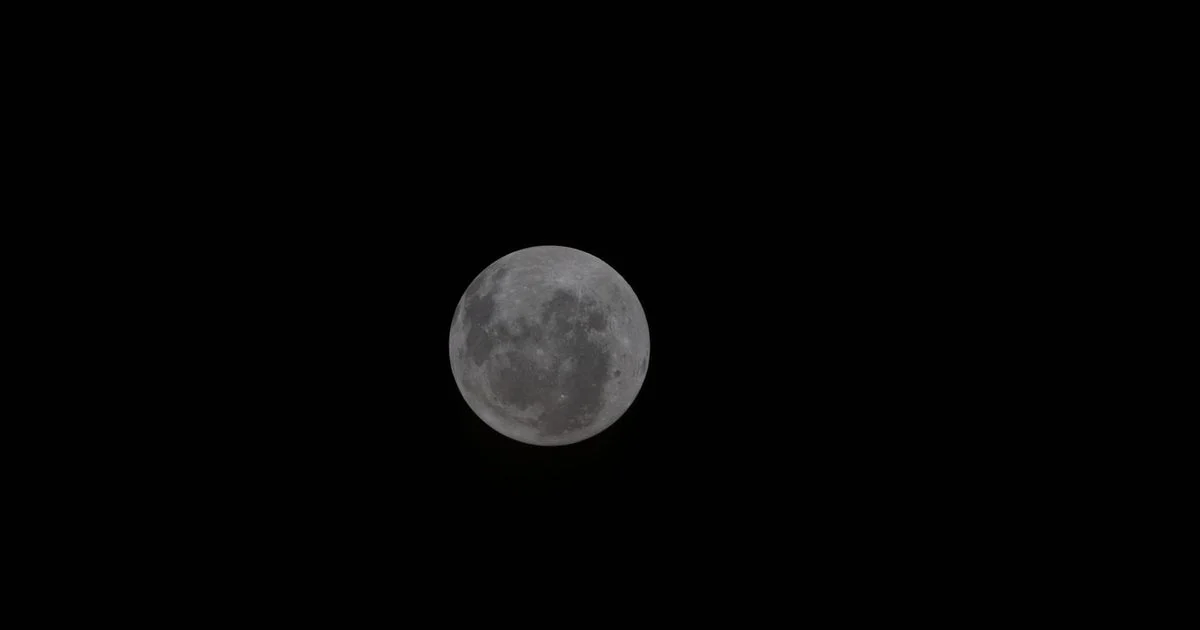
The crew of NASA’s Artemis II mission captured a new photograph of the far side of the Moon on the fourth day of their flight, marking a significant milestone in human lunar exploration. NASA released the image on Sunday, showing the Moon oriented with its South Pole at the top and revealing parts of the far side not visible from Earth.
The photograph prominently features the Orientale basin, a vast and ancient impact crater located along the Moon’s right edge in the image. This basin has never before been fully seen by human eyes. The Artemis II mission is the first in over 50 years to send astronauts beyond low Earth orbit since the Apollo program, and the crew will continue to observe and study the Orientale basin during their lunar flyby.
NASA described the Orientale basin as an important geological feature that scientists will use as a reference point for comparing impact craters across other rocky bodies in the solar system, from Mercury to Pluto.
The Artemis II crew consists of four astronauts aboard the Orion spacecraft: commander Reid Wiseman, pilot Victor Glover, and mission specialists Christina Koch and Jeremy Hansen. On Sunday, the crew was approximately 64,000 miles from the Moon as they prepared to enter the lunar sphere of influence, the region where the Moon’s gravitational pull becomes dominant over Earth’s.
During this phase of the mission, scheduled for later on Sunday, the crew will conduct critical spacesuit tests and other flight evaluations to validate systems ahead of Artemis III, the planned mission to return astronauts to the lunar surface.
In a recent interview on CBS’s “Face the Nation,” NASA Administrator Jared Isaacman emphasized that Artemis II’s primary objective is gathering scientific observations and technical data to inform future deep space missions. “Learning as much as we can about Orion is critically important, because Artemis III is a year away,” he said.
The mission continues to progress with close monitoring from mission control at NASA’s Johnson Space Center, which will hold a televised briefing Sunday evening to update the public on Artemis II’s status.
Why it matters
The Artemis II mission represents a crucial step in NASA’s Artemis program, paving the way for human return to the lunar surface. Photographing and studying the far side of the Moon and features like the Orientale basin provide new scientific data that enhances understanding of lunar geology and impact processes across the solar system. The mission’s technical validations of spacecraft and spacesuits are essential for ensuring astronaut safety and mission success in subsequent lunar landings.
Background
Artemis II is the first crewed mission in NASA’s Artemis program, which aims to establish sustainable human exploration of the Moon and prepare for future missions to Mars. Launched from Cape Canaveral, Florida, Artemis II follows the uncrewed Artemis I test flight and is intended to test Orion spacecraft systems and crew operations in lunar orbit. It builds on more than five decades of lunar exploration heritage since the Apollo missions.
Read more US News stories on Goka World News.