
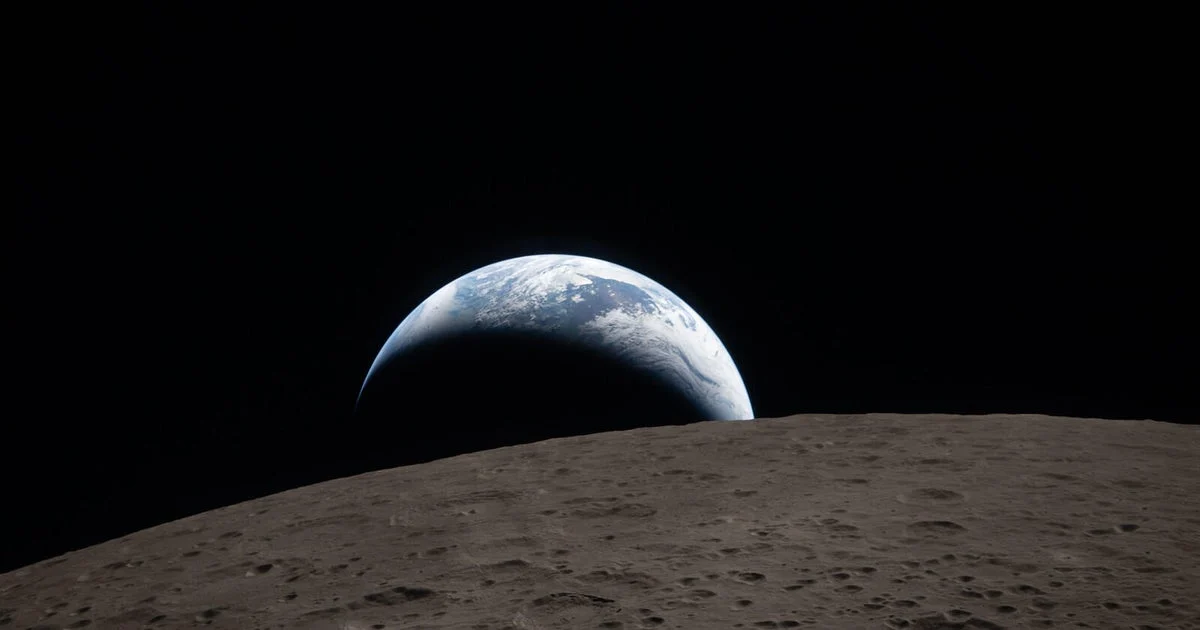
The Artemis II crew has released striking images taken during their historic flyby of the moon, including a rare view of “Earthset” and a lunar eclipse visible only from space. These photos provide an unprecedented perspective on Earth’s silhouette against the lunar surface and the moon’s eclipse of the sun.
One image, captured through the Orion spacecraft window on April 6, 2026, shows Earth partially in darkness as it dips below the moon’s horizon, revealing Australia and Oceania on the planet’s sunlit side. NASA and the White House described this view as “Humanity, from the other side,” highlighting the mission’s milestone of humans seeing portions of the moon’s far side with the naked eye for the first time. The Artemis II crew is now the farthest humans have traveled from Earth in history.
Another extraordinary photograph depicts the moon fully eclipsing the sun—a phenomenon not observable from Earth. NASA noted that from Artemis II’s vantage point, the moon appeared large enough to completely block the sun, producing nearly 54 minutes of totality. Astronaut Victor Glover described the view as unreal, emphasizing the visible sun’s corona creating a halo around the moon and the distinct lunar surface visible against Earthshine during the eclipse. The crew wore eclipse glasses until totality was reached for eye safety.
Additional images show detailed ridged craters and elongated shadows along the boundary between lunar day and night, where low-angle sunlight casts dramatic shadows, revealing the moon’s rugged topography in striking detail.
The Artemis II crew is currently returning to Earth and is expected to splash down off the coast of California near San Diego on Friday evening.
Why it matters
These images mark a historic moment, offering humanity its first direct view of the far side of the moon and a space-only lunar eclipse while farther from Earth than any astronauts before. The visuals provide valuable scientific insights into lunar geography and eclipse dynamics, advancing human space exploration and inspiring public interest in NASA’s Artemis program.
Background
Artemis II is NASA’s first crewed mission in the Artemis program aiming to return humans to the moon and establish a sustained presence. This mission follows Artemis I, an uncrewed test flight, and sets the stage for Artemis III, which plans to land astronauts on the lunar surface. The mission emphasizes expanding human exploration beyond low Earth orbit, deepening understanding of lunar geography and space phenomena.
Read more US News stories on Goka World News.