
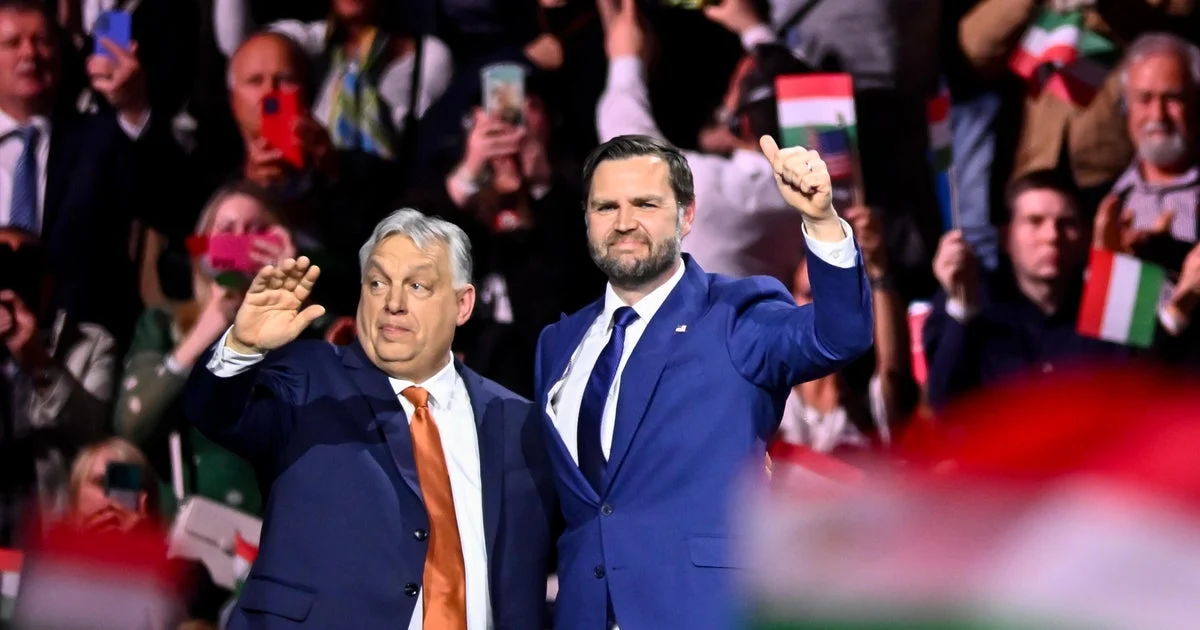
U.S. Vice President JD Vance travelled to Budapest to publicly support Hungarian Prime Minister Viktor Orbán ahead of Hungary’s parliamentary election scheduled for April 12, 2026. During his visit, Vance accused the European Union of interfering in Hungary’s electoral process by threatening to withhold billions in funds.
On April 8, Vance criticized the EU for what he described as coercive tactics against Hungary for its border policies, stating, “That’s apparently not foreign influence.” He contrasted this with accusations aimed at him of foreign interference simply because he came to Hungary to back Orbán, a nationalist leader known for advocating an “illiberal democracy.”
Vance emphasized his intention to help Orbán secure a fifth consecutive term, characterizing the Hungarian government under Orbán as a defender of Western civilization and Christian values. He framed the election as a choice between Hungarian sovereignty and what he called bureaucratic overreach from Brussels, urging voters to support Orbán for “freedom, truth and for the God of our fathers.”
Orbán’s ruling party, Fidesz, is trailing in independent polls by a double-digit margin against main opposition candidate Péter Magyar, according to reports. Freedom House classifies Hungary as “partly free,” citing concerns over democratic backsliding, election fairness, and weakening independent institutions under Orbán’s leadership. The prime minister’s government has also deepened ties with Russia, drawing international scrutiny.
The visit included a phone call with former President Donald Trump, who lauded Orbán in front of a crowd in Budapest. Vance and Trump’s support highlights continued backing from certain U.S. conservative circles for Orbán’s government.
European Union response to allegations
EU officials quickly rejected Vance’s claims of interference. European Commission spokesperson Thomas Regnier told CBS News that “elections are the sole choice of citizens” and praised EU measures to protect democratic processes from digital and external manipulation. The EU’s foreign affairs spokesperson Anitta Hipper noted that diplomatic exchanges with U.S. counterparts continue regarding election-related concerns, but declined to provide details.
Why it matters
Vance’s visit and explicit endorsement underscore the active role U.S. political figures are playing in international elections, raising questions about foreign influence on democratic processes. Meanwhile, the accusations against the European Union reflect ongoing tensions between national sovereignty claims by Hungary’s government and EU oversight mechanisms. The outcome of the Hungarian election will have significant implications for EU cohesion, regional security, and the future direction of Hungarian democratic governance.
Read more World News stories on Goka World News.