
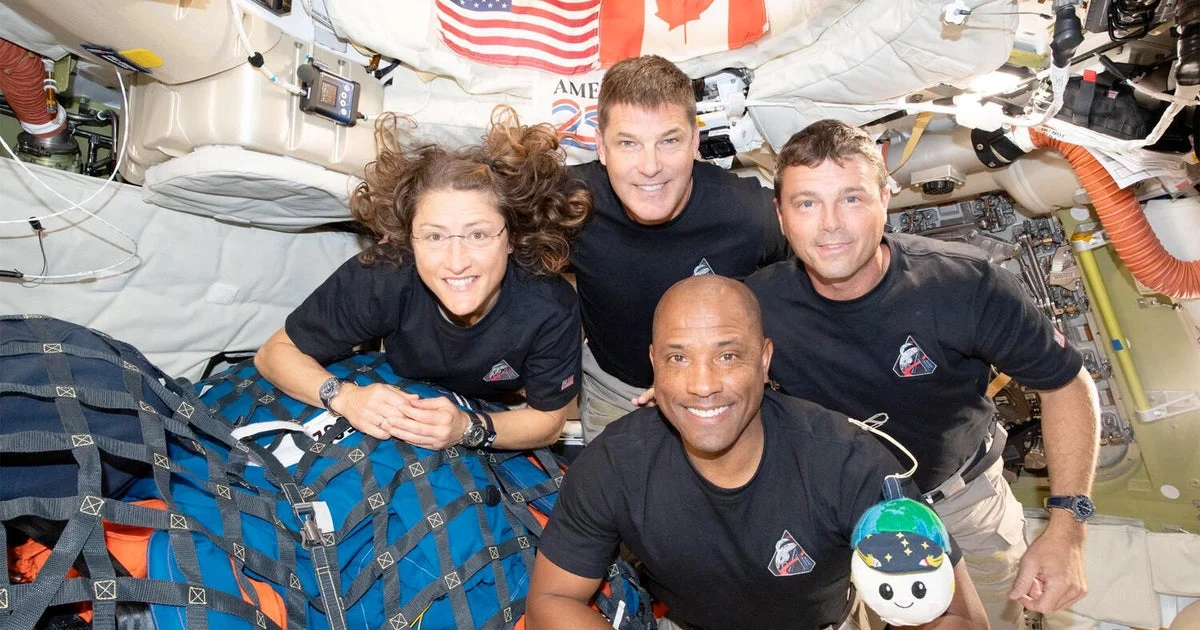
NASA’s Artemis II astronauts have reflected on their historic mission around the moon as they prepare for re-entry and splashdown off the coast of Southern California on Friday. The crew, consisting of commander Reid Wiseman, Victor Glover, Christina Koch, and Canadian astronaut Jeremy Hansen, discussed memorable experiences and mission challenges during a space-to-ground news conference Wednesday.
A deeply personal moment for the crew came when they unofficially named a previously unnamed lunar crater after Commander Wiseman’s late wife, Carroll, who passed away in 2020. The idea originated with the crew before launch during their quarantine period. Hansen relayed the tribute to mission control on Monday, delivering an emotional highlight of the flight that Wiseman described as the mission’s pinnacle. He expressed the moment’s significance, reflecting on raising his two daughters as a single father following his wife’s death.
The crew also recounted breathtaking sights, including a solar eclipse where the sun disappeared behind the moon, creating a ghostly glow visible from their Orion capsule. Glover called it one of the mission’s greatest gifts. Wiseman described watching Earth set below the lunar horizon, an event that left them out of contact with mission control for about 40 minutes and stood as an “unbelievable sight.”
Despite the inspiring views, the crew maintained focus on scientific objectives, including gathering critical geological observations of the lunar surface. The astronauts took brief moments to share small personal reflections and tokens, such as maple cookies brought by Hansen, underscoring the unique nature of working together in such rare circumstances.
NASA recently postponed a planned manual piloting test of the Orion spacecraft by the full crew to address a higher-than-expected pressure reading in one of the spacecraft’s oxygen manifolds. Flight controllers isolated the affected manifold as a precaution. While not required for the return journey, the issue is being investigated to prevent recurrence in future missions.
Recovery teams are currently en route to the splashdown site near San Diego, where the capsule is expected to arrive at approximately 8:07 p.m. EDT on Friday. Weather conditions are reported favorable for the recovery operation.
Why it matters
This mission marks NASA’s first human flight around the moon since 1972 and is a critical step for the Artemis program aimed at sustainable lunar exploration and establishing a long-term human presence on the moon. The data and photographs collected from the partly illuminated far side of the moon provide new scientific insights into lunar geology, enhancing understanding of the moon’s evolution.
Background
The Artemis II mission follows the successful uncrewed Artemis I flight and precedes Artemis III, which aims to land astronauts near the lunar south pole. The Orion spacecraft utilized in Artemis II is designed for deep space travel, with redundant systems for propulsion and life support. The crew’s ability to pilot Orion manually is being tested to broaden the roles available to astronauts in future missions.
Read more US News stories on Goka World News.