
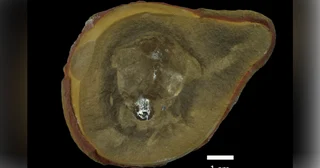
A fossil previously recognized as the world’s oldest octopus has been reclassified as a cephalopod related to the nautilus, according to a recent study led by zoologist Thomas Clements of the University of Reading. The findings overturn prior identification and have prompted Guinness World Records to remove the fossil from its register as the earliest octopus specimen.
The fossil, named Pohlsepia mazonensis, was discovered in the Mazon Creek fossil beds in Illinois, an area known for its exceptional preservation of prehistoric life from before the age of dinosaurs. When first described in 2000, Pohlsepia challenged established timelines of octopus evolution by suggesting eight-armed cephalopods existed much earlier than supported by other fossils, the next oldest confirmed octopus being approximately 90 million years old.
Clements and his team reexamined the fossil using synchrotron imaging, a technique employing intense light beams generated by fast-moving electrons to analyze internal structures without damaging specimens. This approach revealed details invisible to earlier examinations, including a radula—a ribbon-like structure of teeth common to mollusks but varying across species. The fossil’s radula rows contained 11 teeth, exceeding the 7 or 9 teeth typical of modern octopuses, indicating Pohlsepia was not an octopus.
Further comparison aligned its radula teeth with Paleocadmus pohli, a fossil nautiloid also from the Mazon Creek site. This evidence supports the conclusion that Pohlsepia is actually a soft-bodied nautilus relative rather than a true octopus. The initial misidentification likely stemmed from the decomposition and loss of any shell prior to fossilization, complicating earlier analyses.
The study, published in the Proceedings of the Royal Society B, highlights the importance of reexamining contentious fossils with modern technologies to refine understanding of evolutionary history. Guinness World Records has acknowledged the research and will retire Pohlsepia mazonensis as the oldest octopus fossil.
Pohlsepia, named after its discoverer James Pohl, is housed in the Field Museum of Natural History in Chicago. Clements noted the institution can now claim custody of the world’s oldest known soft-tissue nautilus fossil, a significant specimen for cephalopod research. The Field Museum has been approached for comment.
Why it matters
Correctly identifying key fossils is vital for reconstructing the evolutionary timeline of major animal groups like cephalopods. The reclassification of Pohlsepia adjusts the known origin of octopuses, reaffirming they emerged later than previously assumed. This impacts scientific models of cephalopod development and biodiversity through deep history. Additionally, the case underscores how advancements in imaging continue to transform paleontology by offering new insights into well-studied specimens.
Background
Octopuses are soft-bodied cephalopods noted for their eight arms and lack of an external shell, distinguishing them from their shelled relatives like nautiluses. The fossil record of octopuses is sparse due to their delicate bodies, making discoveries like Pohlsepia important for understanding their evolution. Mazon Creek fossils, dated to the Carboniferous period over 300 million years ago, provide valuable windows into prehistoric marine ecosystems. Previously, Pohlsepia’s assignment as the oldest octopus suggested an earlier emergence for this group, contrasting with the fossil record that indicated a much younger origin. This study helps reconcile those discrepancies.
Read more Climate & Environment stories on Goka World News.