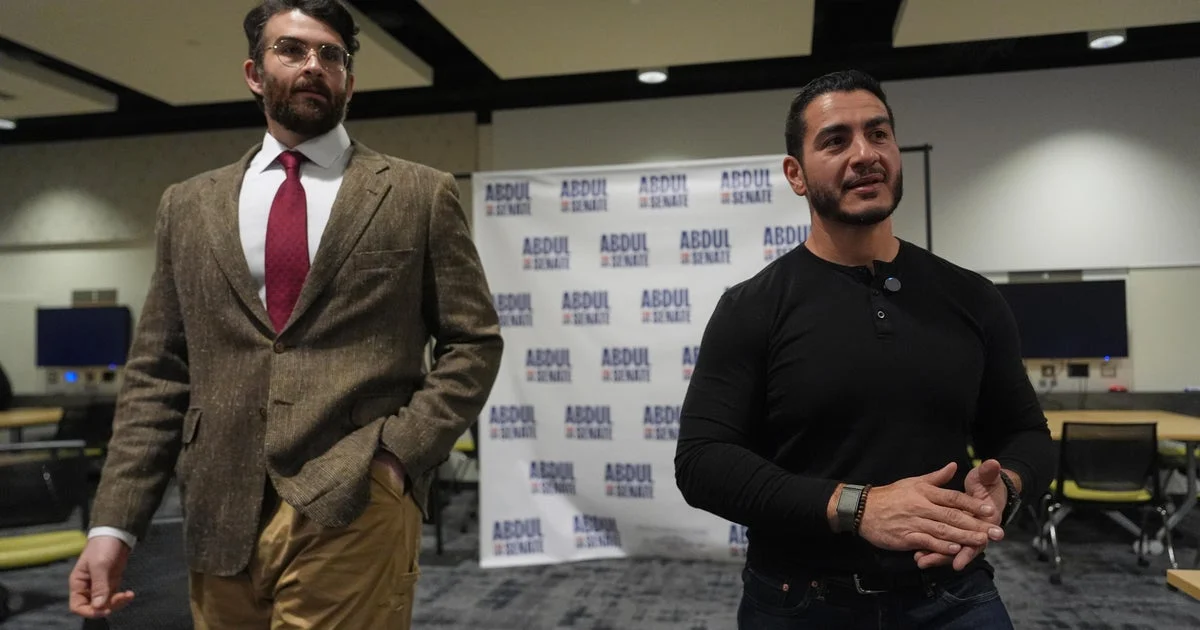
Michigan Democratic Senate candidate Abdul El-Sayed held campaign events with Hasan Piker, a left-wing podcaster and Twitch streamer, at Michigan State University and the University of Michigan on April 7, 2026, drawing attention to divisions within the Democratic Party over the Israel-Hamas conflict.
Piker, who has over three million followers on Twitch, has made controversial statements about the Israel-Hamas war, including framing the October 7 Hamas attack as a “direct consequence” of Israeli and U.S. government actions. His comments have sparked backlash from within the party and beyond.
El-Sayed defended his decision to campaign with Piker, stating in a brief interview before the Michigan State University event that his focus was on addressing local issues rather than national political controversies. “Here in Michigan, people can’t afford to fill up a tank because of the war that’s being fought out of D.C. and have to suffer,” El-Sayed said. He emphasized reaching voters who feel excluded from politics due to economic struggles.
El-Sayed’s primary opponents, Rep. Haley Stevens and state Sen. Mallory McMorrow, have criticized his association with Piker. Stevens, supported by the pro-Israel group American Israel Public Affairs Committee (AIPAC), called the campaign partnership “unacceptable.” McMorrow, who shares El-Sayed’s description of the Gaza conflict as genocide and refuses AIPAC donations, compared Piker to far-right commentator Nick Fuentes, citing offensive rhetoric intended to gain attention.
Piker addressed critics at the Michigan State rally, accusing prominent Democrats of prioritizing corporate donors and foreign lobbyists over addressing the political climate and criticizing Donald Trump. Michigan is home to the largest Arab, Muslim, and Palestinian American population in the U.S., which adds a layer of significance to the electoral dynamics in the state.
Progressive Rep. Rashida Tlaib and moderate Rep. Debbie Dingell attended the University of Michigan event, which along with the Michigan State gathering drew approximately 1,200 attendees. Students and local voters expressed mixed but largely supportive views toward El-Sayed’s campaign. A Michigan State student emphasized rejecting candidates tied to AIPAC, while other attendees praised El-Sayed’s outreach to left-wing voters often alienated by the broader party.
Why it matters
This campaign partnership exposes a stark ideological divide within the Democratic Party over U.S. foreign policy in the Middle East, particularly concerning Israel. It highlights tensions between established politicians aligned with pro-Israel organizations and progressive candidates advocating for a reexamination of U.S. support amid ongoing regional conflicts. As Michigan plays a pivotal role in national elections, these divisions could influence party unity and voter turnout ahead of the August primary.
Background
The 2024-2026 Israel-Hamas conflict has intensified debates within the Democratic Party regarding U.S. aid to Israel and the characterization of the conflict. Candidates like El-Sayed and McMorrow have referenced allegations of genocide in Gaza, rejecting donations from AIPAC, while others like Stevens maintain support for continued U.S.-Israel relations. Hasan Piker’s online commentary has amplified progressive critiques but also generated controversy due to his framing of events and inflammatory remarks.
Read more Politics stories on Goka World News.