
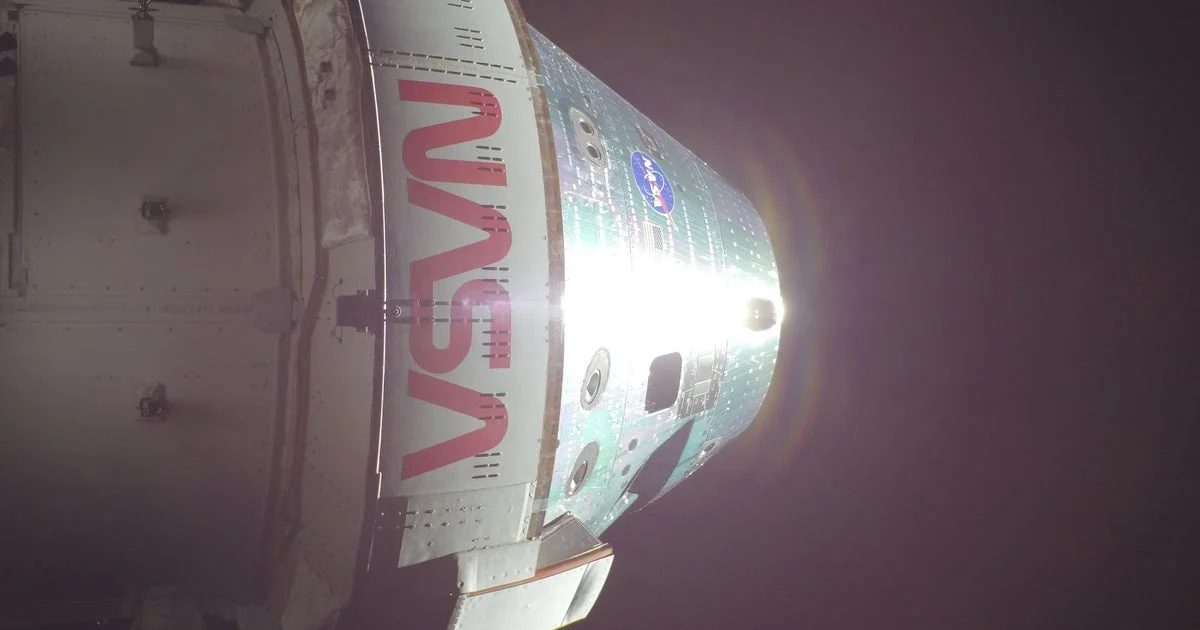
The Artemis II mission crew is preparing for a high-risk reentry to Earth after circumnavigating the moon, placing their safety on the performance of the Orion capsule’s heat shield. As the spacecraft reenters the atmosphere over the Pacific Ocean, it will encounter temperatures nearing 5,000 degrees Fahrenheit while decelerating from speeds of 24,000 mph, making the heat shield essential for protecting the astronauts from intense thermal stress.
The crew—Commander Reid Wiseman, Victor Glover, Christina Koch, and Canadian astronaut Jeremy Hansen—count on the heat shield to maintain a safe, controlled environment throughout the fiery descent, culminating in a parachute-assisted splashdown off the California coast scheduled for 8:07 p.m. ET.
Heat shield challenges from Artemis I
The Artemis II heat shield is identical to the one used on the uncrewed Artemis I test flight in 2022, which experienced unexpected damage upon reentry. After splashdown, inspections revealed over 100 locations where the Avcoat ablative material that forms the shield’s protective char layer had developed cracks and gas pockets, causing pieces of the outer layer to detach instead of eroding as designed. NASA’s Office of Inspector General flagged this as a potential risk to crew safety on future missions.
Engineers traced the damage to the heat shield’s lack of permeability during the “skip” reentry trajectory. During Artemis I, the capsule dipped into the atmosphere, then briefly ascended before the final descent. This sequence caused changing temperature and pressure conditions, trapping gas within the shield’s layers as the outer char became less permeable at cooler external temperatures while still extremely hot internally. Pressure buildup led to the outer layer fracturing and flaking away.
Modified reentry strategy for Artemis II
Rather than redesigning the heat shield and delaying Artemis II by over a year, NASA opted to maintain the existing shield but alter the reentry trajectory. Engineers propose a modified “lofted” profile involving a shallower initial atmospheric dip followed by a shorter climb back out, maintaining higher external heating for longer. This approach is intended to keep the heat shield’s outer char layer permeable throughout reentry, allowing trapped gases to escape and preventing the crack formation observed in Artemis I.
Extensive laboratory tests—including wind tunnel, laser, and hypervelocity experiments—have supported this adjustment. An independent review team endorsed the conclusion that the revised trajectory should secure the shield’s integrity during Artemis II’s reentry. However, the change will reduce the capsule’s ability to alter its landing zone in response to weather, and results in sustained high temperatures on the shield.
Assessment and crew confidence
Despite remaining uncertainties, NASA leadership and the Artemis II crew express confidence in the modified plan. Amit Kshatriya, NASA’s associate administrator, noted that engineering data, prior flight results, and ground testing provide a strong technical basis for the heat shield’s performance. Commander Wiseman stated that the team’s thorough research and testing all point to mission safety, while Glover acknowledged the ongoing scrutiny enhances mission diligence.
Some critics, including former astronaut Charles Camarda, have questioned NASA’s decision to proceed without installing a redesigned shield, warning that the underlying causes of Artemis I’s damage may not be fully understood and cautioning against overconfidence. Nonetheless, the Artemis II astronauts have expressed trust in the expert teams responsible for heat shield assessment and mission planning.
Why it matters
Reentry heat shield reliability is critical not only for Artemis II but for the safety of future crewed lunar missions under NASA’s Artemis program. The experience with the Artemis I shield underscores the challenges of developing robust thermal protection systems for deep space exploration. Successful reentry of Artemis II will validate engineering solutions and inform design improvements needed for sustained lunar presence.
Read more US News stories on Goka World News.