
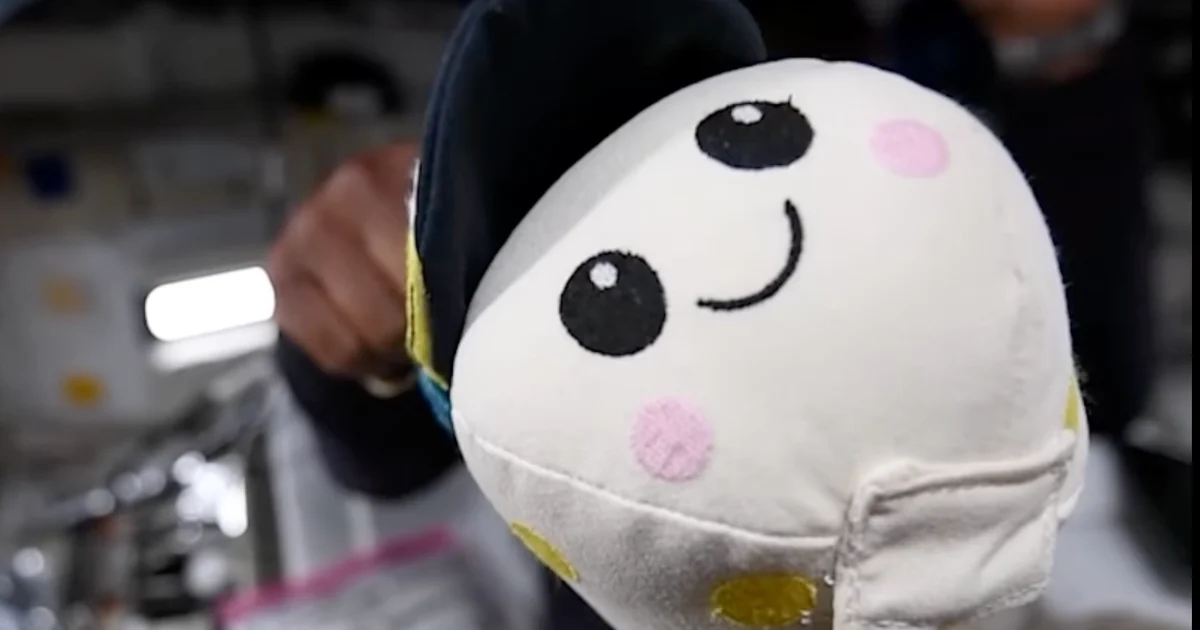
NASA’s Artemis II mission, currently returning from its historic lunar orbit, carried a unique mascot designed by an eight-year-old. The plush toy, named Rise, served as the mission’s zero-gravity indicator, floating freely inside the Orion spacecraft to signal when the crew reached weightlessness.
Rise’s design originated from a 2025 contest run by NASA in partnership with Freelancer, a global crowdsourcing platform. The competition sought a mascot that could also function as a gravity sensor and embody the spirit of exploration and humanity intrinsic to Artemis. Contestants were required to meet strict size, weight, and material criteria, including fitting into a 6x6x6-inch box and not exceeding 12 ounces.
Lucas Ye, a second-grade student, entered the contest after brainstorming several ideas. His final concept incorporated multiple space history references: a round white body symbolizing the moon, a footprint on the back referencing Neil Armstrong’s 1969 lunar landing, an Apollo 8-inspired cap featuring the iconic “Earthrise” photograph, and decorations depicting the Orion constellation and spacecraft. Lucas not only sketched Rise but also built a prototype himself.
Out of 2,605 entries submitted from over 50 countries, Freelancer announced 25 finalists in August 2025, including Rise. Five designs were shortlisted, and the Artemis II crew ultimately selected Rise as their mascot. Pilot Victor Glover described the decision as difficult, while mission specialist Christina Koch highlighted the historical symbolism linked to the Apollo missions as a decisive factor.
NASA’s Thermal Blanket Lab at the Goddard Space Flight Center manufactured the final version of Rise, ensuring it met stringent safety standards. Technician Pamela Cain assembled the mascot using a combination of machine and hand-sewing techniques. A special pocket was added to hold a micro SD card containing more than 5.6 million names submitted through NASA’s “Send Your Name with Artemis” campaign.
On April 1, Rise was secured inside the Orion capsule and later floated aboard as the crew traveled around the far side of the moon, setting a record for the farthest humans have traveled from Earth. The plush toy’s visibility in videos from the mission made it a viral sensation.
As Artemis II prepares for its splashdown in the Pacific Ocean this Friday, Rise will demonstrate the return of gravity by dropping back to the capsule’s floor. The post-mission fate of the mascot has not been disclosed.
Lucas Ye and his family watched the launch from Kennedy Space Center, expressing pride in his role. Lucas said this experience has inspired him to dream of a future career at NASA and possibly becoming an astronaut.
Why it matters
Rise highlights NASA’s efforts to engage the public, including children, in space exploration through innovative outreach and education initiatives. The mascot’s design process connected young talent to a milestone mission, symbolizing the next generation’s involvement in humanity’s journey beyond Earth.
Background
The Artemis II mission is the first crewed test flight in NASA’s Artemis program, which aims to return humans to the moon and eventually send astronauts to Mars. Zero-gravity indicators, like Rise, are traditional tools used during spaceflights to visually confirm when astronauts enter weightlessness, combining practical functionality with cultural and motivational significance.
Read more US News stories on Goka World News.