
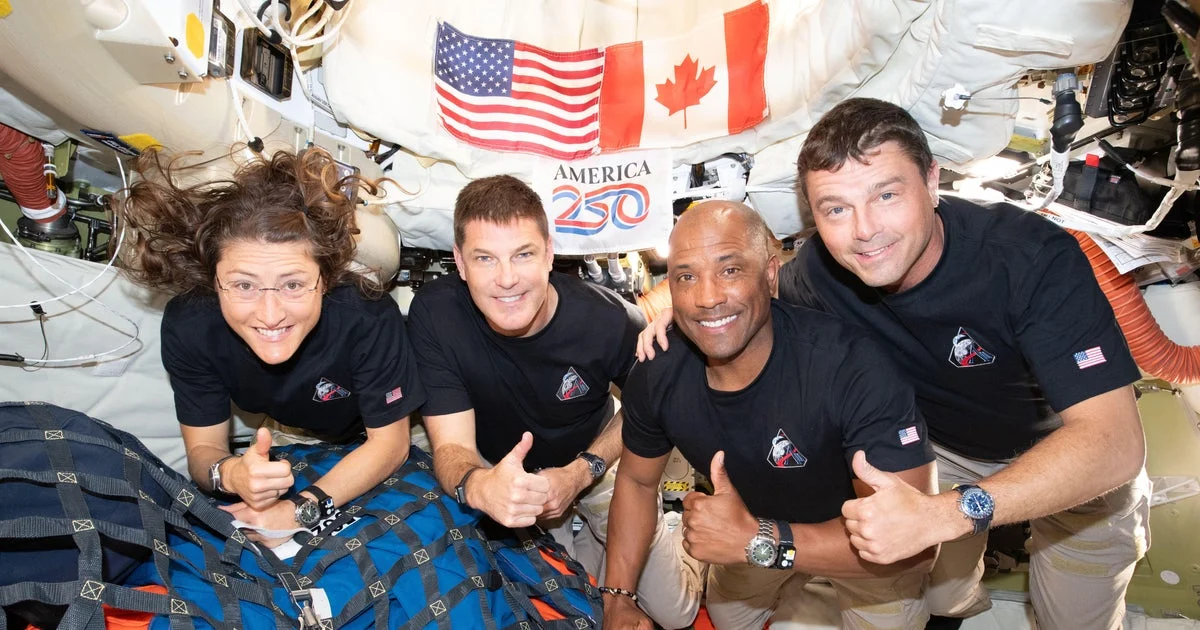
NASA’s Artemis II mission is concluding as its crew prepares for a splashdown in the Pacific Ocean near San Diego, California, at approximately 8:07 p.m. ET on Friday, April 10, 2026. The Orion capsule is carrying commander Reid Wiseman, pilot Victor Glover, mission specialist Christina Koch, and Canadian astronaut Jeremy Hansen back to Earth after a nine-day spaceflight marking humanity’s farthest journey from the planet.
Mission Highlights and Record-Breaking Distance
During the mission, Artemis II astronauts set a new record for the farthest distance ever traveled by humans from Earth, reaching 252,756 miles on the far side of the moon. This surpassed the Apollo 13 record from 1970 by more than 4,000 miles. The spacecraft also achieved a closest lunar approach of approximately 4,067 miles above the moon’s surface.
Throughout the journey, the crew captured striking images, including an “Earthset” photo showing the Earth dipping behind the moon, and a unique solar eclipse visible only from their vantage point in space. Astronaut Victor Glover described witnessing the eclipse as one of the trip’s most profound moments.
Splashdown and Recovery Operations
The Orion capsule will enter Earth’s atmosphere traveling at about 24,000 mph. NASA recovery teams aboard the USS John P. Murtha, including Navy crews supported by four helicopters and six small boats, will retrieve the astronauts and capsule from waters roughly 40–50 miles southwest of San Diego.
NASA Administrator Jared Isaacman will be present on the recovery ship for the crew’s return. Following retrieval, the astronauts will undergo medical checks aboard the ship before being flown to land by helicopter.
Personal Tributes and Crew Experiences
Among the mission’s emotional moments, the crew named a previously unnamed moon crater “Carroll” in memory of commander Reid Wiseman’s late wife. Jeremy Hansen led the tribute, describing it as a deeply meaningful part of the mission.
The crew also flew with “Rise,” a zero-gravity plush mascot designed by an 8-year-old California student, which served as a visual indicator of weightlessness throughout the mission.
Why it matters
Artemis II’s successful mission serves as a critical step in NASA’s broader Artemis program, paving the way for future crewed lunar landings and continued deep-space exploration. The record distance and mission operations validate capabilities that will support sustainable presence on the moon and prepare for eventual human missions to Mars.
Read more US News stories on Goka World News.