
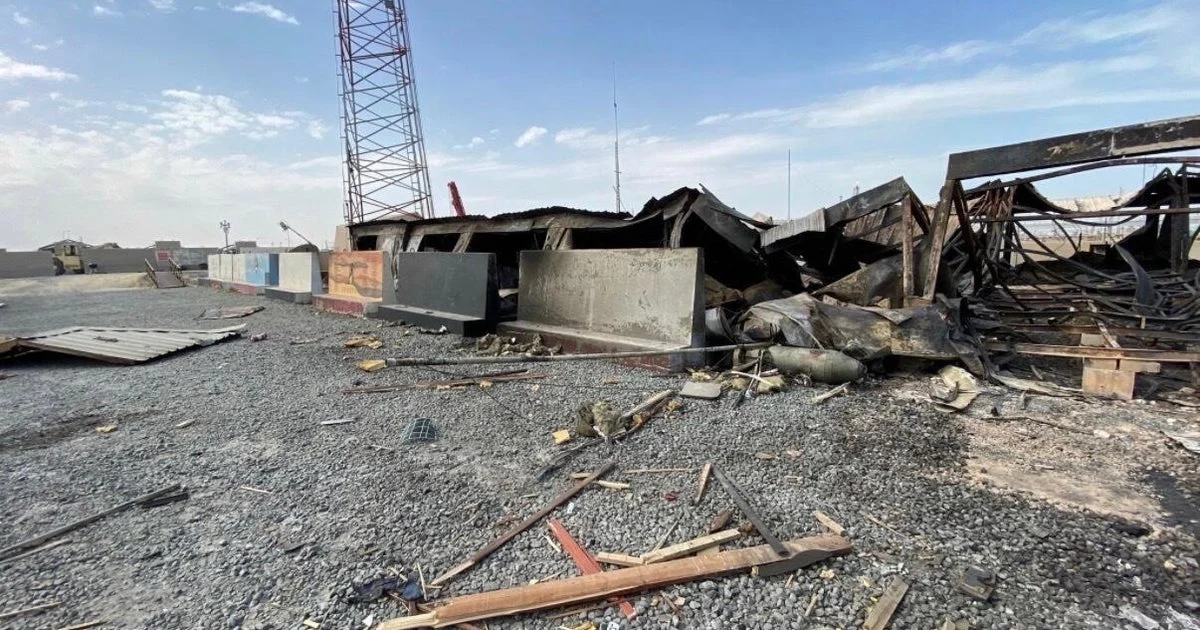
Survivors of the March 1 Iranian drone attack on a U.S. military facility in Kuwait have publicly disputed the Pentagon’s description of the incident, stating their unit was inadequately prepared and vulnerable during the deadliest Iranian strike on American forces since 2021.
Members of the U.S. Army’s 103rd Sustainment Command described to CBS News how their outpost at the Port of Shuaiba, south of Kuwait City, was neither fortified nor equipped to defend against aerial drone attacks despite being within known Iranian missile range. Six service members were killed and more than 20 wounded in the blast, which occurred at approximately 9:45 a.m. local time.
One injured soldier, speaking on condition of anonymity due to military media restrictions, rejected Defense Secretary Pete Hegseth’s characterization of the drone as a “squirter” that penetrated a fortified position. Instead, the soldier said, “the unit was unprepared to provide any defense for itself. It was not a fortified position.”
The facility consisted of a wooden and tin structure surrounded by steel-reinforced concrete barriers designed to protect against mortars and rockets, but these offered no effective cover from drone or missile strikes. Soldiers recalled the base resembled older military setups common in Iraq and Afghanistan before the era of widespread drone warfare.
In the hours before the strike, troops sheltered in a concrete bunker due to missile alarms but returned to their positions after an all-clear was issued. When the drone detonated, survivors described chaotic scenes with severe injuries including head wounds, perforated eardrums, and shrapnel wounds. They improvised first aid under fire and used civilian vehicles to transport the most seriously wounded to local hospitals.
The attack occurred shortly after most U.S. forces in Kuwait had been relocated farther from the Iranian threat to Jordan and Saudi Arabia. However, the 103rd Sustainment Command was ordered to remain at the Port of Shuaiba, despite intelligence indicating the site was a probable Iranian target.
A soldier said: “We moved closer to Iran, to a deeply unsafe area that was a known target. I don’t think there was a good reason ever articulated.” Another described the defensive fortifications as essentially non-existent against aerial threats.
The Pentagon has not provided detailed comment beyond affirming that an investigation into the attack is ongoing. Assistant Secretary of Defense Sean Parnell stated via social media that “every possible measure has been taken to safeguard our troops” and described the facility as being “fortified with 6-foot walls.”
Despite the security failures, survivors emphasized the courage and quick thinking displayed by their comrades. “I’m immensely proud of them, and their families should be proud,” one soldier said. Others voiced a desire for transparency to learn from the incident, with one asserting, “In my opinion, [the attack] was absolutely preventable.”
Why it matters
This attack highlights challenges in protecting U.S. forces against increasingly sophisticated drone threats in volatile regions. It raises questions about military readiness and force posture decisions amid the expanding Iran conflict. Survivor accounts questioning official Pentagon statements may influence public and political scrutiny of defense measures and strategy.
Background
The March 1 drone strike targeted a U.S. logistical outpost supporting ongoing operations across the Middle East, occurring amid escalating tensions with Iran after the outbreak of hostilities earlier in 2026. The attack killed six U.S. service members, marking the deadliest strike against American troops since 2021. Iranian forces have increasingly relied on relatively low-cost drones, reshaping battlefield dynamics and exposing vulnerabilities in traditional base defenses.
Read more World News stories on Goka World News.