
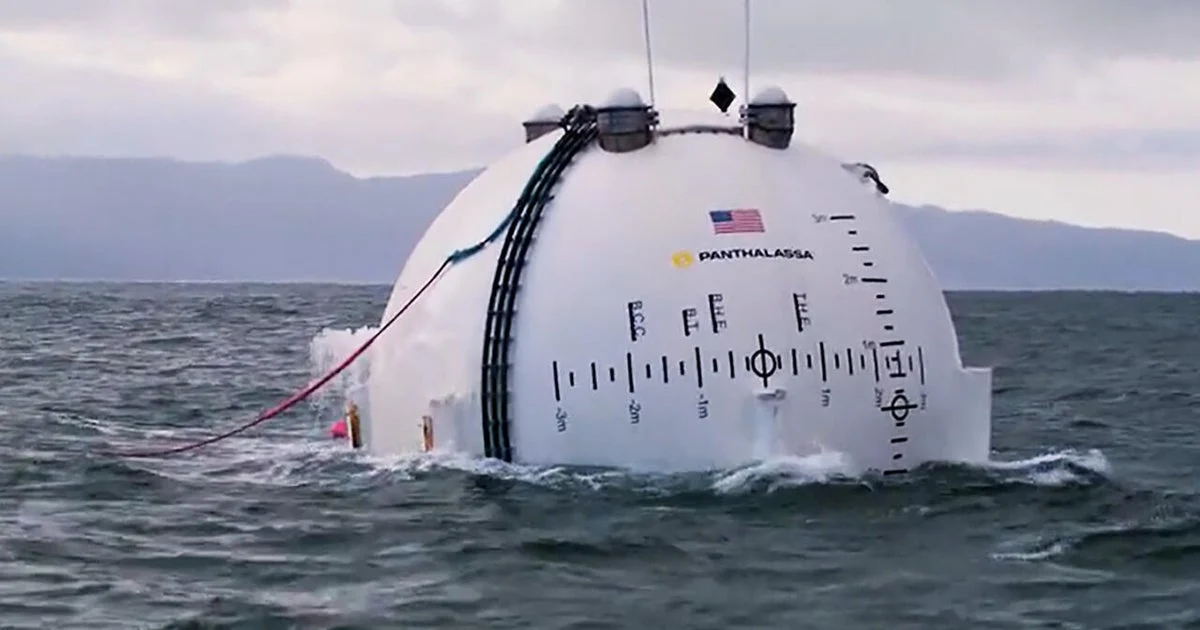
Panthalassa, a renewable energy company based in Vancouver, Washington, is developing wave-powered floating data centers designed to address the growing energy consumption of artificial intelligence (AI) infrastructure while reducing carbon emissions.
The company’s CEO and co-founder, Garth Sheldon-Coulson, explained that these data centers harness ocean wave energy to generate electricity on-site, eliminating the need for traditional, land-based facilities that rely heavily on fossil fuels. “The ocean is really unlimited in terms of how much energy is available,” he said, highlighting wave energy’s potential as the “cheapest energy on the planet.”
Innovative Floating Technology
Panthalassa’s technology, exemplified by their Ocean-2 and Ocean-3 wave energy converters, operates like a floating hydroelectric dam. The system captures the vertical motion of waves to pump water through turbines inside a ball structure, producing electricity continuously. Unlike conventional wave energy devices, the Ocean-3 is not tethered to the ocean floor and requires no cables to transmit power to land.
Instead, the floating units generate electricity to power onboard AI data processing equipment. Results and data are sent via satellite communication, enabling a distributed network of autonomous, off-shore data centers. “When you deploy many of our systems, they work together basically as a data center,” Sheldon-Coulson said.
Commercial Deployment and Future Plans
Panthalassa has secured sufficient private funding to proceed with constructing the Ocean-3 units, with operational deployment expected offshore by August 2026. The company envisions scaling its wave-powered data centers extensively, deploying thousands of units far out at sea.
The key advantages include no fuel consumption, no land use, minimal environmental interference onshore, and rapid scalability. These features position wave-powered floating data centers as a sustainable alternative to traditional data centers, which contribute significantly to carbon emissions due to their substantial electricity demands.
Why it matters
Data centers account for a growing portion of global electricity consumption, driven by expanding AI and cloud computing needs. This growth exacerbates climate change unless cleaner power sources are adopted. Panthalassa’s wave energy data centers offer a novel solution that combines renewable energy generation with computing, potentially reducing the carbon footprint while addressing escalating energy demands.
By operating offshore, these data centers also alleviate land scarcity and local environmental impacts associated with terrestrial data center construction. Their scalable design supports future expansions to meet rising digital infrastructure demands without further straining the power grid or increasing fossil fuel use.
Read more Science & Technology stories on Goka World News.