
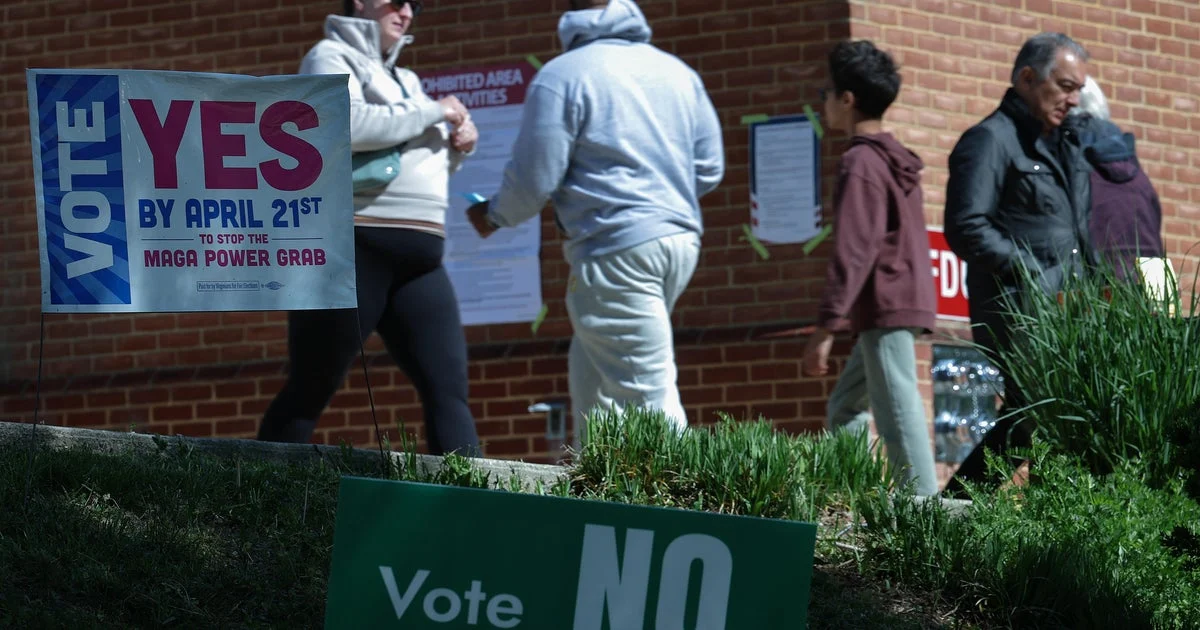
Virginia voters approved a new congressional map on Tuesday that favors Democrats in 10 House districts while leaving just one district as a safe Republican seat, according to CBS News projections. The map, drawn by the Democratic-controlled state legislature, could help Democrats gain up to four additional seats in Congress ahead of this year’s midterm elections, marking a significant setback for Republicans in redistricting battles nationwide.
Details of the referendum and impact
This referendum overturned the bipartisan commission’s map, originally established after a 2020 constitutional amendment in Virginia requiring such a commission to draw congressional districts. The approved map replaces the commission’s current boundaries with those crafted by the Democratic General Assembly. The bipartisan system will return after the 2030 census.
The new districts expand Democratic influence across Northern Virginia, Richmond, and Virginia Beach. Critics in more rural areas argue the changes disenfranchise their communities. Democrats have positioned the referendum as a countermeasure to Republican-led state redistricting efforts, particularly following Texas’s move to make five previously Democratic districts more GOP-leaning. Virginia’s referendum followed similar Democratic efforts in California last year to reshape districts more favorably for their party.
National Democrats emphasized the vote’s significance, with House Minority Leader Hakeem Jeffries calling it a rejection of expectations that Democrats would concede. The Democratic National Committee stated Virginians refused to allow former President Trump’s influence to undermine fair representation. Conversely, Republicans highlighted the narrow margin of victory and condemned the map as a partisan gerrymander. North Carolina Republican Rep. Richard Hudson described it as an “egregious power grab” that underscored Virginia’s purple political nature.
Political context and financial influence
Democratic surrogates, including former President Barack Obama and former Attorney General Eric Holder, actively campaigned for the referendum. Holder, chairman of the National Democratic Redistricting Committee, supported the strategy as a necessary response to the current political landscape. Meanwhile, former President Donald Trump urged voters to reject the map despite his prior advocacy for GOP-favorable redistricting in other states.
The referendum attracted nearly $100 million in funding, with about 95% coming from dark money groups. Pro-map group Virginians for Fair Elections donated $64 million, while Virginians for Fair Maps spent nearly $20 million opposing it.
Legal challenges and upcoming elections
Several lawsuits from Republican officials contest the referendum’s legality, but the Virginia Supreme Court allowed the vote to proceed pending those challenges. Former Virginia Governor Glenn Youngkin criticized the process, calling it unconstitutional and disenfranchising.
With the November midterm elections approaching and filing deadlines closed, few other states are expected to engage in redistricting before 2026. Florida may hold a legislative special session on redistricting next week. Additionally, ongoing Supreme Court cases such as Louisiana v. Callais could influence future redistricting by potentially weakening protections under the Voting Rights Act.
Why it matters
Virginia’s new congressional map shifts the state’s political landscape significantly toward Democrats ahead of the 2026 midterms, exemplifying the continuing national battle over district boundaries that influence the balance of power in the House of Representatives. The referendum illustrates the strategic use of redistricting as a political tool amid growing partisan polarization and legal contests over election fairness.
Read more Politics stories on Goka World News.