
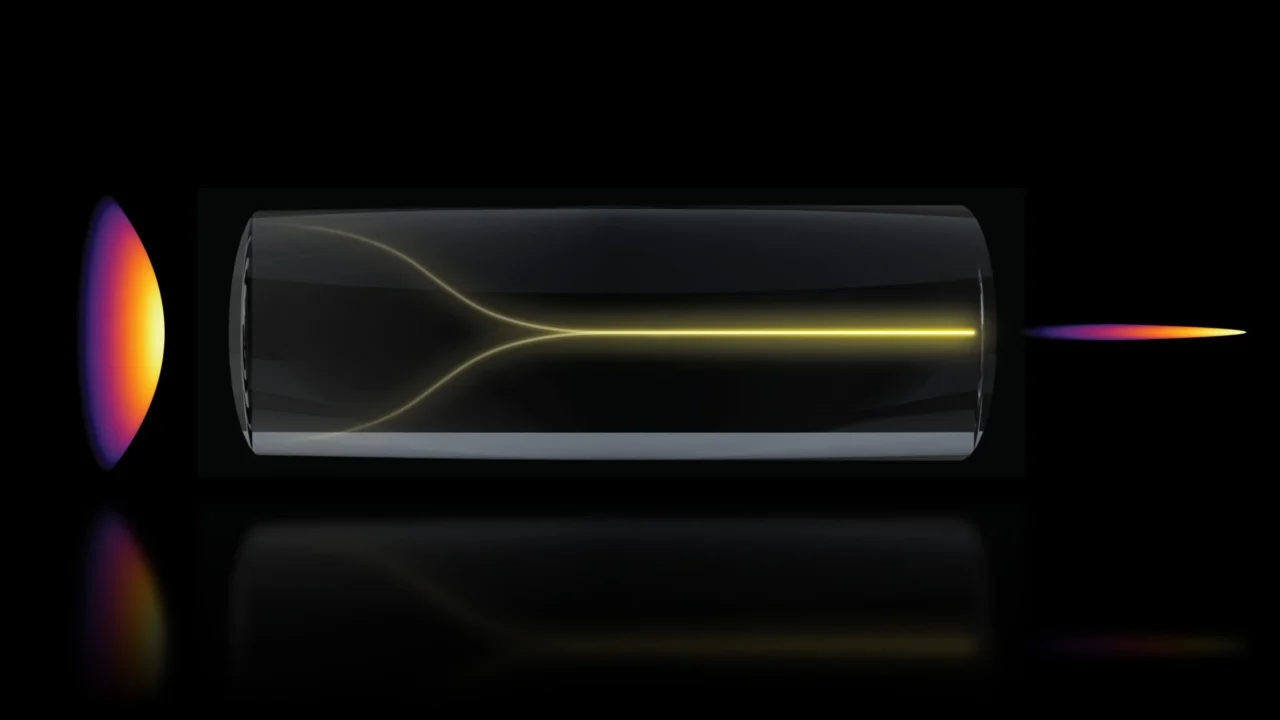
MIT researchers have discovered a novel optical physics phenomenon where a chaotic laser beam self-organizes into a highly focused “pencil beam,” enabling biomedical imaging up to 25 times faster than current gold-standard methods while maintaining high resolution. This breakthrough has potential to accelerate the development of brain-targeted therapies by allowing scientists to visualize drug absorption in real time.
Discovery of the Self-Organizing Pencil Beam
The team, led by Sixian You, assistant professor in MIT’s Department of Electrical Engineering and Computer Science (EECS), observed that when a laser beam passing through a multimode optical fiber was pushed to near its physical power limit, the scattered light unexpectedly collapsed into a stable, needle-sharp beam rather than becoming increasingly disordered. This self-organization occurs only under two precise conditions: the laser must enter the fiber at a perfect zero-degree angle, and the power must reach a critical level at which nonlinear interactions balance the inherent disorder in the fiber’s glass.
Typically, higher power in such fibers causes beam scattering and instability, but this new method eliminates the need for complex beam-shaping devices. According to You, the technique uses a conventional optical setup and minimal domain expertise, making it accessible for broader applications.
Applications in Imaging the Blood-Brain Barrier
The research team demonstrated the pencil beam’s capability by imaging the human blood-brain barrier (BBB), a critical layer of cells that blocks toxins but also restricts many drugs from entering the brain. Using the pencil beam, they captured 3D, cellular-level images 25 times faster than standard optical methods and could dynamically track how individual cells absorb proteins without requiring fluorescent tagging.
Roger Kamm, a co-author and MIT professor of biological and mechanical engineering, highlighted the significance for drug development. Animal models often fail to predict human BBB drug permeability, so this human-based imaging technique could revolutionize screening by providing time-resolved visualization of drug entry and cell-specific absorption rates.
Advantages and Future Directions
The pencil beam offers superior resolution with minimized image distortion compared to traditional beams, which often exhibit “sidelobes” or blurry halos. Its combination of high resolution and large depth of focus overcomes typical trade-offs in imaging, enabling detailed 3D scanning through tissue.
The researchers plan to further investigate the physics underlying the beam’s self-organization and explore applications in neural imaging and other biomedical fields. Efforts toward commercialization are also underway.
Why it matters
This development addresses key challenges in brain imaging and drug delivery research by providing a faster, higher-resolution method to study molecular interactions at the blood-brain barrier. It has immediate implications for screening neurodegenerative disease therapies and could improve the predictive value of human models compared to animal studies.
Background
Multimode optical fibers typically carry laser beams that scatter at higher powers due to internal imperfections. Prior imaging methods often traded speed for resolution or depth of focus. This discovery overturns conventional assumptions about beam instability under high power and expands the capabilities of fiber-based laser imaging systems.
Read more Science & Technology stories on Goka World News.
Sources
This article is based on reporting and publicly available information from the following source: