
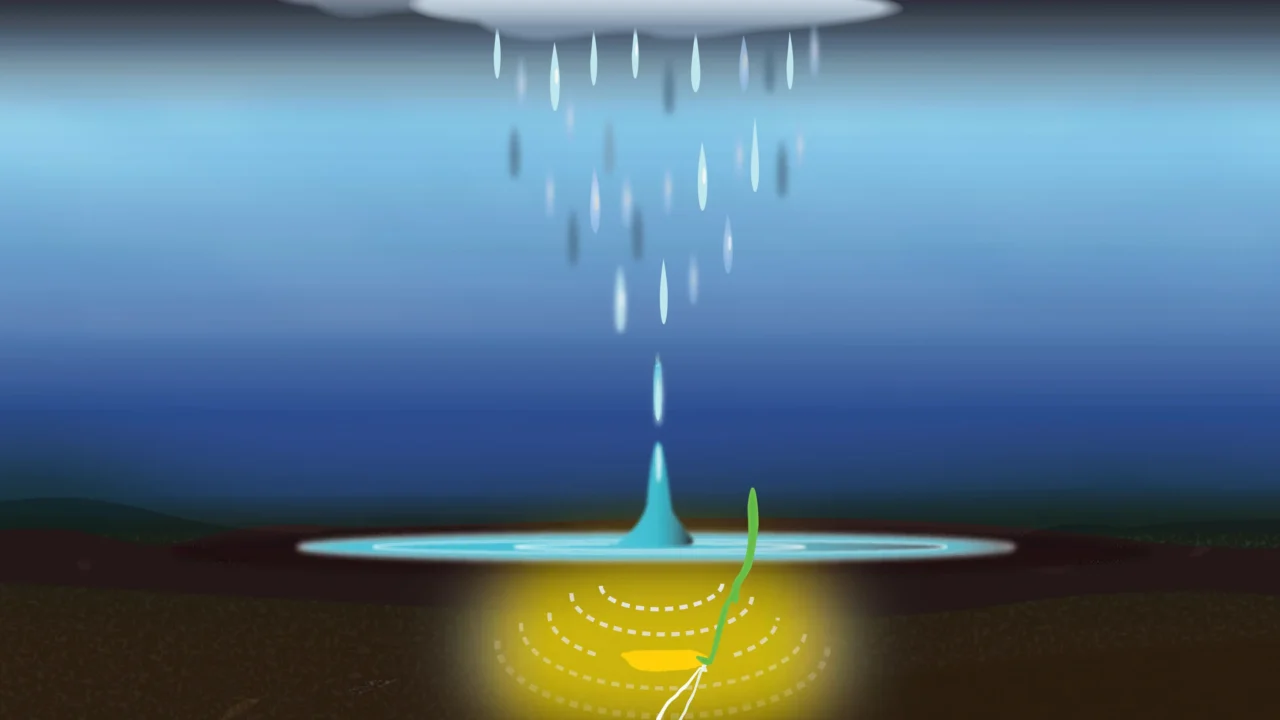
MIT engineers have discovered that the sound of raindrops hitting water or soil can significantly speed up the germination process in rice seeds. Their study, published in Scientific Reports, provides the first direct evidence that plant seeds can sense natural sounds and respond by accelerating growth.
Seed Response to Rain-Induced Vibrations
The research team conducted experiments with roughly 8,000 rice seeds submerged in shallow water to mimic their natural growth environment. They exposed some seeds to the acoustic vibrations generated by dripping water, simulating rain at various intensities. Seeds subjected to these sound vibrations germinated 30 to 40 percent faster than seeds kept in identical conditions without exposure to the rain sounds.
The acceleration in germination was most pronounced in seeds positioned close to the water’s surface, which allowed them to better detect sound vibrations. The researchers concluded that the rain sound creates pressure waves strong enough to reach submerged or soil-buried seeds and stimulate their growth.
Mechanism Behind Sound Perception in Seeds
The study explains that raindrops produce sound waves that cause microscopic vibrations in water or soil. These vibrations can dislodge tiny organelles inside seed cells called statoliths, which help plants sense gravity and spatial orientation. When statoliths are jolted, they send signals triggering growth and germination.
Calculations factoring the size and speed of raindrops demonstrated these vibrations were sufficient to shift the statoliths inside the seeds. This mechanism likely enables seeds to “hear” rain and respond by sprouting, especially when near the surface where moisture conditions for growth are optimal.
Why it matters
This discovery highlights a previously unknown adaptive advantage for plant seeds, showing they can detect environmental cues like sound to improve survival chances. Understanding seed responses to natural sounds could have implications for agriculture, potentially informing new techniques to enhance crop germination and growth by simulating or amplifying beneficial vibrations.
Background
Plants are known to sense various stimuli, including light, gravity, touch, and chemical signals. Gravity perception, mediated by statoliths within cells, influences root and shoot growth directions. This MIT study extends that knowledge by demonstrating that sound-induced vibrations, specifically from rain, also interact with statoliths to affect the timing of seed germination.
The research was supported by the MIT Bose Fellowship and the MIT Koch Chair, and builds on previous acoustic studies of rain underwater, linking those pressure waves to biological impacts on plants.
Read more Science Discoveries stories on Goka World News.
Sources
This article is based on reporting and publicly available information from the following source: