
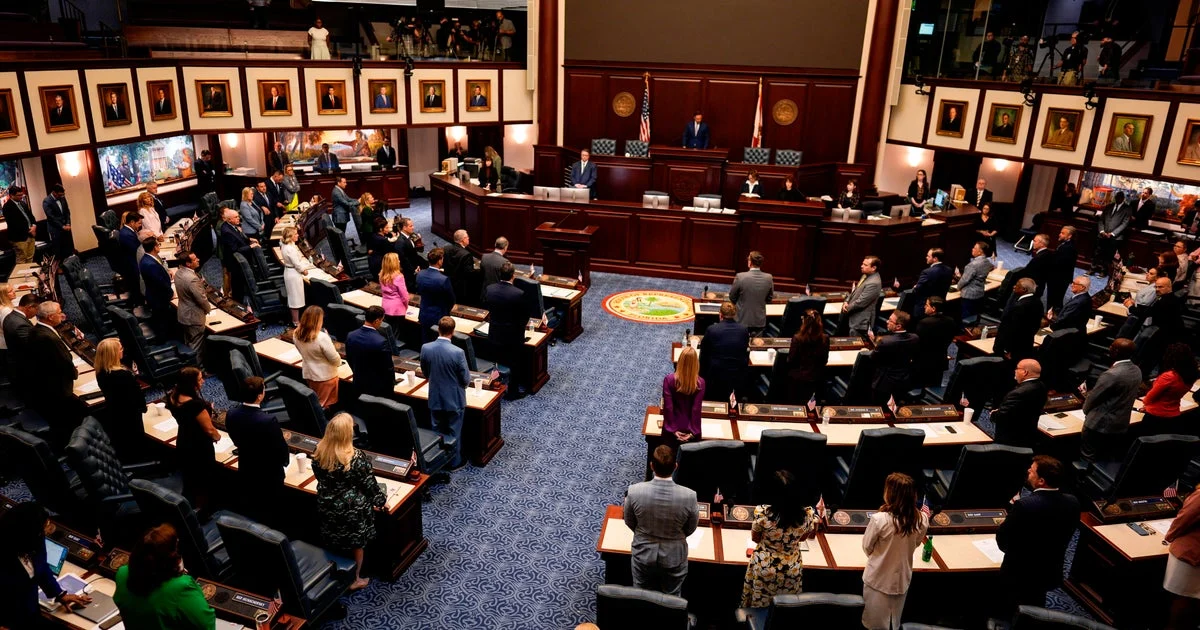
The Florida Legislature approved a new congressional redistricting plan on April 29, 2026, that aims to increase Republican representation in Congress by up to four seats. The bill, championed by Governor Ron DeSantis, now awaits his final approval.
The legislation passed shortly after the U.S. Supreme Court limited a section of the Voting Rights Act, a change expected to influence how states redraw districts with significant Black or Latino populations that have traditionally supported Democrats.
Changes to Florida’s congressional map
Florida currently has 27 U.S. House seats represented by 20 Republicans and seven Democrats, with one Democratic-leaning seat vacant following Rep. Sheila Cherfilus-McCormick’s resignation. The new map proposes reducing or reshaping Democratic-leaning districts around Tampa, Orlando, and parts of the southeast coast.
One notable adjustment involves a majority Hispanic district in central Florida being altered, a move criticized by Democrats as an effort to dilute minority voting strength. The Florida Senate approved the bill by a 21-17 vote, joined by four Republicans and one independent siding with Democrats. The state House passed the map strictly along party lines without Republican dissent.
During House debate, Democratic Representative Angie Nixon attempted to halt proceedings with a pink bullhorn but was unsuccessful. Democratic Minority Leader Fentrice Driskell’s request for a two-hour recess to review the recent Supreme Court ruling was also denied.
Legal context and controversy
Governor DeSantis cited the Supreme Court decision in announcing the map, asserting it nullifies Florida constitutional provisions that prevent redistricting based on race or language minority considerations. His general counsel argued that the ruling supports abandoning Florida’s “Fair Districts Amendment,” enacted in 2010 to curb partisan gerrymandering.
Opponents contend that the new plan violates this amendment’s anti-gerrymandering provisions, raising the prospect of legal challenges. However, any lawsuits face obstacles given that DeSantis appointed six of the seven justices on Florida’s Supreme Court, which may influence the judicial outcome.
Why it matters
This redistricting effort comes as Republicans seek to strengthen their control of the U.S. House ahead of the 2026 midterm elections. The changes could reshape voter representation in one of the country’s fastest-growing and politically competitive states, intensifying nationwide debates over voting rights and electoral fairness.
Read more Politics stories on Goka World News.
Sources
This article is based on reporting and publicly available information from the following source: