
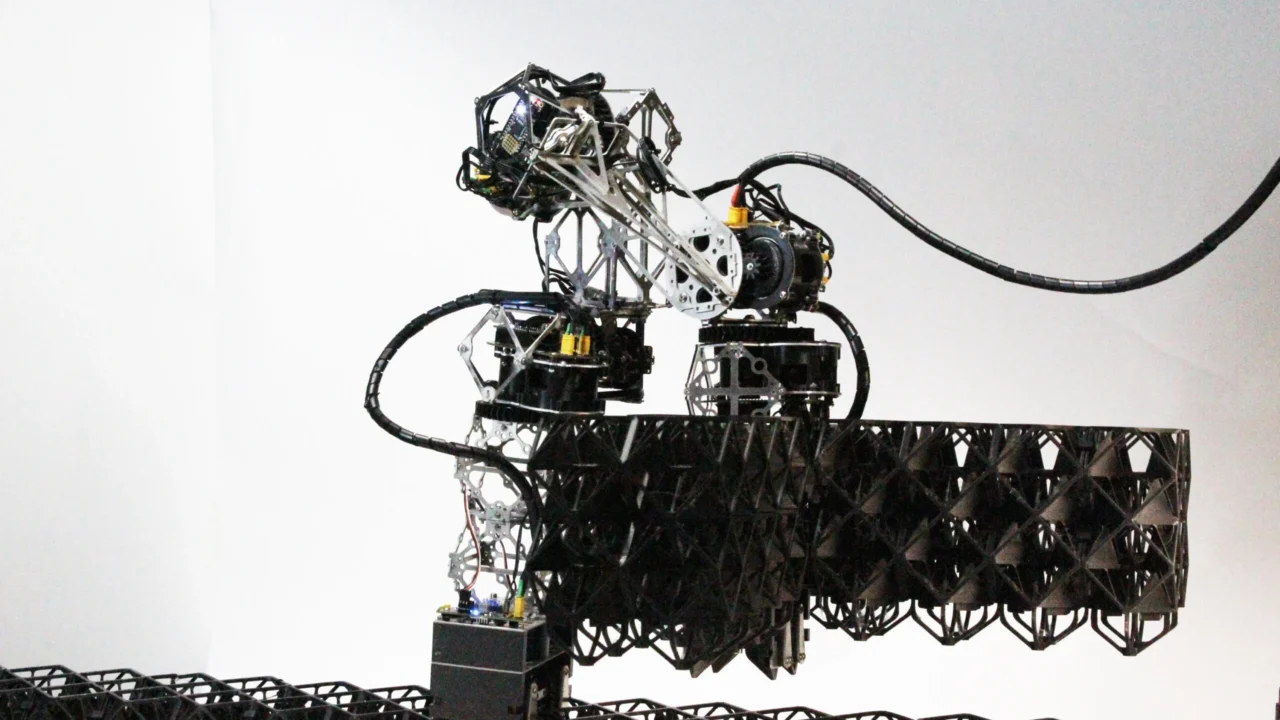
MIT researchers have developed a robotic assembly system that uses modular building blocks, called voxels, to construct buildings with significantly reduced carbon emissions compared to traditional methods. Their study found that this voxel-based system could cut embodied carbon—total carbon emissions from building materials—by as much as 82% relative to techniques such as 3D concrete printing, precast modular concrete, and steel framing.
Modular Voxels and Robotic Assembly
The research team evaluated eight existing voxel designs that are lattice-structured building blocks with high strength and stiffness, previously applied in aerospace and space structures. Based on these assessments, they created three new voxel designs featuring a high-strength octet lattice geometry that mechanically self-aligns, allowing rapid and connector-free assembly.
To assemble these voxels, the team developed a robotic system called Modular Inchworm Lattice Assemblers (MILAbots). These robots crawl across structures by anchoring and extending their bodies, placing voxel blocks precisely and using snap-fit connections to lock them in place.
Environmental and Efficiency Advantages
Material choice was integral to the system’s sustainability and cost-effectiveness. When constructed from plywood, the voxel structures showed the lowest embodied carbon, requiring only 17% to 24% of the carbon emissions compared to 3D concrete printing and precast concrete, respectively. Steel voxel assemblies also provided substantial carbon savings, using 36% and 52% of the emissions for those methods.
In terms of construction time, the robotic voxel system with steel and plywood materials averaged 99 hours on-site, faster than 155 hours typically required by conventional construction methods. This time advantage depends on deploying multiple MILAbots working in parallel, as a single robot alone assembles slower than traditional approaches.
Future Directions and Potential Applications
While the voxel system shows promise, further research is needed to address durability, fire resistance, lateral load stability, and integration of utilities. Researchers are preparing to test the system at a larger scale in Bhutan’s “super fab lab” as part of a sustainable city project.
Additionally, the team created a user-friendly interface for designing voxel structures and generating robot assembly instructions to facilitate practical deployment.
Why it matters
Construction accounts for a significant share of global carbon emissions, and innovations that reduce embodied carbon are crucial for sustainability goals. This voxel-based robotic system offers a scalable, potentially cost-competitive alternative to traditional construction methods that could accelerate adoption of greener building practices and enable flexible, reversible structures.
Read more Science & Technology stories on Goka World News.
Sources
This article is based on reporting and publicly available information from the following source: