
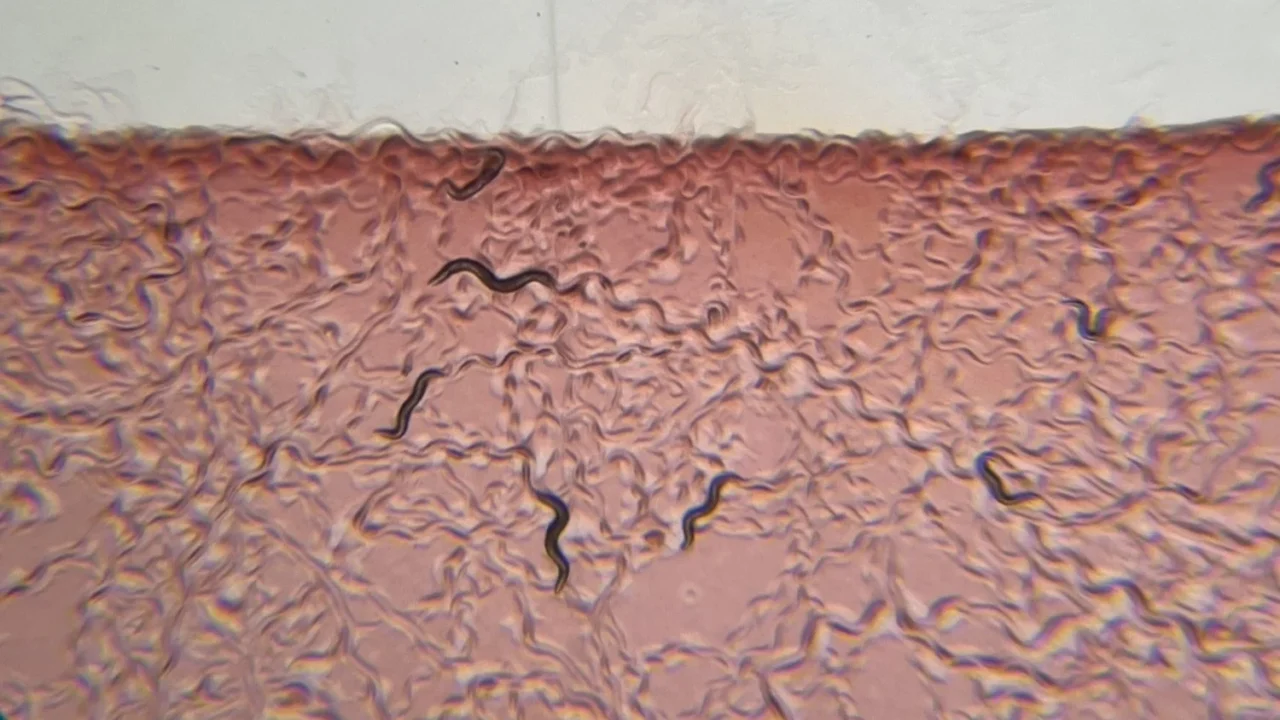
Neuroscientists at MIT’s Picower Institute for Learning and Memory have uncovered the chemical signals that neurons in the nematode Caenorhabditis elegans detect to differentiate between edible and harmful bacteria. This discovery sheds light on how gut bacteria influence nervous system function, advancing understanding of host-microbe interactions.
The study, published in Current Biology, focused on the NSM neuron, which extends into the alimentary canal of the worm. NSM employs acid sensing ion channels (ASICs)—similar to channels in human neurons—to detect bacterial intake. When NSM senses nutritious bacteria, it releases serotonin, prompting the worm to increase feeding and reduce movement to remain near the food source.
To identify the bacterial components activating NSM, researchers exposed worms to 20 different bacterial species and then analyzed their chemical compositions. They excluded DNA, lipids, proteins, and simple sugars as triggers. Instead, they pinpointed bacterial polysaccharides, specifically peptidoglycan in gram-positive bacteria and other polysaccharides in gram-negative bacteria, as responsible for stimulating NSM activation.
Further experiments demonstrated that these polysaccharides not only activate NSM’s electrical response but also cause the worm’s characteristic feeding and slowing behaviors. Genetic deletion of the ASICs prevented these responses, confirming their necessity in bacterial detection.
The team also studied the worm’s response to the pathogenic bacterium Serratia marcescens. Strains containing the red pigment prodigiosin, which are more lethal to worms, failed to activate NSM, leading to avoidance behaviors. Adding prodigiosin to otherwise appetizing bacteria suppressed NSM activity and inhibited feeding responses, indicating that worms can detect and avoid a chemical associated with bacterial danger.
Why it matters
This research clarifies the molecular mechanisms by which the nervous system senses gut bacteria, bridging the gap between microbiome presence and neural function. Understanding these processes in a simple model organism like C. elegans provides a foundation for exploring similar interactions in mammals and could inform therapeutic strategies to manipulate microbiome-brain communication.
Background
C. elegans is a bacterial specialist that relies entirely on bacteria for food but must avoid harmful strains. Previous work identified ASICs in the NSM neuron as essential for detecting bacterial ingestion. This study builds on that by revealing the specific bacterial molecules these ion channels recognize, elucidating how the worm distinguishes food from foe at a neurochemical level.
The findings underscore the evolutionary adaptation of the nervous system to precisely respond to environmental bacterial cues, a topic of growing interest due to the microbiome’s known links to human health conditions such as depression and Parkinson’s disease.
The study was led by Picower Fellow Cassi Estrem and Associate Professor Steven Flavell, with contributions from Malvika Dua, Colby Fees, Greg Hoeprich, Matthew Au, Bruce Goode, and Lingyi Deng. Funding came from the National Institutes of Health, the McKnight Foundation, the Alfred P. Sloan Foundation, the Howard Hughes Medical Institute, and The Freedom Together Foundation.
Sources
This article is based on reporting and publicly available information from the following source:
Read more Science Discoveries stories on Goka World News.