
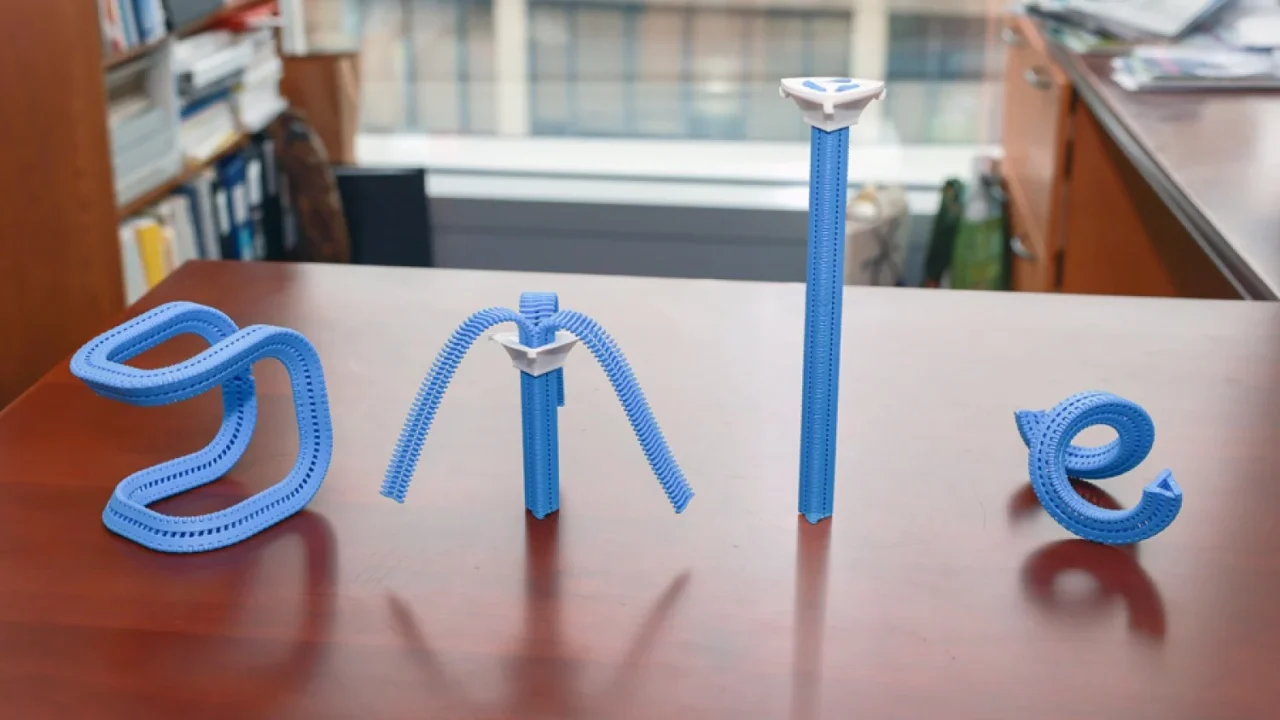
MIT researchers have developed a modern version of a three-sided zipper design originally proposed in 1985, enabling objects to transition seamlessly between flexible and rigid states. This innovation, called the “Y-zipper,” uses 3D-printed plastics and custom software to create adaptive fasteners that can transform items like tents, medical devices, and robots with greater ease and automation.
From Concept to Modern Application
The original three-sided zipper concept was invented in 1985 by William Freeman, then an electrical engineer, who envisioned a zipper shaped like a triangular tube rather than the traditional flat closure. Freeman’s prototype used belts and narrow wooden teeth that zipped into a rigid structure, potentially simplifying the assembly of foldable chairs, tents, and purses. While his design was initially rejected, Freeman patented it and stored the prototype for decades.
Nearly 40 years later, MIT’s Computer Science and Artificial Intelligence Laboratory (CSAIL) revisited the idea to address the challenge of creating objects with tunable stiffness — materials that can shift between soft and firm states without manual reconstruction. The team developed an automated design tool and 3D printing process to fabricate the Y-zipper using plastics like polylactic acid (PLA) and thermoplastic polyurethane (TPU).
Flexible, Customizable Shape-Shifting Structures
The Y-zipper is controlled by software that allows users to customize its length, bending angle, and shape when zipped, selecting from motions such as straight, bent, coiled, or twisted. Unzipped, the device’s three “tentacles” can extend freely; zipped, they form a rigid rod or other compact shapes. This versatility can simplify processes like tent pitching by attaching zipper arms to tent edges, enabling quick canopy setup in under two minutes compared to six minutes manually.
The researchers demonstrated medical applications by wrapping the Y-zipper around a wrist cast, allowing the user to loosen the device during the day and tighten it at night for injury protection. Additionally, motors can automate the zipper’s operation to create adaptive robotic components, such as quadruped legs that extend or compress to adapt to uneven terrain, or dynamic art installations that physically change shape.
Durability and Future Prospects
To assess durability, the team ran stress tests simulating repeated opening and closing of the Y-zipper. After around 18,000 cycles, the plastic zipper components showed wear but demonstrated significant resilience due to their elastic structure, which distributes mechanical stress effectively. Researchers intend to develop versions using stronger materials, like metal, and scale up the size for larger applications.
Potential future uses include embedding Y-zippers into spacecraft for rapid shape adjustments during sample collection or enabling emergency shelters to be deployed swiftly in disaster zones. This reimagining of zipper technology bridges the gap between soft and rigid states, offering scalable and innovative possibilities across various fields.
Why it matters
The Y-zipper’s ability to toggle objects between flexible and rigid states opens new avenues for rapid assembly and adaptive design in sectors ranging from outdoor equipment and healthcare to robotics and disaster relief. By integrating automation and 3D printing, this innovation could enhance functionality and comfort while saving time in practical setups.
Background
Traditional zippers are limited to closing flat objects like clothing; however, Freeman’s 1985 triangular zipper proposed a new way to fasten three-dimensional shapes. Until recent advances in 3D printing and computational design, realizing such complex fasteners for real-world applications remained challenging. CSAIL’s recent work updates this concept with modern fabrication and software tools, demonstrating the ongoing value of integrating engineering innovations across decades.
Sources
This article is based on reporting and publicly available information from the following source:
Read more Science & Technology stories on Goka World News.