
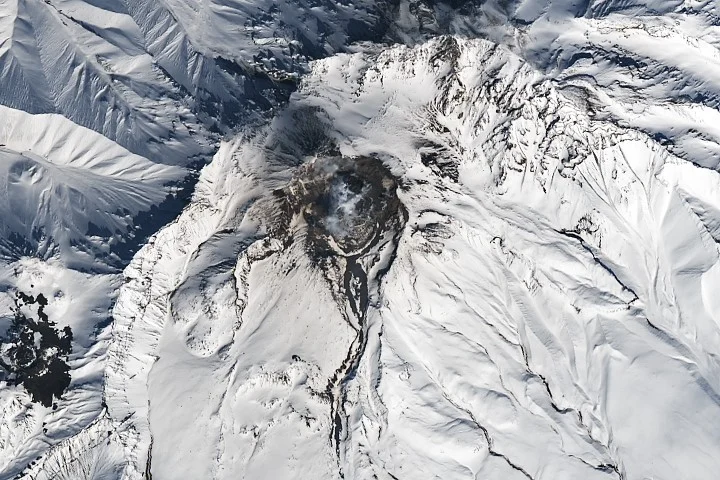
Russia’s Shivelyuch volcano, the northernmost active volcano on the Kamchatka Peninsula, continues to exhibit near-daily volcanic activity, with recent satellite data confirming lava dome growth and ongoing explosive events. The volcano’s horseshoe-shaped caldera, captured by the Landsat 9 satellite on April 23, 2026, shows distinct dark patches where viscous lava dome material is accumulating amid the late spring snowpack.
According to the Kamchatka Volcanic Eruption Response Team (KVERT), the lava dome—a thick, slow-moving mass of lava—has been actively growing over the past months. Such domes typically form lobed or spine-like shapes as lava extrudes slowly and accumulates. On Shivelyuch, this growth cycle involves periodic collapses of the dome, which trigger explosive ash eruptions and avalanches of hot ash and soil, known as pyroclastic flows.
These pyroclastic flows descend through well-defined channels described by volcanologists as “avalanche chutes” and “lahar channels.” The flows often result in “block-and-ash flows,” deposits composed of coarse volcanic rock blocks mixed with fine ash and soil. These deposits are notably insulated and can retain heat for extended periods, sometimes melting snow during colder months.
Satellite observations frequently detect thermal anomalies near the lava dome and throughout debris channels, consistent with ongoing heat release. On the day the Landsat image was taken, KVERT reported a continuing “explosive-extrusive eruption” with significant gas and steam emissions.
The volcano’s most dramatic recent event occurred in April 2023 when a large eruption and flank collapse produced extensive pyroclastic flows that devastated adjacent forests and left lasting deposits visible at the mountain’s base. Research by geologists including Janine Krippner highlights that heat from such deposits can persist for several years, as observed during fieldwork at Shivelyuch.
Why it matters
Shivelyuch’s persistent volcanic activity poses ongoing hazards, including ashfall and pyroclastic flows that can impact nearby ecosystems and communities. Monitoring thermal anomalies and dome dynamics is crucial for eruption forecasting and hazard mitigation in this volcanically active region.
Background
Shivelyuch is one of the largest and most active volcanoes in Kamchatka, known for its repeated cycles of lava dome growth and collapse. This activity pattern has shaped a complex volcanic landscape with significant geological features, including frequent block-and-ash flows and lahars. The volcano is continuously monitored by KVERT using satellite imagery and ground-based observations to track changes and potential eruption threats.
Sources
This article is based on reporting and publicly available information from the following source:
Read more Science Discoveries stories on Goka World News.