
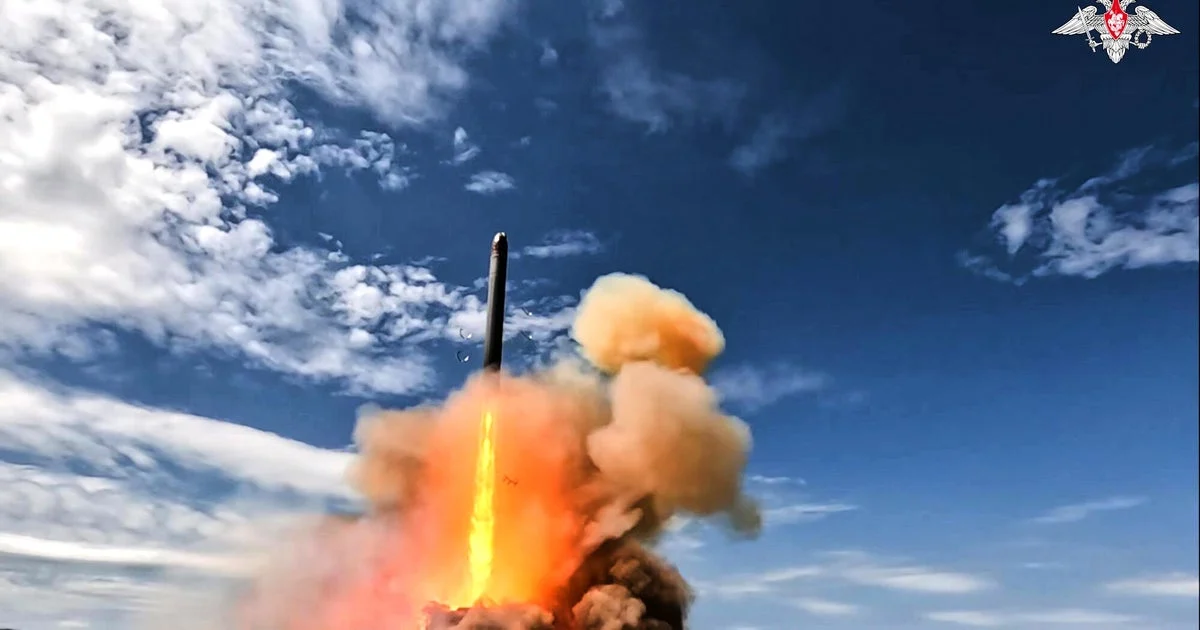
Russia conducted a test launch of its new nuclear-armed intercontinental ballistic missile (ICBM), the Sarmat, on May 12, 2026, as part of ongoing efforts to modernize its strategic nuclear forces. President Vladimir Putin hailed the missile as “the most powerful missile in the world,” stating it would enter combat service by the end of the year.
The Sarmat missile, designated “Satan II” by NATO, is intended to replace the older Soviet-era Voyevoda missiles. Putin emphasized that the missile’s combined warhead power is more than four times greater than that of any Western equivalent. He also highlighted the missile’s extended range of over 21,700 miles and its enhanced ability to penetrate missile defense systems through suborbital flight capabilities.
Details of the Sarmat Missile
Development of the Sarmat began in 2011, with the missile classified as a “heavy” ICBM capable of carrying up to 10 tons of payload. Before this test, it had only one successful known test; a previous trial in 2024 reportedly ended in a massive explosion at the Plesetsk Cosmodrome launch site. The missile’s design aims to upgrade Russia’s aging nuclear arsenal, which has been a priority for Putin since he assumed power.
Putin described the Sarmat as matching the power of the Voyevoda but with greater precision and added capabilities. It is part of a broader suite of advanced weapons revealed in 2018, including the Avangard hypersonic glide vehicle, which flies at speeds 27 times the speed of sound and has recently entered service.
Russia’s Nuclear Modernization amidst Arms Treaty Expiration
The Sarmat test launch comes amid heightened tensions following the expiration of the last major nuclear arms control treaty between Russia and the United States in February 2026. The termination of this treaty removed limits on the two largest nuclear arsenals, raising concerns about an unchecked arms race.
Since 2000, Russia has actively modernized its nuclear triad, introducing new land-based missiles, nuclear-capable submarines, and bombers. Other weapons under development or in service include the Oreshnik intermediate-range missile, conventionally armed versions of which have been used in Ukraine, and futuristic systems such as the Poseidon nuclear underwater drone designed to create radioactive tsunamis, and the Burevestnik nuclear-powered cruise missile with essentially unlimited range.
Putin’s Strategic Rationale
Putin stated that Russia’s expanded nuclear capabilities are in response to the United States’ missile defense initiatives established after its 2001 withdrawal from a Cold War-era treaty that limited missile defenses. Russian military planners view these defenses as potentially encouraging a U.S. first strike, aiming to neutralize Moscow’s nuclear deterrent.
“We were forced to consider ensuring our strategic security in the face of the new reality and the need to maintain a strategic balance of power and parity,” Putin said regarding the development of the Sarmat and other advanced nuclear weapons.
Why it matters
The successful test launch of the Sarmat missile signals a significant advancement in Russia’s nuclear capabilities, underscoring growing risks amid the absence of bilateral arms control agreements. With no current treaty limiting arsenals or missile defenses, tensions between Russia and the U.S. may increase, complicating global nuclear stability and arms race control efforts.
This development highlights ongoing modernization efforts that could shape the strategic balance and inform future diplomatic and military policies between nuclear powers.
Sources
This article is based on reporting and publicly available information from the following source:
Read more World News stories on Goka World News.