
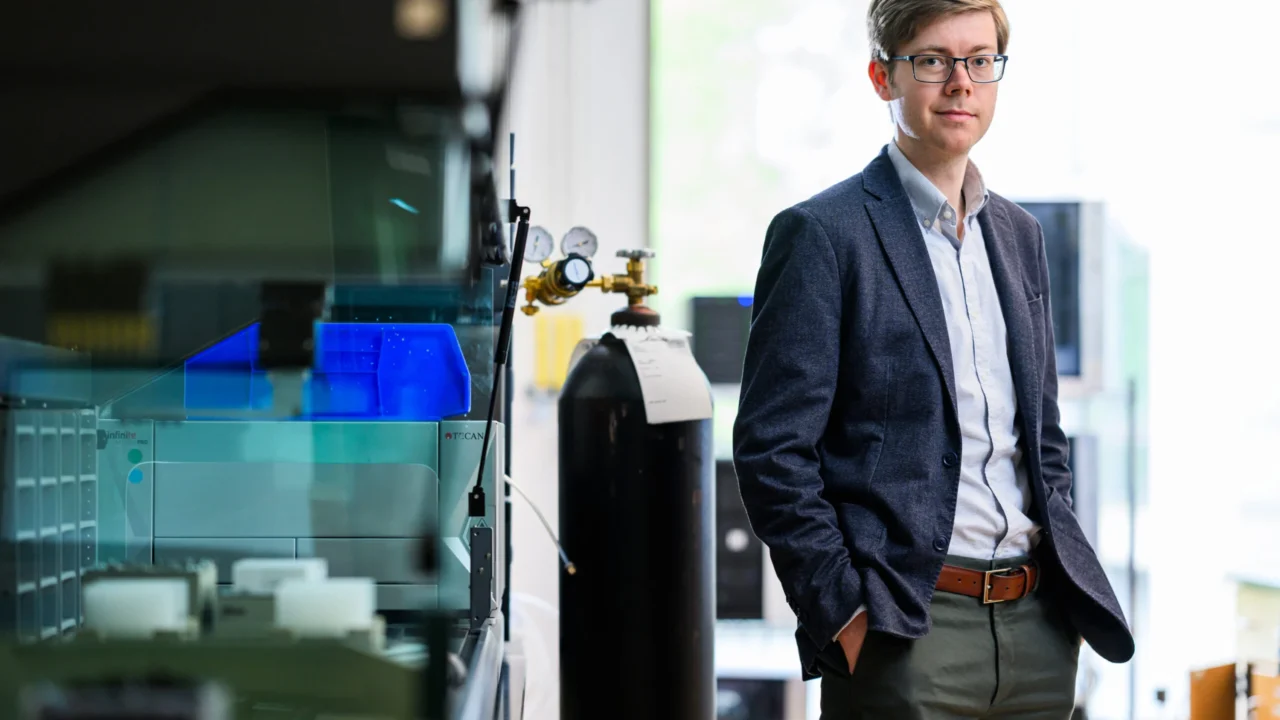
MIT Associate Professor Connor Coley and his team are advancing artificial intelligence (AI) models that better understand fundamental chemical principles to accelerate drug discovery and molecular design. By integrating core concepts like reaction mechanisms and conservation of mass, their AI tools offer improved accuracy in predicting chemical reactions and designing new drug molecules.
What happened
Coley, who holds positions in MIT’s Chemical Engineering, Electrical Engineering, Computer Science departments, and the Schwarzman College of Computing, leads research combining machine learning with cheminformatics to analyze and generate organic compounds. His lab developed several AI models, including ShEPhERD, which evaluates potential drug molecules based on their 3D shapes and predicted interactions with target proteins. This model is now actively utilized by pharmaceutical companies in drug development efforts.
Another breakthrough from Coley’s group is the FlowER model, a generative AI that predicts reaction products by simulating intermediate steps and reaction feasibility, grounded on physical laws such as mass conservation. This approach seeks to mirror how chemists understand reaction mechanisms, addressing a limitation in many prior machine learning models that lacked chemical reasoning.
Why it matters
The sheer number of potential small-molecule compounds—estimated between 1020 and 1060—makes experimental evaluation impossible at scale. AI tools like those developed by Coley’s lab provide computational methods to rapidly screen and design candidates for pharmaceuticals and other chemicals. By embedding detailed chemical knowledge into AI, these models offer more reliable predictions, reducing trial-and-error in labs and accelerating the path from molecule conception to drug candidate.
Improving predictive accuracy in reaction outcomes and molecular design helps cut research time, lowers costs for drug discovery, and increases the likelihood of identifying therapeutically viable compounds efficiently.
Background
Connor Coley began his MIT PhD in 2014 focusing on automated chemical reactions and the combination of machine learning with chemical data analysis. Supported by DARPA’s Make-It program, his early work emphasized improving drug synthesis from simple building blocks. After a postdoctoral stint at the Broad Institute gaining expertise in chemical biology and drug discovery, Coley returned to MIT in 2020 to establish his lab.
His research spans molecular design, reaction optimization, and AI-informed cheminformatics, reflecting MIT’s interdisciplinary support for AI in science. The lab continues to develop tools uniting computational power with chemical intuition, aiming to advance AI applications throughout chemistry and pharma.
Sources
This article is based on reporting and publicly available information from the following source:
Read more Artificial Intelligence stories on Goka World News.