
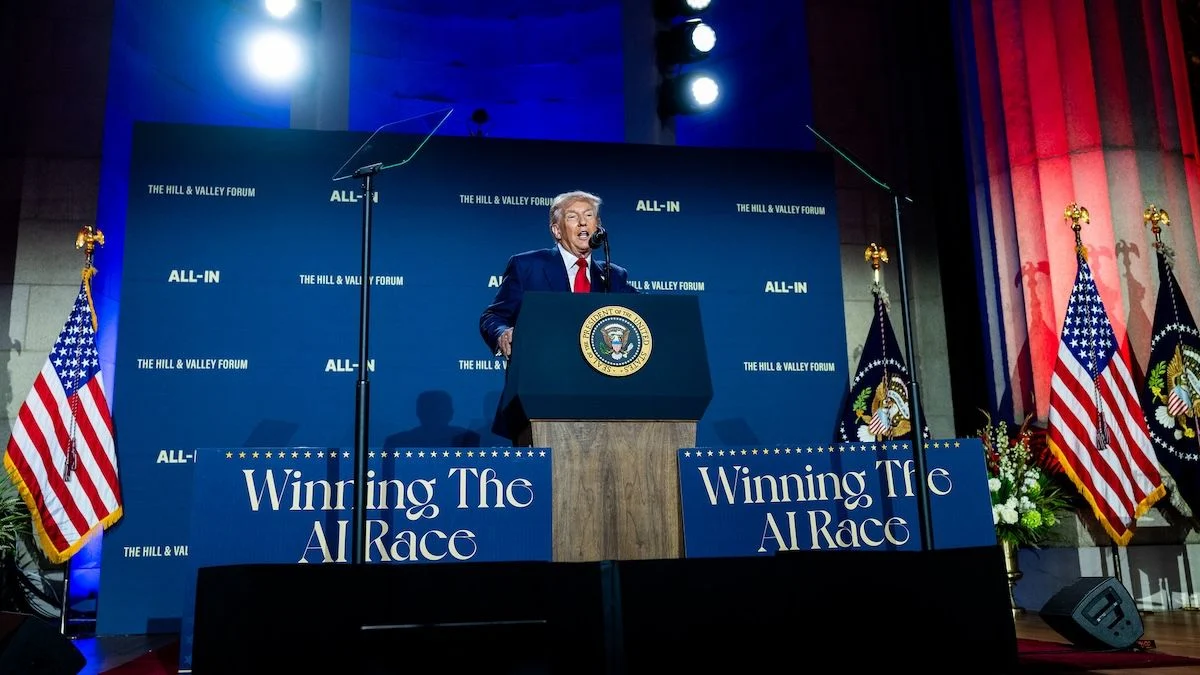
President Donald Trump signed an executive order titled “Promoting Advanced Artificial Intelligence Innovation and Security,” directing federal agencies to bolster cybersecurity and create a voluntary oversight framework for advanced AI models. This order includes key elements from a previously shelved draft that was postponed following opposition from technology leaders.
What happened
The June executive order mandates a coordinated set of actions by federal agencies to integrate AI into national security infrastructure and manage cybersecurity risks posed by frontier AI models. It requires upgrades to cybersecurity defenses within 30 days by the Committee on National Security Systems, the Department of War, and the Cybersecurity and Infrastructure Security Agency (CISA), which is to issue guidance protecting civilian federal government systems and promote AI-enabled defensive tools.
A key provision directs the Treasury Department, in cooperation with the Department of War, National Security Agency (NSA), Homeland Security, and CISA, to establish an AI cybersecurity clearinghouse within 30 days. This body will identify software vulnerabilities, coordinate remediation efforts, and distribute patches.
The order also instructs these agencies to develop a classified benchmarking process for evaluating the cyber capabilities of advanced AI models within 60 days. This process will designate certain powerful AI systems as “covered frontier models,” which developers will voluntarily report and provide access to select trusted partners to enhance infrastructure security.
To combat AI-enabled cybercrime, the Attorney General is directed to prioritize enforcement against illegal computer access and misuse of AI in criminal activities.
Notably, the executive order explicitly precludes mandatory government licensing, preclearance, or permitting for AI systems, maintaining its “voluntary” nature but shortening the model access review window from 90 to 30 days compared to the earlier draft.
Why it matters
The order signifies a federal effort to balance rapid AI innovation with national security and cybersecurity concerns. It establishes a novel voluntary cooperation framework between AI developers and the government to manage risks associated with highly capable AI models, aiming to prevent misuse and protect critical infrastructure. The focus on AI-specific cybersecurity responses highlights growing recognition of AI’s dual-use potential in cyber threats.
While the absence of mandatory regulation drew criticism from some policymakers, the order represents a strategic approach to maintain U.S. competitiveness in AI innovation without imposing stifling controls. The decision to adopt voluntary oversight may influence ongoing legislative discussions and set a precedent for public-private collaboration on AI governance.
Background
The executive order follows an earlier, nearly identical draft planned for release in May, which was abruptly canceled due to pressure from prominent tech executives, including Elon Musk and Mark Zuckerberg, and internal advisors. President Trump justified postponing the draft by citing concerns that regulation could hinder U.S. leadership over China.
The finalized June order retains much of the original language praising U.S. AI industry innovation and rejects any form of mandatory regulatory frameworks akin to an “FDA for AI,” despite previous comparisons by officials. Parallel to the executive action, Congress has begun examining AI security challenges, with hearings scheduled to address AI’s impact on cybersecurity and infrastructure resilience.
Sources
This article is based on reporting and publicly available information from the following source:
Read more AI Regulation stories on Goka World News.