
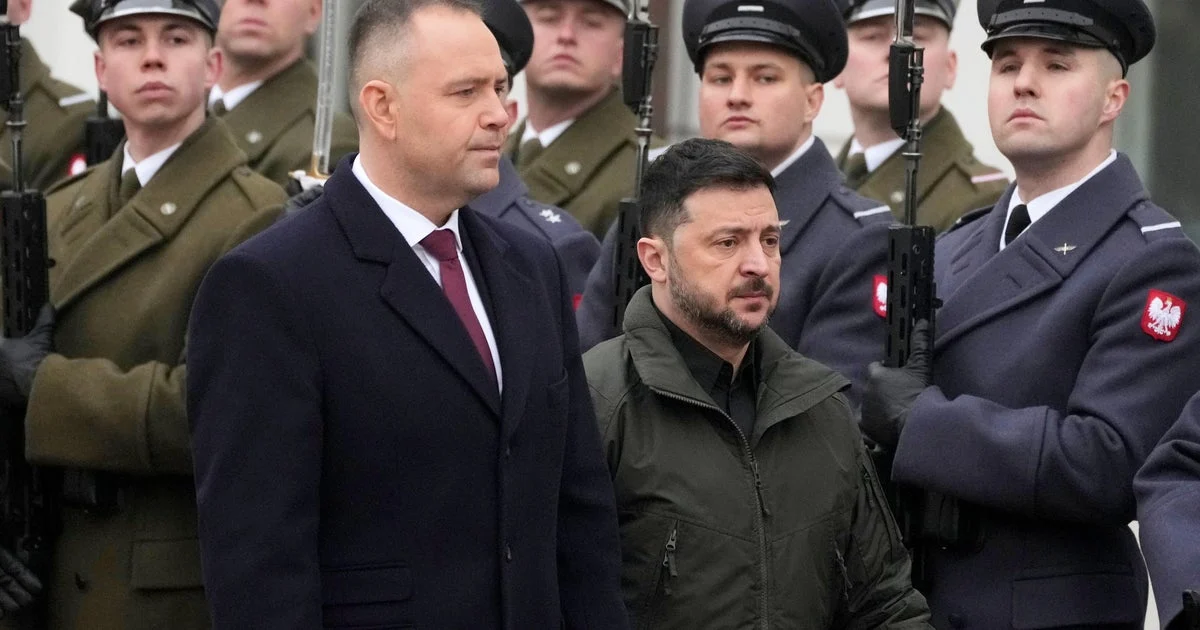
Ukrainian President Volodymyr Zelenskyy has returned Poland’s highest state honor, the Order of the White Eagle, following its revocation by Polish President Karol Nawrocki. The move ignited renewed tensions over disputed interpretations of World War II history, underscoring lingering regional sensitivities and the fragility of Polish-Ukrainian relations.
What Happened
On June 20, 2026, Zelenskyy announced on social media that he sent back the Order of the White Eagle, which was awarded to him in 2023 by former Polish President Andrzej Duda for his contributions to security and defense of human rights. The award was revoked by Poland’s current President Karol Nawrocki after Zelenskyy’s May 26 decree naming a Ukrainian Special Operations Forces unit after the Ukrainian Insurgent Army (UPA), a paramilitary formation active during the 1940s and 1950s.
Polish authorities condemn the UPA for its role in mass killings of Poles during World War II, a position Nawrocki reiterated in a lengthy social media statement explaining his decision. Meanwhile, Zelenskyy emphasized that the honor was intended to recognize the Ukrainian people and their army, expressing hope that future relations would restore mutual respect.
Key Facts
The Order of the White Eagle is Poland’s most prestigious award. Zelenskyy received it in 2023 for Ukraine’s resilience and defense against Russian aggression. President Nawrocki revoked it citing the UPA’s alleged responsibility for “cruel crimes” against Poles during the war. The Ukrainian Insurgent Army is accused by Poland of massacring tens of thousands of Polish civilians, particularly in Volhynia and Eastern Galicia.
In 2016, the Polish Parliament officially recognized UPA’s actions as genocide. Ukraine disputes this characterization, pointing to violent reprisals and mutual civilian casualties involving Polish underground forces. The Ukrainian unit named after the UPA was intended by Zelenskyy as a restoration of military traditions and to honor defense of Ukraine’s sovereignty.
Despite the dispute, Nawrocki clarified that this revocation did not signify any reduction in Poland’s support for Ukraine in the ongoing war with Russia. However, Zelenskyy’s office and other Ukrainian officials condemned the decision as unfriendly and suggested that Moscow might exploit the rift.
What This Means
This incident highlights the enduring and sensitive historical wounds between Poland and Ukraine, which continue to complicate their strategic partnership amid Russia’s aggression against Ukraine. Even as Poland remains a key ally and host for millions of Ukrainian refugees, nationalist political dynamics in Poland threaten to inflame old grievances and fuel societal tensions against Ukrainians within Poland.
The mutual accusations related to WWII atrocities challenge reconciliation efforts and risk eroding the united front needed for Ukraine’s security and postwar reconstruction. This dispute could strain diplomatic cooperation at a time when both countries rely heavily on each other for military and humanitarian support. Furthermore, the controversy illustrates how historical memory can be politicized, affecting current international relations in Eastern Europe.
For ordinary Ukrainians and Poles alike, these tensions reverberate beyond political rhetoric, influencing public sentiment, minority treatment, and regional stability.
Background
The Ukrainian Insurgent Army, active mainly during the 1940s and early 1950s, fought against both Nazi and Soviet forces seeking Ukrainian independence. However, it is widely accused by Poland and scholars of committing mass atrocities against Polish civilians, leading to enduring disputes between the countries. Past diplomatic efforts, including talks on exhumations of Polish WWII victims and direct presidential meetings, had aimed at reconciliation. Yet nationalist rhetoric and political rivalries within Poland have reopened the divide.
Reactions
Ukrainian Presidential Office chief Kyrylo Budanov denounced Nawrocki’s revocation as “an unfriendly act” and warned it would be used by Russia against both countries. Several Ukrainian officials also announced plans to return Polish honors. Conversely, Polish Prime Minister Donald Tusk—an opponent of Nawrocki—urged calm, warning that escalating tensions only benefit Russian interests and harm allied unity.
What Comes Next
Poland is set to host a major international conference on Ukraine’s postwar rebuilding efforts in the coming week, which Zelenskyy was expected to attend. This event could serve as an opportunity to ease tension and refocus on cooperation, though diplomatic strains remain.
Sources
This article is based on reporting and publicly available information from the following source:
Read more World News stories on Goka World News.