
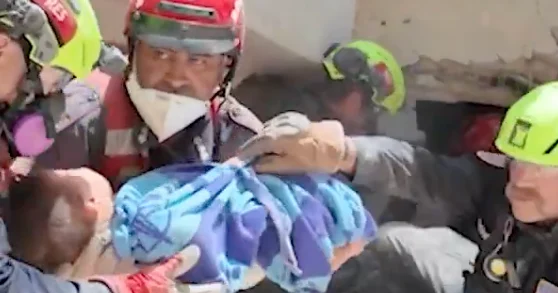
A U.S. urban search and rescue team successfully extracted a mother and her nine-month-old baby from the rubble of collapsed buildings in Venezuela following two powerful earthquakes that have killed more than 1,400 people and left thousands missing. The rescue highlighted the critical international response underway amid a worsening humanitarian crisis in the country.
What Happened
On June 22, 2026, two earthquakes struck Venezuela within minutes, severely damaging buildings and infrastructure across regions including the coastal city of La Guaira. The Virginia Urban Search and Rescue Task Force 1, deployed to assist Venezuelan authorities, shared videos capturing the dramatic rescue of a woman and her infant from collapsed rubble. The U.S. State Department also disseminated footage showing the baby being pulled out wrapped in blue fabric, crying but unharmed.
Alongside these rescue efforts, the U.S. military’s Southern Command (SOUTHCOM) sent approximately 100 airmen to support air traffic management at Venezuela’s primary airport and 130 Marine Corps personnel to help reopen the port in La Guaira, facilitating much-needed maritime supply routes. The amphibious ship USS Fort Lauderdale and Army helicopters have also been deployed to aid operations. Urban Search and Rescue Task Force 2, with 71 members from Los Angeles, has conducted extensive ground and aerial damage assessments across affected areas. Volunteers from Mexico, El Salvador, Switzerland, and other countries are also contributing to the relief work.
Key Facts
More than 1,450 people have been confirmed dead, as stated by Jorge Rodríguez, president of Venezuela’s National Assembly. Hospitals in La Guaira and other impacted regions have reported over 3,150 injuries. Venezuelan officials reported rescuing around 200 people, although an estimated 51,000 individuals remain unaccounted for according to online databases. The dual earthquakes’ shallow depth intensified surface-level destruction, leaving many trapped inside collapsed homes with little time to evacuate, explained Northwestern University professor emeritus Emile Okal.
The mother and baby rescued by the U.S. team sustained only minor injuries. Despite the urgency, Venezuelan citizens have frequently resorted to local, informal rescue efforts amid reported shortages of official government aid. Acting President Delcy Rodríguez has stated that the government is mobilizing a full response to the disaster.
What This Means
The involvement of U.S. rescue teams and international volunteers underscores the severity and scale of the humanitarian emergency in Venezuela. The high death toll and large number of missing persons signify the pressing need for coordinated rescue and relief operations to prevent further loss of life. Reopening key transport hubs like La Guaira’s port and the main airport is crucial to allow timely delivery of food, medical supplies, and other aid.
For Venezuelans, the disaster compounds preexisting struggles linked to economic and political challenges, intensifying the humanitarian burden. The rescue of the mother and child represents not just individual survival but a symbol of hope amid widespread devastation, illustrating the critical importance of early intervention in natural disasters. The widespread engagement by multiple nations also reflects growing international commitment to disaster relief in the region.
Background
The twin earthquakes struck on June 22, 2026, within roughly a one-minute interval. Their shallow focus caused severe shaking across populated areas, leaving many trapped before evacuation was possible. Venezuela has faced political and economic crises in recent years, complicating governmental disaster response capabilities. The National Assembly president described the event as the most brutal natural disaster in the country’s history.
What Remains Unclear
Discrepancies exist regarding the exact number of missing people, given communication difficulties caused by damaged cellphone networks and possible duplicated reports. The full extent of the government’s rescue operations and resource deployment remains uncertain, with local residents reporting limited state presence in hardest-hit communities.
What Comes Next
Search and rescue efforts will continue in the crucial first days following the earthquakes, with teams leveraging aerial and ground damage assessments to prioritize relief zones. The reopening of La Guaira’s port and Venezuela’s main airport will remain a focus to expedite aid flow. International assistance, including volunteers and U.S. military support, is expected to sustain until the situation stabilizes.
Sources
This article is based on reporting and publicly available information from the following source:
Read more World News stories on Goka World News.