
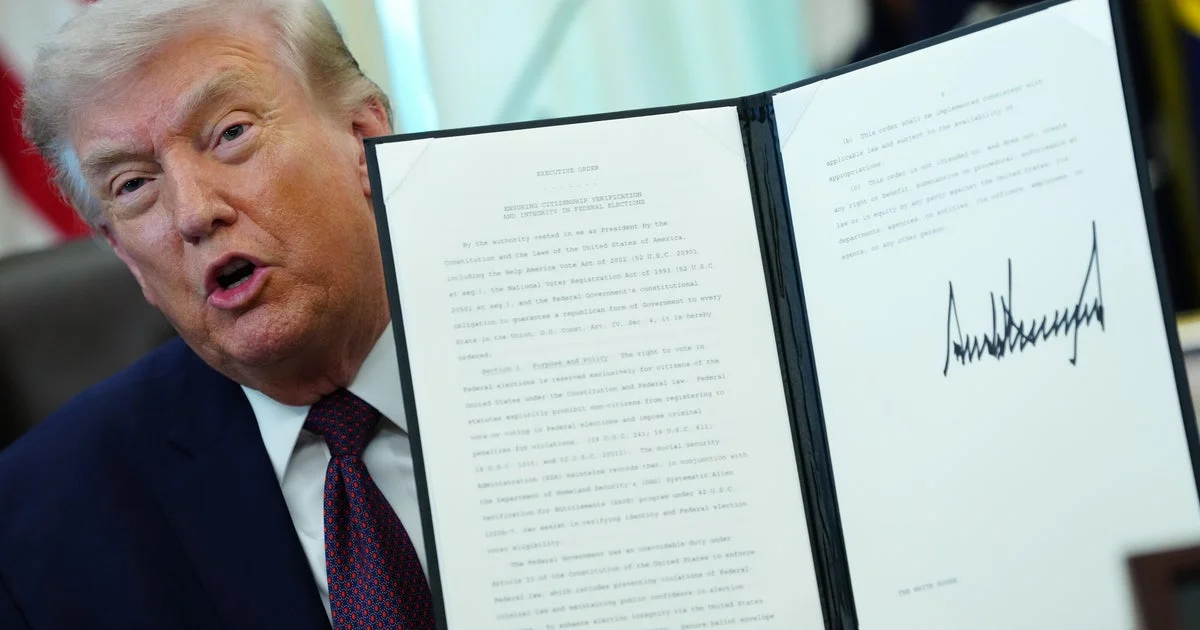
Twenty-three states and the District of Columbia have filed a lawsuit seeking to block President Donald Trump’s latest executive order that imposes federal restrictions on mail voting ahead of the November midterm elections. The suit argues the order unlawfully interferes with states’ constitutionally granted authority to manage elections.
The lawsuit, led by California, was filed Friday in U.S. District Court in Massachusetts. It contends that the president lacks constitutional or statutory authority to mandate sweeping changes to how states conduct federal elections. The plaintiffs say the executive order “transgresses Plaintiff States’ constitutional power to prescribe the time, place, and manner of federal elections” and attempts to “amend and dictate election law by fiat based on the President’s whims.”
Signed on Tuesday, the order requires the Department of Homeland Security to create “State Citizenship Lists” of registered voters eligible to participate in federal elections. It also directs the U.S. Postal Service to send mail or absentee ballots only to voters included on these lists. Additionally, it mandates that mail ballot envelopes bear unique barcodes to facilitate tracking. The order threatens to withhold federal funding from states and localities that do not comply with these new requirements.
The suit warns the directive “violates bedrock principles of federalism and separation of powers.” It notes that each plaintiff state has enacted its own laws governing voter rolls and mail-in voting consistent with federal statute, and the order usurps both states’ and Congress’s constitutional powers to regulate elections.
Trump has repeatedly criticized mail voting as susceptible to fraud, despite no evidence that such fraud occurs on a widespread scale. Ironically, he and members of his family have used mail ballots; Trump recently voted absentee in a Florida state House special election.
The Constitution’s Elections Clause grants states the authority to set the “times, places and manner” of elections for federal offices, with Congress empowered to regulate election rules. While Trump alleges some Democratic-controlled states permit noncitizens to vote, such voting is a federal crime and is exceedingly rare.
This executive order complements Trump’s push for the SAVE America Act, legislation requiring proof of citizenship and photo ID for federal voter registration. Though passed by the House, it faces significant challenges in the Senate.
Why it matters
The lawsuit highlights an ongoing constitutional dispute over the balance of power in election administration between the federal government and individual states. The court’s decision could set a precedent affecting how and whether future presidents can use executive orders to reshape federal election processes, especially voting access methods such as mail ballots. With midterm elections approaching, the outcome may influence voter participation rules nationwide.
Background
President Trump has repeatedly targeted mail voting, arguing it undermines election integrity without evidence of widespread fraud. He previously signed an executive order last year imposing documentation requirements for voter registration, but key provisions were blocked in court. States traditionally have broad autonomy over election rules, while Congress can regulate federal contest procedures. Challenges to federal attempts to impose uniform voting rules continue to test this framework.
Read more Politics stories on Goka World News.