
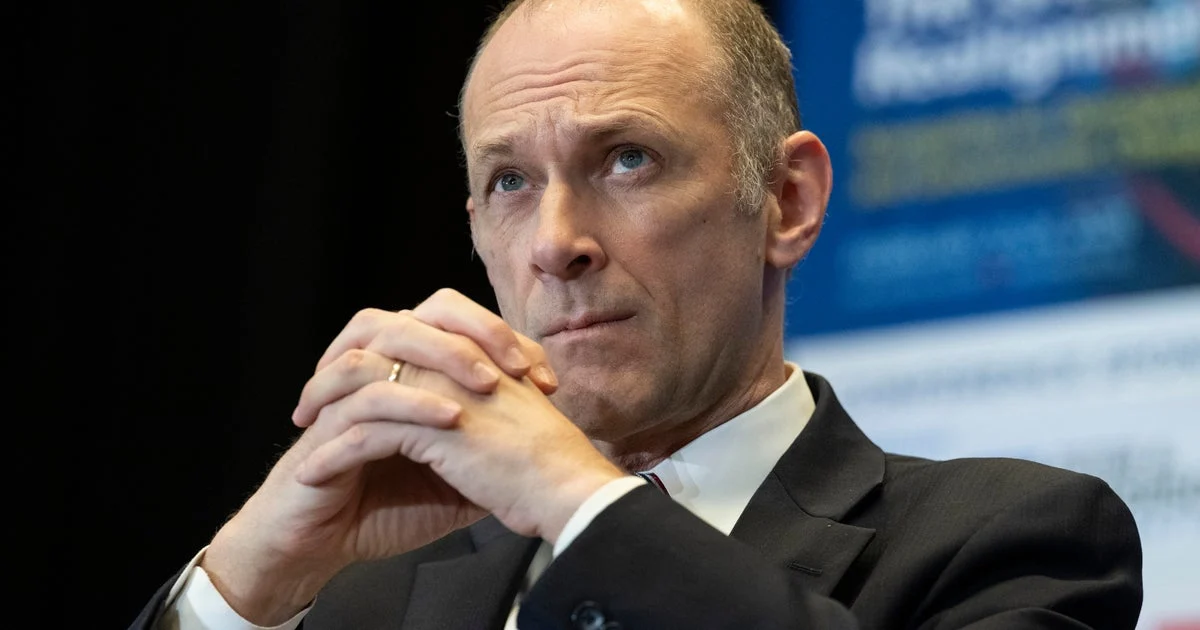
Chicago Federal Reserve President Austan Goolsbee identified inflationary pressures stemming from the ongoing war in Iran as a significant risk to the Federal Reserve’s plan to cut interest rates in 2026. Speaking for himself and not the entire Federal Reserve, Goolsbee said the conflict’s impact on oil prices complicates prospects for easing monetary policy this year.
Before the onset of the Iran war, Goolsbee was optimistic that the Fed could lower its benchmark federal funds rate multiple times in 2026. However, the spike in energy costs has dampened that outlook. “If we’re truly not going to see any improvement in inflation, to me that starts pushing these decisions off to 2027 at the earliest,” he said.
The Federal Reserve maintained the federal funds rate unchanged in March due to economic uncertainty caused by the conflict, despite still anticipating one rate cut in 2026. Since then, gasoline prices have risen sharply, averaging $4.09 per gallon—over $1 higher than before the war began.
Currently serving as an alternate member of the Federal Open Market Committee (FOMC), which sets U.S. monetary policy, Goolsbee participates in discussions but will become a voting member in 2027. His concerns align with private economists who have also reduced their forecasts for rate cuts this year amid inflation risks. The CME FedWatch tool, which assesses rate cut probabilities based on futures markets, now predicts no Fed rate cuts in 2026.
Economists expect the upcoming April 10 Consumer Price Index report to show inflation accelerating to an annual rate of 3.1% in March, up from 2.4% in February. Rising energy prices threaten to erode household budgets and consumer spending, which Goolsbee noted as the “backbone” of economic growth. He warned that higher costs could cause consumers to reduce discretionary spending, which risks undermining the current economic expansion.
Goolsbee also highlighted the broader uncertainty caused by geopolitical tensions and oil markets as factors contributing to a muted labor market. Although March saw 178,000 new jobs added, the February payroll report was revised downward to a loss of 133,000 jobs. He described the labor market as “low hire, low fire,” where employers hesitate to hire or lay off amid unsettled conditions.
Why it matters
The potential delay of interest rate cuts beyond 2026 could affect borrowing costs for consumers and businesses, influencing economic growth and financial markets. Inflation driven by geopolitical instability poses a challenge to the Federal Reserve’s efforts to stabilize prices and support a durable economic expansion.
Background
The Federal Reserve has been managing rates to combat inflation exceeding its 2% annual target, which increased sharply after the Iran war began due to higher oil prices. Energy costs are a major factor in inflation measures and consumer spending patterns, making the Fed’s monetary policy decisions sensitive to changes in the global geopolitical landscape.
Read more Business stories on Goka World News.