
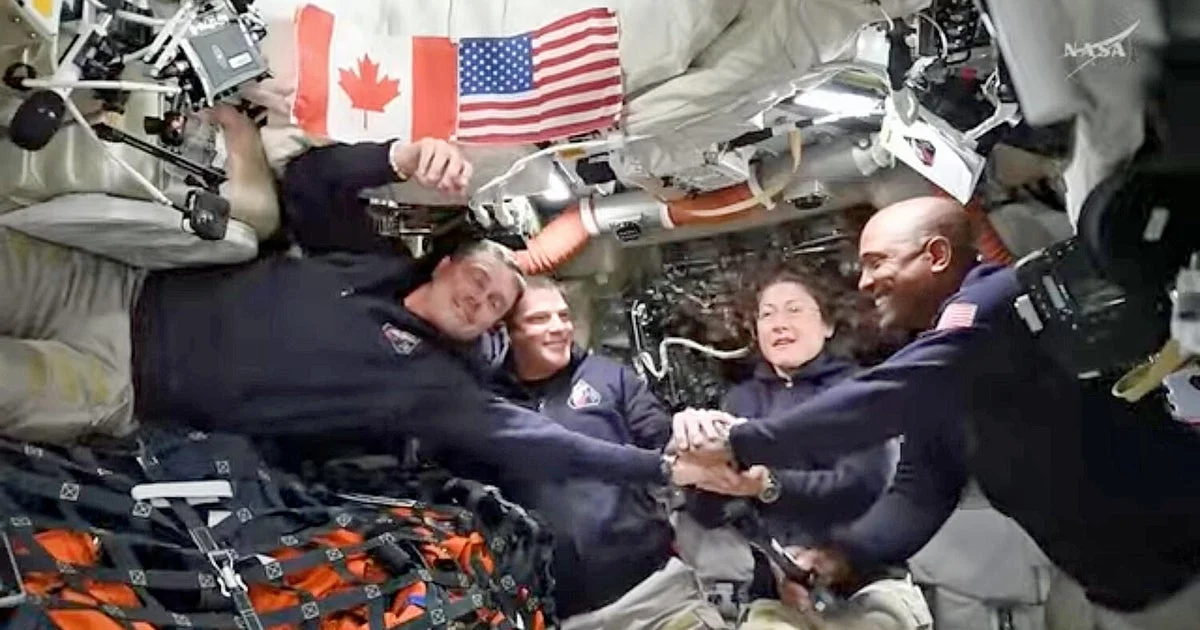
The Artemis II crew, currently en route to the moon, shared their awe at the vastness of space and the beauty of Earth as it receded behind them, even as they continued to contend with technical issues involving their spacecraft’s toilet system.
Pilot Victor Glover described the experience of approaching the moon over Easter weekend as a profound reminder of Earth’s uniqueness. “You are special in all of this emptiness,” Glover said, emphasizing the rarity and value of life on Earth within the vast cosmos. He highlighted the shared experience of all cultures on the planet, urging a sense of unity and gratitude as the crew prepared for their upcoming lunar flyby.
Commander Reid Wiseman and astronauts Christina Koch and Canadian astronaut Jeremy Hansen joined Glover in reflecting on the significance of their journey and the remarkable views through Orion’s windows. Koch noted her striking impression of Earth surrounded by blackness on all sides. As the spacecraft neared the moon, the crew continued to enjoy detailed views of the lunar far side—a region no humans have previously directly observed.
Flight controllers at NASA’s Johnson Space Center communicated with the crew, noting that Artemis II was closer to the moon than to Earth, a milestone that was met with joy by the astronauts. The spacecraft was on near-perfect trajectory, allowing cancelation of planned thruster corrections. Wiseman and Glover planned to test manual piloting of Orion to provide valuable flight data for future missions.
However, the mission has experienced ongoing difficulties with the Orion capsule’s toilet since launch. Flight controllers intermittently advised the crew to use contingency collapsible urinals (CCUs) due to a suspected frozen vent line preventing proper waste venting. The “bake out” technique—reorienting Orion to warm the vent line with sunlight—partially thawed the blockage but did not fully resolve the issue. Flight Director Judd Frieling confirmed the toilet functions for liquid waste but recommended keeping tanks partially filled while troubleshooting continues.
Mission Management Team Chairman John Honeycutt acknowledged public interest in the toilet problem, highlighting the inherent complexity of waste management in space. Veteran astronaut Don Pettit explained the CCUs’ design, which uses capillary forces to contain urine in microgravity, providing an essential backup system on long-duration missions.
The crew is scheduled to loop around the moon’s far side Monday evening at about 4,100 miles altitude—the closest human approach to this lunar hemisphere—and observe lunar surface features with specialized video and mapping equipment. NASA scientists anticipate these observations will contribute significantly to lunar research.
Why it matters
This mission marks the first crewed lunar flight since Apollo 17 in 1972, providing critical insights into human operations beyond low Earth orbit. The Artemis II crew’s experiences, including managing technical challenges such as the toilet malfunction, will inform design improvements and operational protocols essential for future deep space exploration.
Background
Artemis II is NASA’s first crewed mission in its Artemis lunar program, aimed at establishing a sustainable human presence on the moon and preparing for eventual missions to Mars. The Orion spacecraft, carrying the four astronauts, launched on April 1, 2026, and is conducting a circumlunar flight before returning to Earth.
Read more US News stories on Goka World News.