
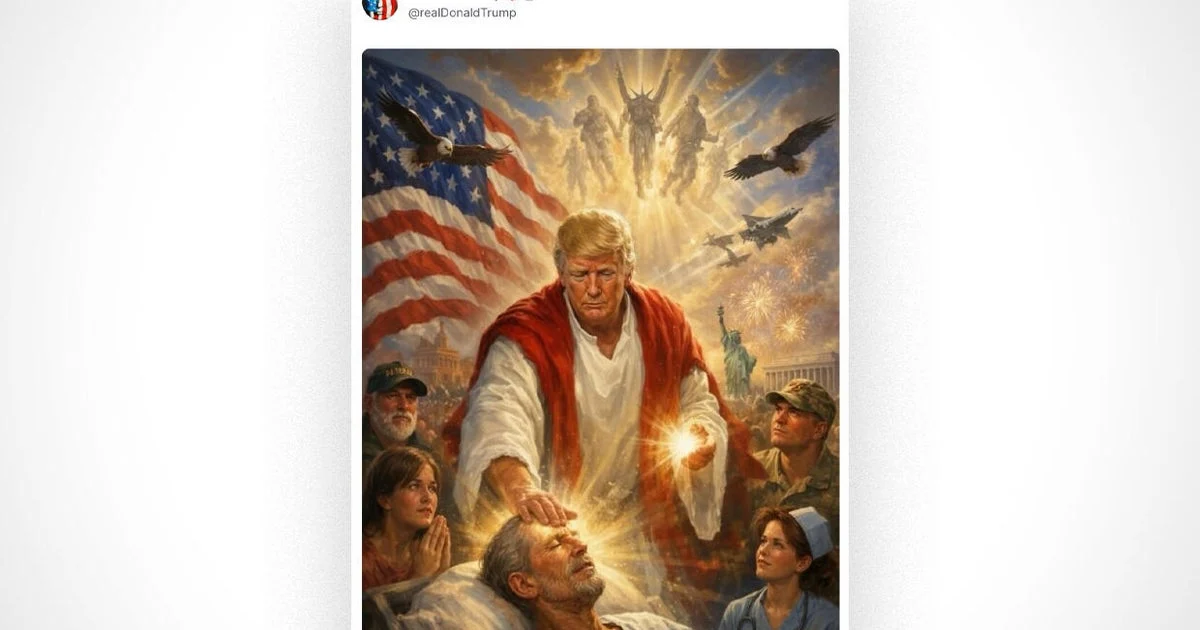
President Donald Trump faced widespread backlash after posting an AI-generated image on Truth Social that depicted him in a style resembling Jesus Christ. The post was shared on Sunday, April 12, coinciding with Orthodox Easter, and was removed the following morning amid mounting criticism.
The image showed Trump dressed in a white robe with a red sash, holding a glowing orb and extending a hand in a gesture associated with healing or blessing. The AI-generated depiction was a modified version of a similar image originally posted months earlier by right-wing influencer Nick Adams. Adams described the image as symbolizing Trump as a healer, stating, “America has been sick for a long time. President Trump is healing this nation.” Trump had appointed Adams as a special presidential envoy for tourism, exceptionalism, and values in March.
In an impromptu press conference outside the Oval Office on Monday, Trump defended the image as portraying him “as a doctor” supporting the Red Cross. He said, “I did post it, and I thought it was me as a doctor… it’s supposed to be me as a doctor, making people better, and I do make people better.” He denied that criticism influenced his decision to take down the post, stating he wanted to prevent confusion among viewers.
However, the image sparked sharp criticism from several conservative figures and some GOP lawmakers. Conservative activist Riley Gaines questioned Trump’s motives, calling for humility and warning, “God shall not be mocked.” GOP Rep. Don Bacon described the post as “gaudy and juvenile,” warning that it divided the Republican Party. Ari Fleischer, former Bush administration press secretary, labeled the image “inappropriate and embarrassing.” Former Republican Rep. Marjorie Taylor Greene denounced the post alongside Trump’s recent criticisms of Pope Leo XIV, calling for prayers against the former president’s conduct.
Conservative commentators highlighted the potential religious offense caused by the post. Podcaster Michael Knowles urged Trump to delete the image despite any humorous intent, while Allie Beth Stuckey attributed the incident to the influence of Trump’s personal pastor and those comparing him to Christ.
The controversial post came shortly after Trump attacked Pope Leo XIV, who has publicly called for peace and reconciliation amid ongoing U.S. involvement in the Iran conflict. The pope responded by emphasizing the importance of avoiding war whenever possible.
Why it matters
The incident underscores tensions within conservative and Christian circles regarding Trump’s public persona and messaging, especially as it relates to religious symbolism and political discourse. It also highlights the risks for political figures in using AI-generated imagery that can be interpreted as sacrilegious or divisive. The backlash illustrates internal divisions among Trump’s supporters and broader conservative critics ahead of ongoing political developments.
Background
This episode follows growing friction between Trump and religious leaders, notably Pope Leo XIV, who has criticized U.S. military actions in Iran. Trump’s use of social media, particularly on platforms like Truth Social, remains a potent tool for shaping his image but has increasingly drawn scrutiny for controversial content. Attempts to cast Trump as a messianic figure reflect a pattern of political symbolism amid ongoing efforts to maintain influence within the Republican Party and conservative base.
Read more Politics stories on Goka World News.