
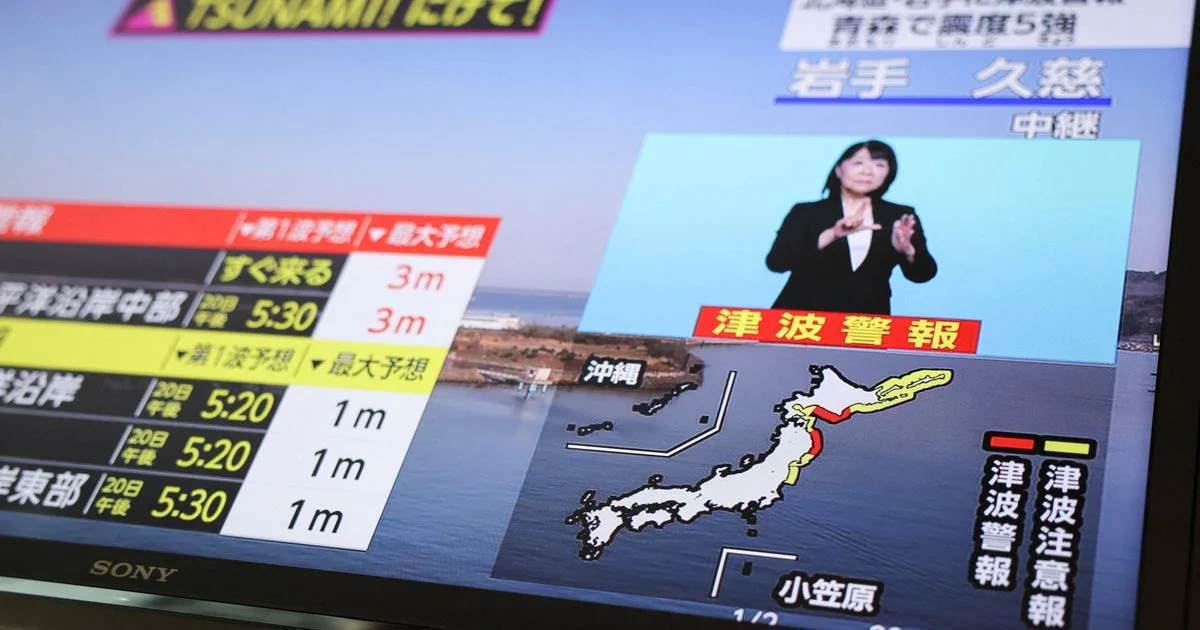
A powerful earthquake with a magnitude of 7.4 struck off the northern coast of Japan near Sanriku on Monday afternoon, leading the Japan Meteorological Agency (JMA) to issue tsunami alerts for a broad coastal region. The earthquake, occurring at a shallow depth of about 6 miles below the sea surface, prompted local authorities to advise evacuations along the coast, though subsequent tsunami waves measured were relatively small and the immediate emergency situation has since eased.
The JMA originally estimated the quake’s magnitude between 7.5 and 7.7, while the U.S. Geological Survey reported it as 7.4. The earthquake occurred around 4:53 p.m. local time (2:53 a.m. EDT), triggering a tsunami wave of approximately 2.6 feet at Kuji port in Iwate Prefecture and a 1.3-foot wave at another nearby port within an hour of the quake.
Tsunami Warnings and Evacuation Advisories
The initial tsunami warning forecasted wave heights as high as 10 feet, but this was lowered to an advisory level once observed waves remained under four feet. Residents were urged to move inland or seek higher ground to avoid risk from potential tidal surges. More than 128,000 residents across four northern prefectures, including Iwate, received non-binding evacuation advisories.
The disaster management authorities reported no immediate casualties or damage to critical infrastructure such as power stations. The Nuclear Regulation Authority confirmed that nuclear power plants and related facilities in the region remained intact with no abnormalities detected. Both nuclear plants in the northeast, currently offline, were unaffected by the quake.
Government Response and Ongoing Risk Assessment
Prime Minister Sanae Takaichi announced that an emergency task force had been established to monitor the situation. Television broadcasts in affected prefectures—Iwate, Aomori, and Hokkaido—displayed evacuation warnings shortly after the earthquake.
Following the quake, the Japanese government issued an advisory indicating a 1% probability that this event might trigger a larger “mega-quake” along the northern coast within the coming week. Although officials emphasized this was not a forecast, they recommended that residents enhance their preparedness by assembling emergency supplies and readiness kits.
Background
This incident comes 15 years after the devastating magnitude 9.0 earthquake and tsunami on March 11, 2011, which caused catastrophic damage in northern Japan, including the Fukushima Daiichi nuclear disaster. That event resulted in over 22,000 deaths and the displacement of nearly half a million people, with long-term evacuations still ongoing in some areas due to radiation concerns.
The 2011 catastrophe’s primary destruction stemmed from the tsunami waves triggered by the earthquake, which severely damaged multiple coastal facilities. The current event’s relatively small tsunami waves and intact infrastructure highlight improvements in monitoring and preparedness since then.
Read more World News stories on Goka World News.