
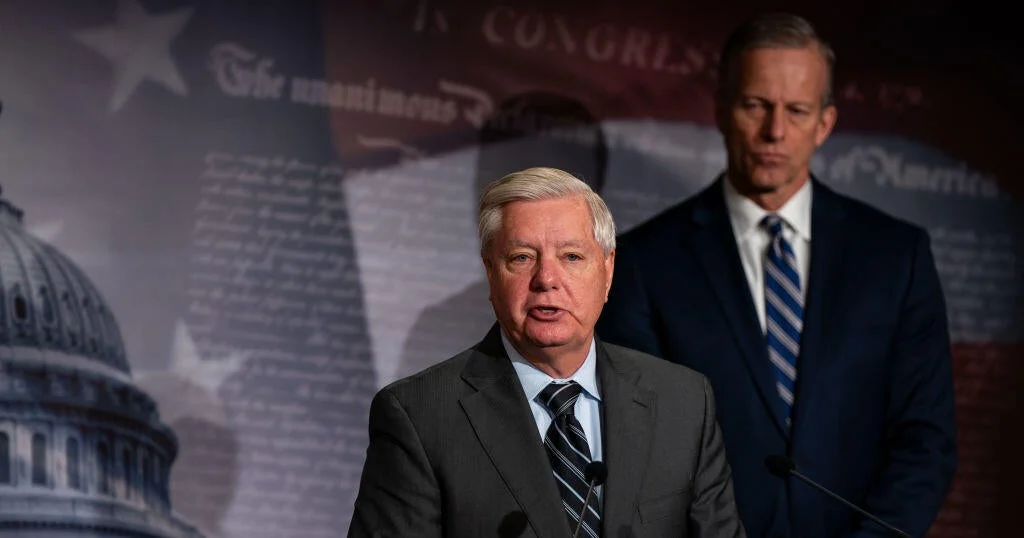
Senate Republicans on Tuesday introduced a budget resolution designed to fund Immigration and Customs Enforcement (ICE) and parts of Customs and Border Protection (CBP) without Democratic support. The resolution launches a reconciliation process, which allows Senate Republicans to advance the funding legislation without needing bipartisan approval.
Senator Lindsey Graham, chairman of the Senate Budget Committee, released the 58-page resolution, emphasizing the party’s commitment to “fully fund Border Patrol and ICE at a time of great threat to the United States.” The resolution authorizes the Senate Judiciary and Homeland Security committees to draft spending bills to increase funding by up to $70 billion for these agencies.
An aide to Senate Majority Leader John Thune indicated that the final legislation is expected to total approximately $70 billion and could secure immigration enforcement funding for up to 3.5 years, covering the remainder of President Trump’s term.
Fundamental legislative strategy
The budget reconciliation mechanism, rarely used for such bills, bypasses traditional legislative gridlock by requiring only a simple Senate majority. Republicans opted for this path after months of failed negotiations with Democrats, who have resisted funding ICE and CBP amid calls for agency reforms following two fatal federal agent-involved shootings in Minneapolis earlier this year.
While most of the Department of Homeland Security (DHS) funding is being advanced through the conventional appropriations process, ICE and CBP funding is being handled separately through reconciliation. Senate Republicans aim to vote on the budget resolution as soon as this week, targeting a final bill approval by the June 1 deadline set by President Trump.
Political context and challenges
Republican leadership, including Senator Thune and House Speaker Mike Johnson, have agreed to this two-track approach with the bulk of DHS funded by appropriations and immigration enforcement agencies funded via reconciliation. However, House Republicans remain divided, with some opposing progress before the reconciliation plan’s completion.
Meanwhile, the DHS has been partially shut down since February 14, as the agency awaits funding approval. The Senate unanimously supported funding most of DHS excluding ICE and CBP, an agreement the House has not yet embraced.
Prospects and potential complications
Thune expressed regret about using reconciliation, calling appropriations a better bipartisan option, but acknowledged Democratic opposition left Republicans with limited choices. He also noted that some Republicans desire additional policy priorities to be added to the reconciliation package, which could complicate swift passage.
The House leadership has committed to funding DHS’s essential functions after the Senate advances the resolution and reconciliation bill. White House officials have been involved in discussions to facilitate a joint legislative effort.
Why it matters
This budget resolution marks a critical step in securing funding for immigration enforcement agencies amid political discord. Passing the funding through reconciliation ensures that Republicans can bypass Democratic resistance, enabling ICE and CBP to operate without delay. The move also highlights the increasing political polarization around immigration policy funding and enforcement.
Background
Immigration agencies within DHS have faced funding uncertainties amid contentious debates over enforcement practices and reform. Following controversial incidents involving federal agents earlier this year, many Democrats have called to reduce or reform ICE and CBP funding. This legislative push by Senate Republicans seeks to maintain current funding levels and policy direction through the remainder of the Trump administration.
Read more Politics stories on Goka World News.