
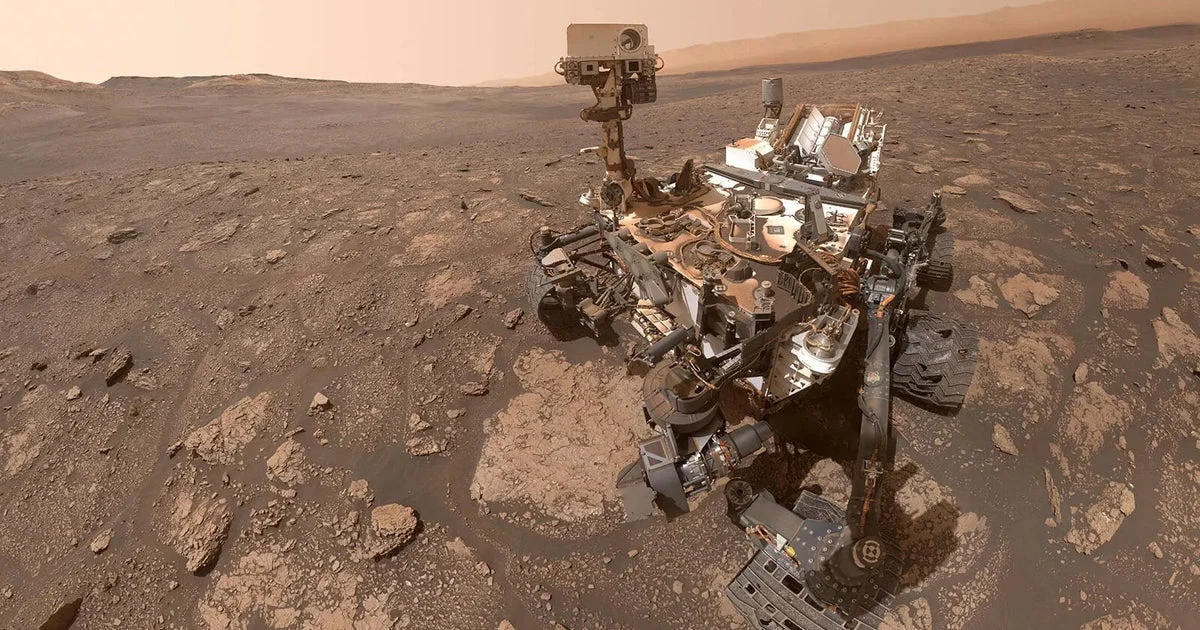
NASA’s Curiosity rover has performed a chemistry experiment on Mars that has never been conducted beyond Earth, detecting more than 20 organic molecules that could provide clues about Mars’ ancient environment and its potential to support life, NASA scientists announced Tuesday.
The experiment took place in 2020 using two tubes of a chemical known as tetramethylammonium hydroxide (TMAH), which breaks down complex organic compounds to reveal their molecular components. This method, a first on another planet, yielded multiple organic molecules, including benzothiophene and nitrogen-containing compounds related to DNA precursors.
Curiosity landed in 2012 in the Gale crater, an ancient lake bed where water once existed in liquid form more than three billion years ago. The discovery of these molecules suggests that organic compounds have been preserved on Mars’ surface since that era, supporting the idea that the planet was once habitable.
Amy Williams, an astrobiologist leading the study published in Nature Communications, stated the findings do not confirm past life on Mars but highlight the preservation of potential life-building blocks. She noted similarities between the molecules found on Mars and those delivered to Earth by meteorites, indicating a shared chemical heritage.
While the results add weight to the evidence of Mars’ habitability, scientists emphasized that proving past life requires further investigation. One promising approach involves bringing Martian rock samples back to Earth for detailed study—a goal of the Mars Sample Return mission. However, this mission has faced setbacks after congressional actions in recent years.
The success of Curiosity’s TMAH experiment has wider implications, paving the way for future missions. The European Space Agency’s Rosalind Franklin rover, equipped with a longer drill and scheduled for launch in late 2028, will carry TMAH to Mars to conduct similar analyses. Additionally, NASA plans to include the chemical on its Dragon rotorcraft for a future mission to Titan, Saturn’s moon.
Why it matters
This experiment marks a significant advance in extraterrestrial chemical analysis, demonstrating methods to detect and characterize organic matter directly on another planet. Identifying organic molecules preserved for over three billion years gives researchers valuable insight into Mars’ early environment and contributes to understanding the solar system’s potential for life.
The discovery also supports ongoing efforts to evaluate Mars’ habitability and informs the design of future missions that may eventually confirm or rule out ancient life on Mars.
Background
Curiosity’s exploration of Gale crater has been focused on assessing Mars’ past habitability by analyzing rock formations and chemical compositions. Previous findings include evidence of ancient water flows and diverse minerals formed in wet conditions.
Organic molecules on Mars have been detected before but not with the detailed chemical breakdown made possible by TMAH. This reagent helps scientists understand the complexity and origin of organics that could be indigenous to Mars or delivered by meteorites.
Other recent discoveries by Curiosity include distinctive surface patterns formed by water erosion and observations of atmospheric phenomena like colorful clouds, providing a broader understanding of Mars’ geology and climatology.
Read more Space & NASA stories on Goka World News.