
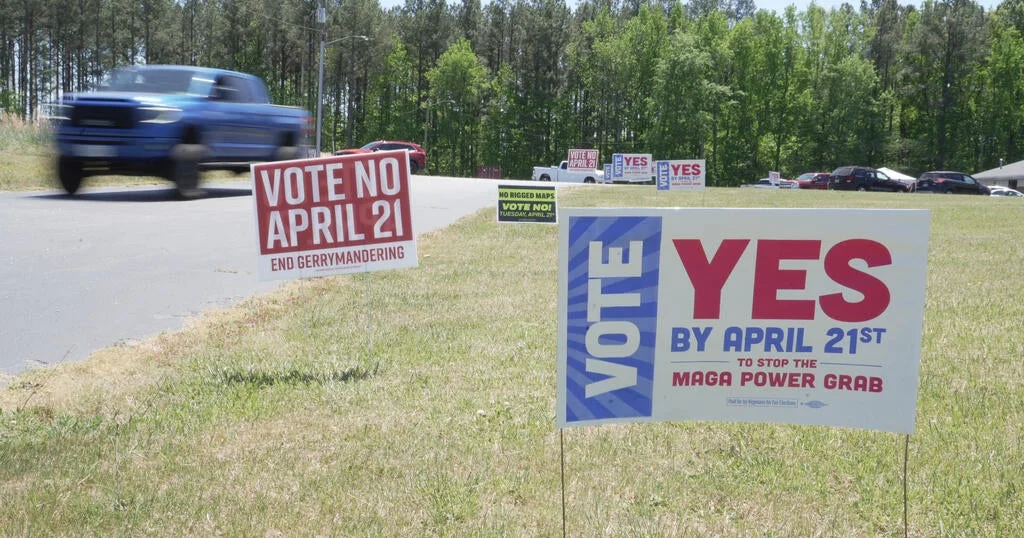
A Virginia state court judge issued an injunction on Wednesday preventing the state from implementing new congressional maps approved in a referendum just one day earlier. Judge Jack Hurley of Tazewell County Circuit Court ruled that the referendum violated multiple provisions of the Virginia Constitution, including the failure to provide the required 90-day public notice and using a “flagrantly misleading” ballot question.
Hurley’s order declares all votes cast for and against the referendum ineffective and prohibits state officials from certifying the results or enacting the redistricting plan passed by the Democratic-controlled General Assembly. The ruling represents a significant obstacle for Democrats’ effort to redraw Virginia’s congressional districts in their favor.
Virginia Attorney General Jay Jones, a Democrat, responded by vowing an immediate appeal, asserting that the public’s vote should stand and criticizing the ruling as an activist judge overriding voters’ will. In contrast, the Republican National Committee, one of the groups that challenged the referendum, praised the ruling as a “major victory,” condemning the Democrats’ initiative as an unconstitutional power grab.
The referendum, which passed by a narrow margin of about 3 points on Tuesday, sought to amend the state constitution to permit lawmakers to redraw the state’s House map directly. This would overturn a 2020 amendment that established a bipartisan commission to handle redistricting. Under the new plan, ten of Virginia’s 11 congressional districts would lean Democratic by dividing the heavily Democratic Washington, D.C., suburbs of Northern Virginia into multiple districts. Currently, Virginia’s House delegation consists of six Democrats and five Republicans.
Judge Hurley previously declared the amendment illegal when passed by the General Assembly earlier this year. The Virginia Supreme Court allowed the referendum to proceed but did not rule on its constitutionality.
This development is part of a broader, contentious national debate over congressional redistricting ahead of the 2026 midterm elections. Several states, including Texas, California, Missouri, and North Carolina, have recently redrawn districts, often triggering legal challenges. Unlike Virginia, courts have so far upheld new maps in other states, including Texas and California, where these changes have tilted districts toward one party.
Why it matters
The court’s injunction halting Virginia’s new maps affects political power balance in a key battleground state, potentially maintaining the current congressional delegation split for the coming elections. The ruling also underscores the continuing legal battles over redistricting processes nationwide and challenges attempts to circumvent bipartisan commissions designed to prevent partisan gerrymandering. How Virginia’s appeal proceeds could influence redistricting disputes in other states heading into the midterms.
Background
Virginia’s 2020 constitutional amendment created a bipartisan commission to oversee redistricting, seeking to reduce partisan influence. This year’s referendum aimed to reverse that by allowing legislators to redraw maps, a move supported by Democrats following their gains in recent elections. The previous redistricting plan had been seen as leaning more balanced, but the new maps passed by Democrats would shift multiple districts to their advantage by fragmenting Northern Virginia’s Democratic strongholds. Republicans opposed the measure on grounds of diminished representation in southern and western Virginia, and concerns over the transparency and constitutionality of the referendum process.
Read more Politics stories on Goka World News.