
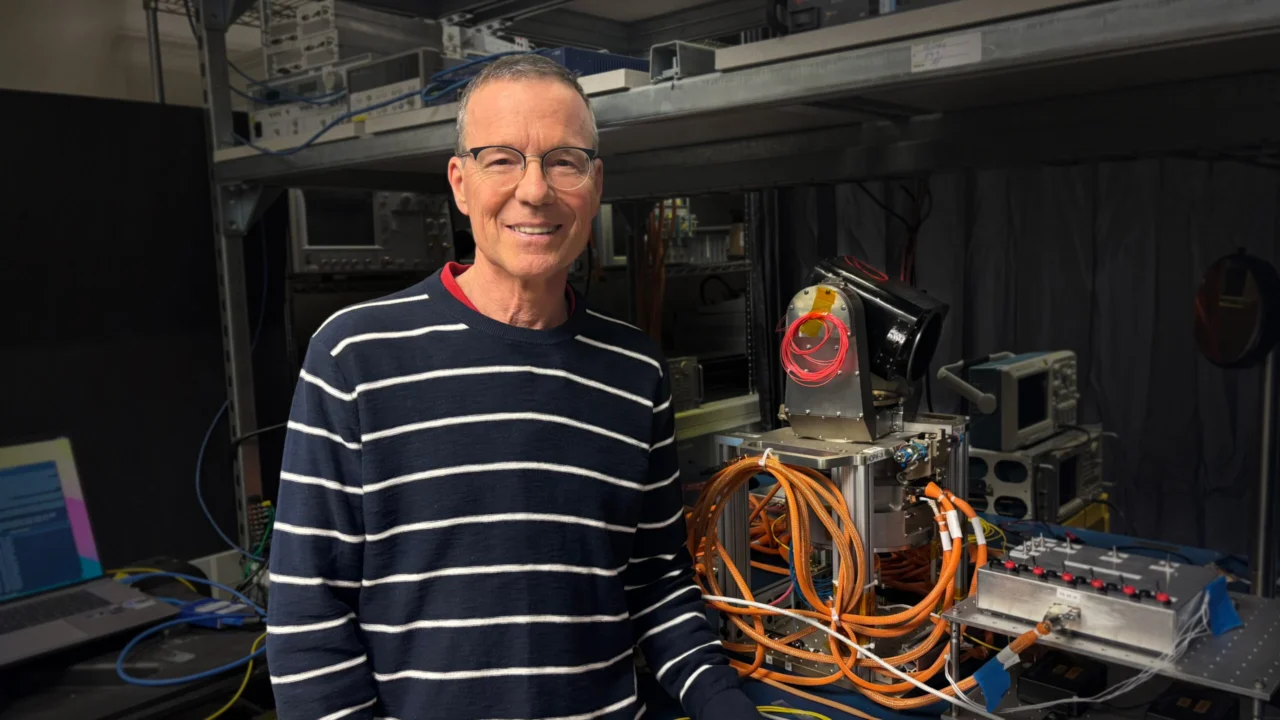
NASA’s Artemis II mission marked a milestone by deploying a laser communications system to transmit data from lunar orbit back to Earth. Peter Rossoni, flight manager for the Orion Artemis II Optical Communications System at NASA’s Goddard Space Flight Center, oversaw the operation during the approximately 10-day mission in April 2026.
The laser communications terminal, flown aboard the Orion spacecraft carrying NASA astronauts Reid Wiseman, Victor Glover, Christina Koch, and Canadian Space Agency astronaut Jeremy Hansen, transmitted more than 450 gigabytes of data to Earth. This volume is equivalent to roughly 100 high-definition movies, illustrating a dramatic increase in data capacity compared to traditional radio systems.
Laser communications use invisible infrared light to deliver faster data rates — the system achieved downlink speeds up to 260 megabits per second. Such speeds allow the transmission of a full-length 4K movie from the Moon to Earth in about one minute. The laser link operated alongside traditional radio communications, both integrated into the same network infrastructure at NASA’s Johnson Space Center and aboard Orion.
Rossoni and his team conducted extensive testing and operational readiness reviews ahead of launch, ensuring the laser communications terminal and ground segments worked seamlessly. During the mission, Rossoni was part of mission control, managing data flow and ensuring reliable communication between the spacecraft and Earth.
Why it matters
The laser communications system on Artemis II represents a significant advancement in deep space communication technology. By enabling data transmission speeds up to 100 times greater than radio frequency systems, this technology enhances real-time video, science data transfer, crew communication, and flight operations during crewed space exploration. Reliable and high-capacity communications are critical for supporting longer deep space missions and ensuring astronaut safety.
Previous laser communication experiments had proven the technology’s potential, but Artemis II was the first operational use on a crewed deep space mission. The success of this mission lays the groundwork for future lunar and Mars exploration programs that demand robust, high-throughput communication infrastructure.
Background
Laser communications use infrared light to increase data transmission rates by packing more information into each signal. NASA’s Space Communications and Navigation (SCaN) program has been developing and testing laser communication technologies for several years. Artemis II, the first crewed test flight around the Moon since the Apollo missions, provided an opportunity to demonstrate the system’s operational viability alongside existing radio links.
Peter Rossoni’s role as flight manager involved coordinating between the optical terminal’s hardware and the ground network, integrating new technology with established communication methods. This integration is crucial for maintaining continuous communication links during complex space missions.
Read more Space & NASA stories on Goka World News.
Sources
This article is based on reporting and publicly available information from the following source: