
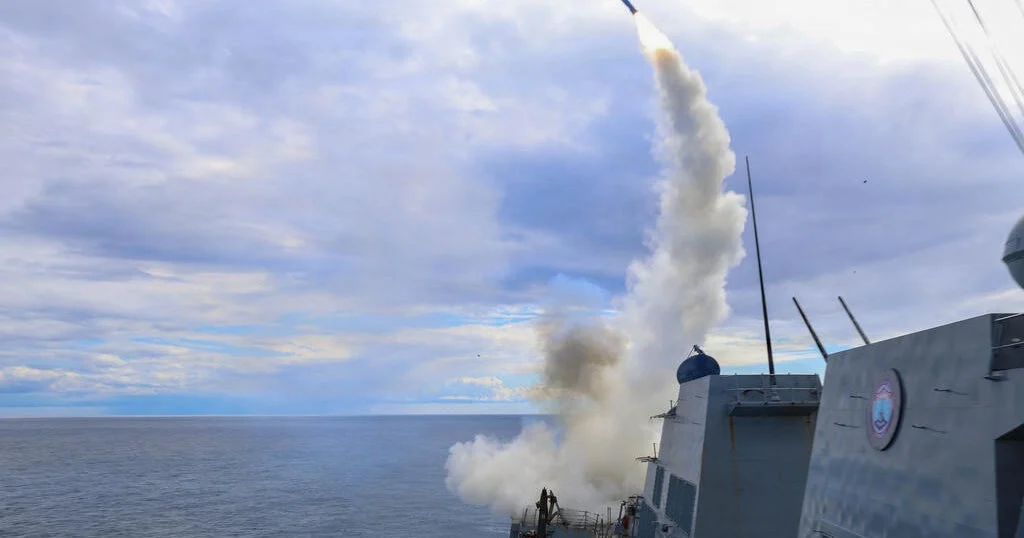
The United States has begun re-arming its military stockpiles following an extended ceasefire with Iran declared by President Donald Trump, but Pentagon officials and independent analysts caution that supplies of advanced munitions, particularly long-range missiles, are finite and replenishment will require significant time.
President Trump announced the ceasefire extension in April 2026, emphasizing that America maintains a “virtually unlimited supply” of ammunition. However, recent congressional testimony and a report from the Center for Strategic and International Studies (CSIS) present a more constrained picture of U.S. munitions capabilities.
Concerns Over Missile Stockpiles
The CSIS analysis estimates that the U.S. may have used over half of its prewar inventory of at least four key missile types, including the Tomahawk cruise missile. While current stocks suffice for ongoing operations against Iran, CSIS warns the military faces risks in sustained or future conflicts.
Adm. Samuel Paparo, commander of U.S. Indo-Pacific Command, testified before the Senate Armed Services Committee that scaling up production of complex weapons like Tomahawks and AGM-158 JASSMs could take “one to two years,” a period he believes is insufficient to meet immediate demand. “There are finite limits to the magazine,” Paparo said, underscoring the need to employ munitions judiciously.
Advanced interceptor systems such as the Patriot and Terminal High Altitude Air Defense (THAAD) are also under pressure. These air defense missiles protect forces in multiple theaters — including Europe, the Middle East, and the Indo-Pacific — and the overlapping demand complicates inventory management and replenishment efforts.
Efforts to Boost Production
In March, President Trump met with defense industry executives who pledged to increase production rates of “Exquisite Class Weaponry” — a Pentagon term for highly sophisticated, costly munitions like Tomahawks and missile defense systems. Following this meeting, the Department of Defense announced several framework agreements aimed at accelerating manufacturing of THAAD systems, critical missile components, and Precision Strike Missiles.
The Pentagon’s 2026 budget request sought over $70 billion for missile procurement, nearly triple the previous year’s amount, signaling an urgent priority to rebuild stockpiles. Defense officials emphasized that encouraging long-term industrial investment is essential to maintaining a strategic advantage.
Impact on Global Military Postures
The U.S. has redistributed some military assets to Central Command in support of the Iran conflict, including missile defense systems and carrier strike groups. This has led to concerns from lawmakers regarding potential gaps in other regions. Army Gen. Xavier Brunson clarified that while some munitions were moved toward the Middle East, THAAD systems remain deployed on the Korean Peninsula.
Why it matters
The strain on advanced munitions supplies highlights a key limitation in U.S. military power: while highly capable, the quantity and production rates of critical weapons are constrained. This poses risks not only for the current Iran conflict but also for potential future engagements, particularly against near-peer competitors like China.
Defense planners now confront the challenge of balancing immediate operational needs with long-term readiness, while encouraging innovation and expanding manufacturing capacity to avoid shortages in pivotal weapons systems.
Background
Concerns over munitions stockpiles intensified after Russia’s invasion of Ukraine revealed limitations in Western weapons production and supply chains. The current focus on long-range missile availability reflects evolving U.S. strategic priorities amid simultaneous commitments in multiple theaters.
Complex supply chains and specialized components required for high-end munitions complicate rapid scaling of production. The Pentagon is therefore pursuing both industrial base expansion and partnerships with emerging defense contractors to diversify capabilities.
Read more US News stories on Goka World News.