
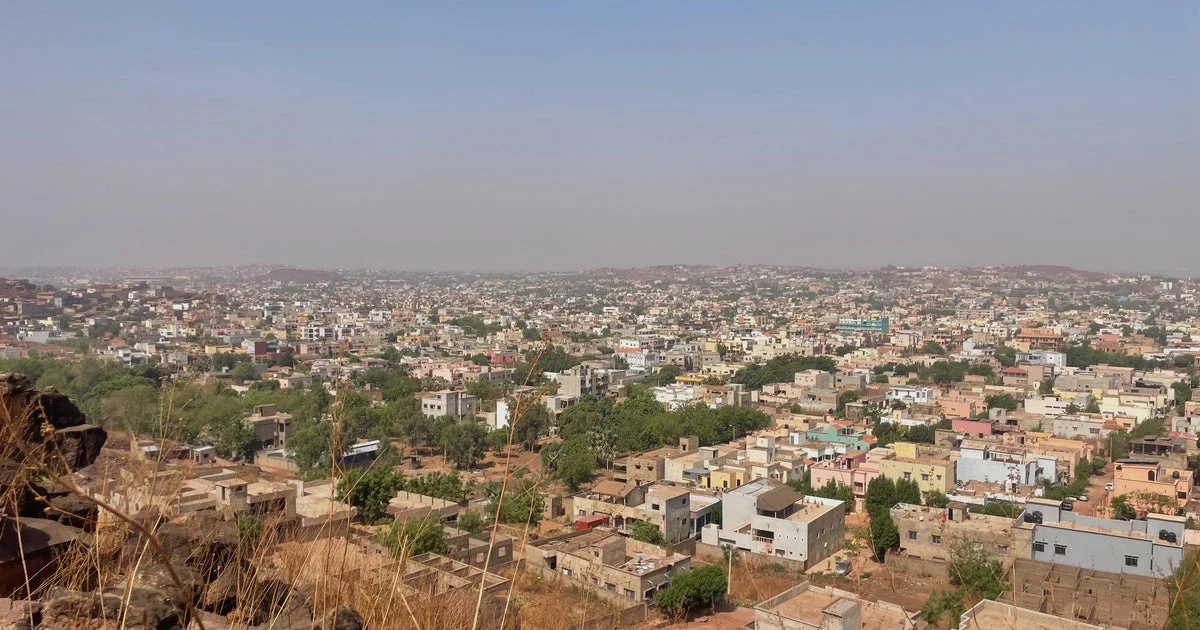
Armed groups launched coordinated attacks early Saturday in Mali’s capital, Bamako, and other key cities, including Kati, Kidal, and Gao, Mali’s army and residents reported. The assaults targeted military bases and infrastructure, with the government stating that soldiers engaged and eventually regained control of affected areas.
Attacks and Military Response
Malian authorities reported that “unidentified armed terrorist groups” attacked several locations and military barracks in Bamako. Heavy gunfire and explosions were heard near Modibo Keïta International Airport, a critical facility adjacent to a military air base approximately 9 miles from Bamako’s city center. Witnesses described helicopters patrolling the vicinity while soldiers responded to the attacks.
Similarly, in the nearby town of Kati—which hosts Mali’s main military base and is home to junta leader Gen. Assimi Goita—residents experienced explosions and gunfire. Videos circulated on social media showing militant convoys moving through Kati’s streets while local residents watched apprehensively.
Violence in Northern Cities and Separatist Involvement
Gunfire and armed confrontations also erupted in the northern cities of Kidal and Gao. In Kidal, gunmen reportedly took control of certain neighborhoods, sparking armed exchanges with the Malian army. Mohamed Elmaouloud Ramadane, spokesperson for the Tuareg-led Azawad separatist movement, claimed their forces seized parts of Kidal and Gao, although these statements have not been independently verified.
The Azawad separatists, who seek independence for northern Mali, previously controlled significant territories before a 2015 peace agreement—subsequently disrupted—allowed some former rebels to join the Malian military. These recent clashes signal renewed instability in that region.
Security Alert and Context
The U.S. Embassy in Bamako issued a security alert advising American citizens to shelter in place and avoid travel near Kati and the international airport until further notice.
Experts identified this as potentially the largest coordinated militant assault in Mali in years. Ulf Laessing of the Konrad Adenauer Foundation noted the significance of alleged collaboration between al Qaeda-affiliated Group for Support of Islam and Muslims (JNIM) and Tuareg separatists, recalling their joint takeover of northern Mali in 2012.
Mali, alongside Niger and Burkina Faso, continues grappling with insurgencies by jihadist affiliates of al Qaeda and ISIS. Recent years have seen a deterioration in security despite international and regional military efforts. Following coups, Mali’s junta shifted alliances from Western nations to Russia for counterterrorism support; however, militant attacks have grown in frequency and intensity.
Why it matters
This coordinated assault marks a serious escalation in Mali’s ongoing conflict, demonstrating the resilience and organizational capacity of armed groups despite government efforts to stabilize the country. The involvement of both jihadist and separatist forces underscores the complexity of Mali’s security challenges. Rising violence poses threats to civilian safety, destabilizes governance, and complicates international counterterrorism partnerships.
Read more World News stories on Goka World News.
Sources
This article is based on reporting and publicly available information from the following source: