
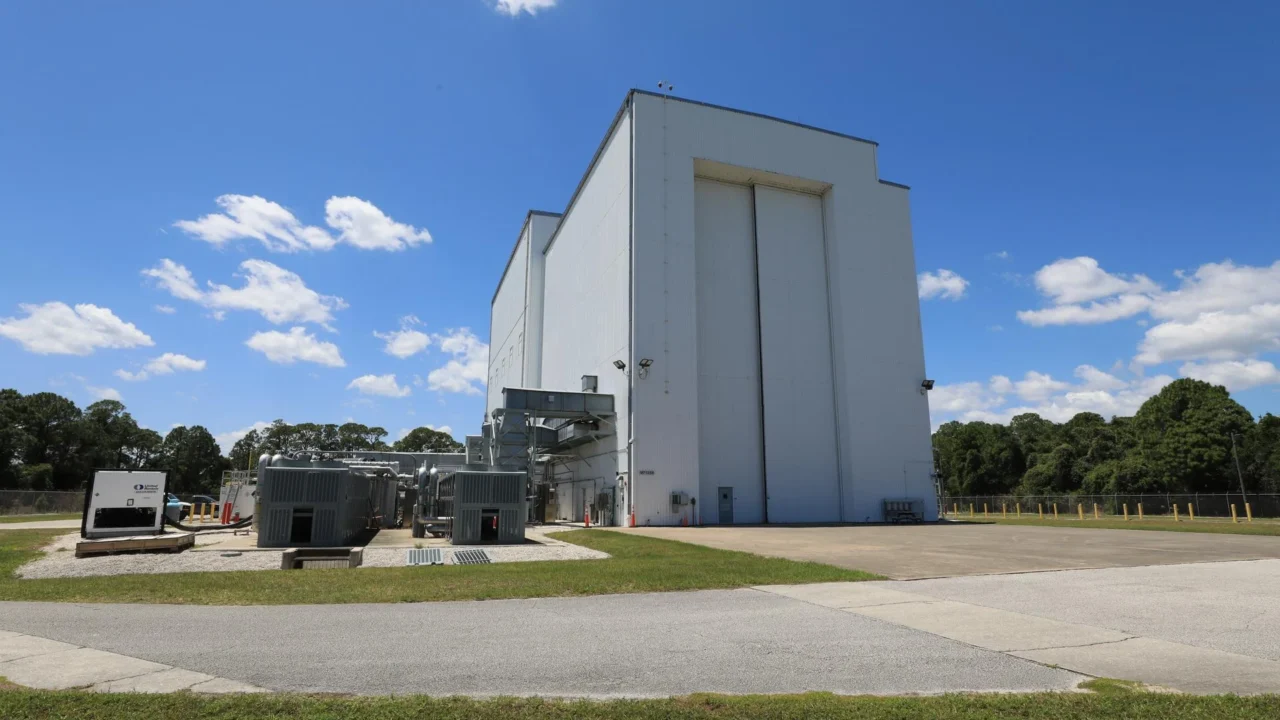
NASA’s Kennedy Space Center is upgrading its Payload Hazardous Servicing Facility (PHSF) to support the upcoming launch of the Nancy Grace Roman Space Telescope, scheduled as early as September on a SpaceX Falcon Heavy rocket from Launch Complex 39A. The facility will host crucial final inspections, checkouts, and fueling before the telescope is transported to the launch pad.
Facility Upgrades to Protect a Sensitive Spacecraft
The PHSF, operational since 1986, combines clean-room standards with hazardous material handling capabilities. It has previously supported notable NASA missions including Hubble Space Telescope components, Mars rovers, and the Europa Clipper. To prepare for Roman, NASA’s Launch Services Program implemented several upgrades to maintain stricter contamination control and environmental stability.
One significant upgrade involved replacing the air-shower system, which uses high-velocity HEPA-filtered air to remove particles from personnel and equipment before entering the clean room. This measure is critical because even microscopic contaminants like dust or hair can interfere with the spacecraft’s sensitive instruments.
The facility’s clean room is certified to ISO class 8 standards but will utilize a HEPA filtration wall to meet the more stringent ISO class 7 requirements necessary for Roman. Additionally, the HVAC system was upgraded, including new chiller coils and enhanced climate controls, to maintain temperatures around 70°F and relative humidity between 30% and 60%. These conditions prevent corrosion and static electricity, ensuring both hardware integrity and technician safety within Florida’s hot, humid environment.
Other upgrades include refurbishing the 15-ton bridge crane with fresh paint formulated to minimize paint-chip debris, which could contaminate the spacecraft.
Prelaunch Processing and Mission Significance
At PHSF, the Roman telescope will undergo several prelaunch steps such as thermal protection closure, cleaning procedures, solar array preparation, and hydrazine propellant loading. The facility’s unique capabilities allow it to manage both hazardous fueling and contamination-sensitive operations simultaneously.
Roman’s mission is designed to capture panoramic deep-space images with a field of view 100 times larger than NASA’s James Webb Space Telescope and up to 200 times larger than Hubble. This broad survey capability will provide data critical to advancing understanding of dark energy, exoplanets, and astrophysics.
Roman will complement existing telescopes; discoveries made by Roman can be analyzed in greater detail by Webb, enhancing overall scientific outcomes.
Why it matters
The meticulous preparation at the PHSF reflects the technical challenges of launching highly sensitive scientific instruments and ensures the highest probability of mission success. Roman’s data will offer unprecedented insights into the cosmos, potentially transforming astrophysics research and advancing humanity’s knowledge of the universe.
Read more Space & NASA stories on Goka World News.
Sources
This article is based on reporting and publicly available information from the following source: