
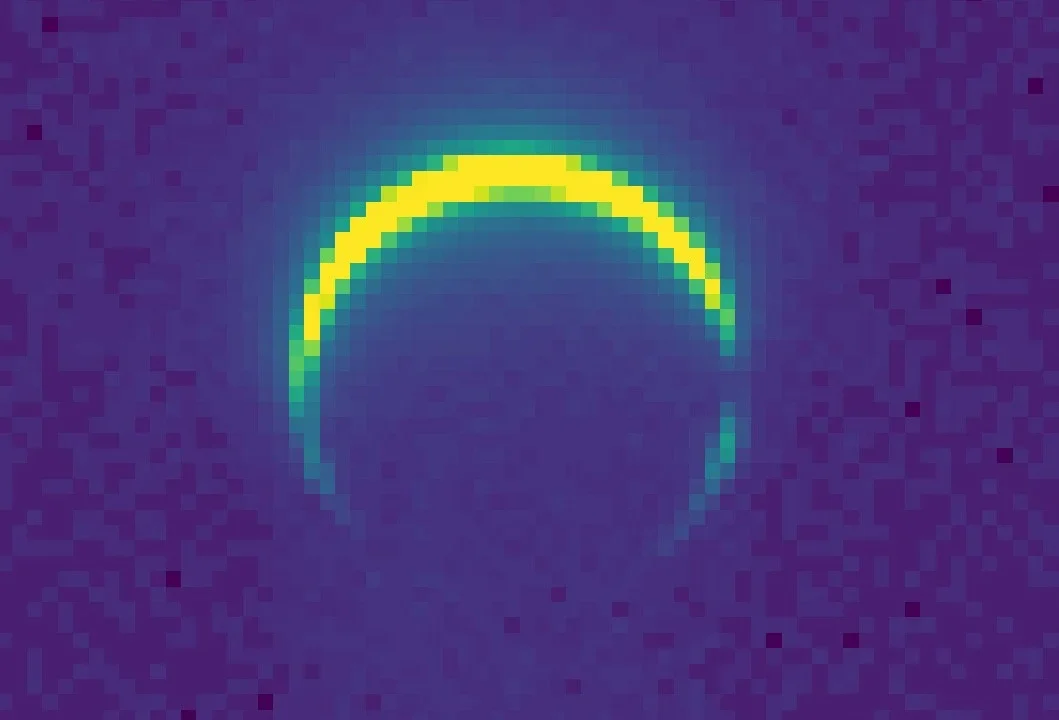
NASA’s Psyche spacecraft captured a colorized image of Mars on May 3, 2026, from approximately 3 million miles (4.8 million kilometers) away, ahead of a planned gravity assist flyby on May 15. This maneuver will increase Psyche’s speed and adjust its trajectory en route to asteroid Psyche, where it is expected to arrive in 2029.
Approaching Mars from a high-phase angle, the spacecraft captured the planet as a thin crescent, similar in appearance to a crescent Moon during a new Moon phase. The Sun is positioned out of the frame and “above” both Mars and the spacecraft, creating this phase geometry.
The image was taken using Psyche’s multispectral imager instrument with a panchromatic broadband filter and a brief exposure time of just two milliseconds. Despite the short exposure, the crescent appeared very bright, causing parts of the image to be oversaturated.
The crescent’s light results from sunlight reflected off the Martian surface and scattered by dust particles in the planet’s atmosphere. The varying levels of Martian atmospheric dust complicate predictions of the crescent’s brightness before imaging. The atmosphere also enhances the crescent’s apparent extent around the planet compared to airless bodies like the Moon.
An interesting feature in the image is a gap on the right side of the crescent, aligned with Mars’ icy north polar cap, currently in winter. NASA mission specialists suggest that seasonal clouds or hazes in this region may obscure atmospheric dust, reducing sunlight scattering and creating this visible gap.
The Psyche mission team will continue acquiring and analyzing similar images as the spacecraft approaches Mars on May 15. These observations serve primarily to calibrate the imaging instruments and test their performance in flight, offering valuable practice for the spacecraft’s eventual arrival at asteroid Psyche.
Why it matters
The gravity assist maneuver at Mars is a critical step in accelerating Psyche toward its primary mission target, the metallic asteroid Psyche, scheduled for exploration in 2029. Calibrating the imaging systems during the approach helps ensure the quality of data collected throughout the mission. Additionally, the images provide scientific insight into Martian atmospheric conditions and offer a unique perspective of Mars from a spacecraft en route to the asteroid belt.
Background
The Psyche mission aims to explore asteroid 16 Psyche, thought to be the exposed metallic core of a protoplanet. Launched in 2023, the spacecraft uses flybys for trajectory adjustments and speed gains. The May 15 gravity assist at Mars is the first significant planetary encounter, leveraging the planet’s gravity to propel Psyche toward the asteroid belt, minimizing fuel use and transit time.
Sources
This article is based on reporting and publicly available information from the following source:
Read more Space & NASA stories on Goka World News.