
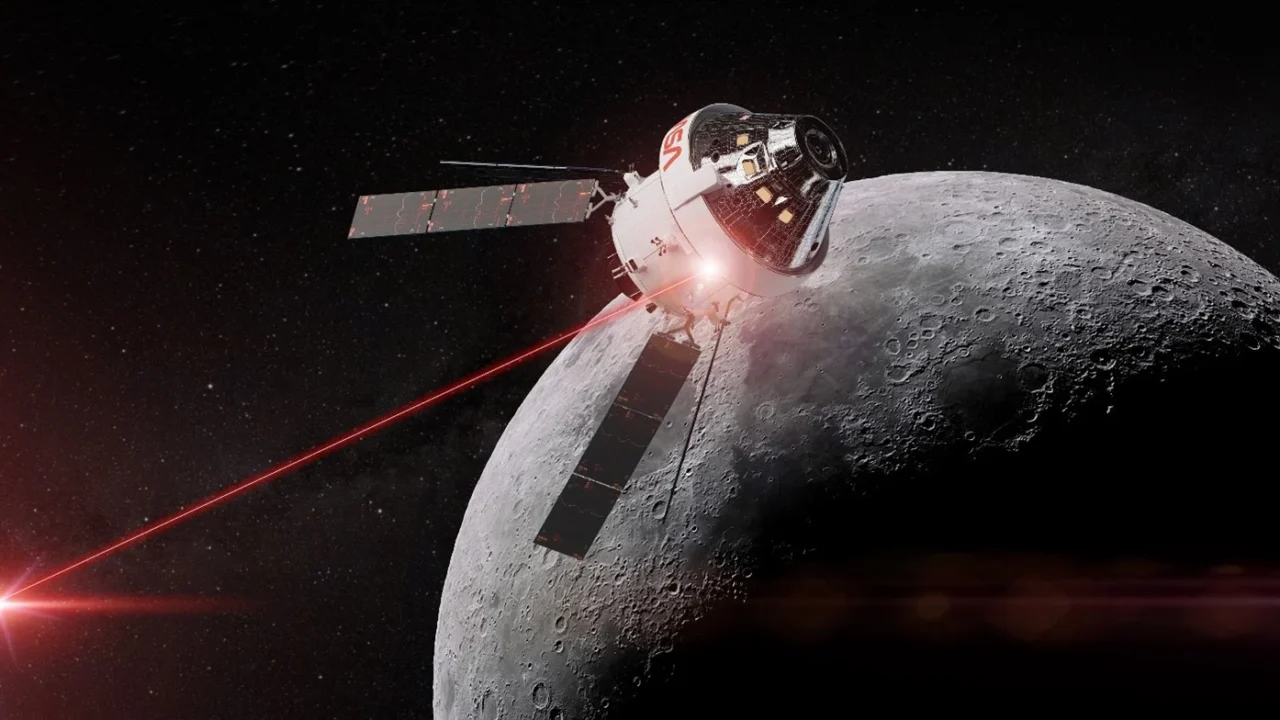
NASA successfully tested a laser communications system aboard the Orion spacecraft during the Artemis II mission, enabling high-speed data transfer while astronauts orbited the Moon. This marked the first time laser communications supported a crewed mission at lunar distances, significantly enhancing the quality and quantity of transmitted data compared to traditional radio frequency systems.
Laser Communications Technology Demonstrated
The optical communications terminal, known as the Orion Artemis II Optical Communications System (O2O), was attached externally to the Orion capsule. Developed by the Massachusetts Institute of Technology Lincoln Laboratory, the system used invisible infrared laser light to transmit high-definition video, images, flight data, and voice communications to Earth.
Over the approximately 10-day mission, O2O exchanged 484 gigabytes of data—roughly equivalent to 100 high-definition movies. When active, the system achieved downlink speeds of 260 megabits per second, far exceeding the single-digit megabit speeds typical of NASA’s conventional radio frequency networks at lunar distances.
Ground Stations Enabled High-Speed Data Reception
NASA ground station telescopes at the Jet Propulsion Laboratory in California and the White Sands Complex in New Mexico received most of the optical signals. These stations, located in high-altitude, dry environments to optimize laser communication, could download 26 gigabytes of data in under an hour.
The Artemis II mission also included a new optical ground station at the Australian National University’s Mount Stromlo Observatory. This facility, built with commercial, off-the-shelf components, successfully received dual-stream video data for over 15 hours and achieved the system’s highest data rate of 260 megabits per second.
Enhanced Real-Time Mission Experience
The high-speed laser link enabled NASA to broadcast clear, uninterrupted video feeds such as Earthsets, Earthrises, and live views from Orion, bringing the mission to the public in near real-time. Dr. Kelsey Young, Artemis II’s lunar science lead, emphasized the impact of fast data access for mission science, saying it enabled timely decision-making and a more integrated science presence during critical mission phases.
Greg Heckler, NASA’s Space Communications and Navigation Program deputy manager, highlighted the qualitative impact of the technology, noting that it brought the crew’s journey to life by delivering images, video, and voice data with unprecedented clarity.
Why it matters
The Artemis II optical communications demonstration validates laser technology as a viable method for supporting future deep space human missions by enabling faster and higher-capacity data transfer. This capability will be critical for extended Moon exploration and eventual crewed missions to Mars, where large volumes of scientific and operational data will need rapid transmission back to Earth.
Read more Space & NASA stories on Goka World News.
Sources
This article is based on reporting and publicly available information from the following source: