
A research team from MIT and collaborating institutions has successfully characterized the three-dimensional atomic structure of a relaxor ferroelectric material, a breakthrough that had eluded scientists for decades. The findings, published in Science, provide detailed insight into the atomic and polar arrangements within these widely used materials, with implications for improving devices such as ultrasounds, microphones, and sonar systems.
Direct measurement of atomic and electric structures
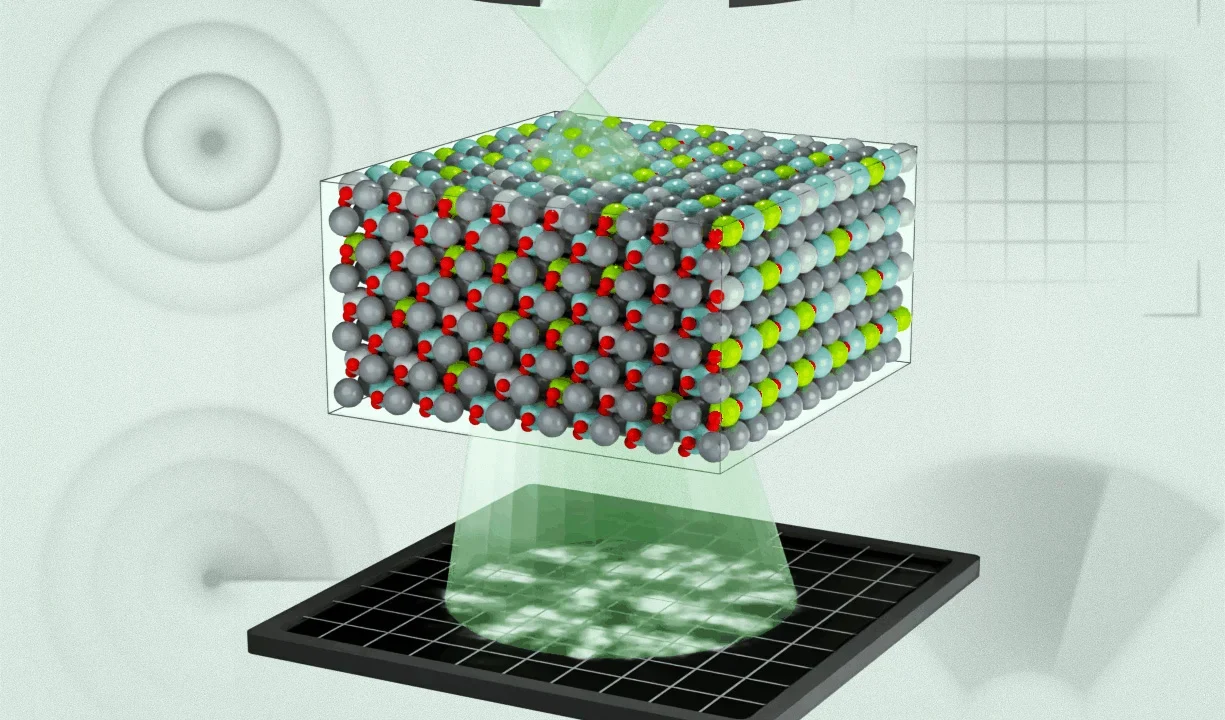
Relaxor ferroelectrics are known for their exceptional energy storage and sensing properties, driven by complex interactions of charged atoms in nanoscale regions. Until now, these nanoscale polar regions had not been directly measured. The team studied a lead magnesium niobate-lead titanate alloy, a common relaxor ferroelectric, using multi-slice electron ptychography (MEP), a cutting-edge technique that reconstructs three-dimensional atomic-scale information by recording electron diffraction patterns as a probe scans the material.
This method allowed the researchers to observe a hierarchy of chemical and polar structures from atomic to mesoscopic scales. Unexpectedly, many polarized regions were significantly smaller than predicted by existing simulations. The team incorporated these experimental observations into computational models, revealing how individual chemical species influence polarization states depending on the atomic charge distributions.
Improving material models and applications
According to James LeBeau, MIT’s Kyocera Professor of Materials Science and Engineering and corresponding author, this enhanced understanding enables more accurate prediction and engineering of desired material properties. “If our models aren’t accurate and we can’t validate them, it’s garbage in, garbage out,” LeBeau said. The study directly links the three-dimensional polar structure with molecular dynamics simulations, marking a key advancement in validating theoretical models.
Co-first authors Michael Xu and Menglin Zhu highlighted that the chemical disorder observed was not fully accounted for in previous models, and their collaboration with international researchers refined these simulations for better predictive power. This improved modeling is expected to benefit the design of future computing, energy storage, and sensing technologies that rely on complex electronic materials.
Why it matters
Relaxor ferroelectrics play a critical role in various sensing and energy applications, yet their internal structures have remained largely theoretical. Direct 3D characterization provides unprecedented clarity, enabling scientists and engineers to tailor materials for improved performance. The ability to validate and refine computational models ensures more reliable design of materials with advanced properties, impacting fields such as defense, electronics, and renewable energy.
Background
Relaxor ferroelectrics have been utilized in commercial and defense technologies for decades due to their unique dielectric and piezoelectric properties. Their behavior arises from nanoscale regions where atomic electric polarizations vary, but capturing these regions in three dimensions had been beyond experimental reach until now. Multi-slice electron ptychography, an emerging technique, is establishing new standards for high-resolution material characterization at the atomic scale.
The research involved collaboration among scientists at MIT, the University of Alabama at Birmingham, Korea Advanced Institute of Science and Technology, University of Pennsylvania, Rice University, and others. The work received support from the U.S. Army Research Laboratory, Office of Naval Research, Department of War, and the National Science Foundation.
Read more Science Discoveries stories on Goka World News.
Sources
This article is based on reporting and publicly available information from the following source: