
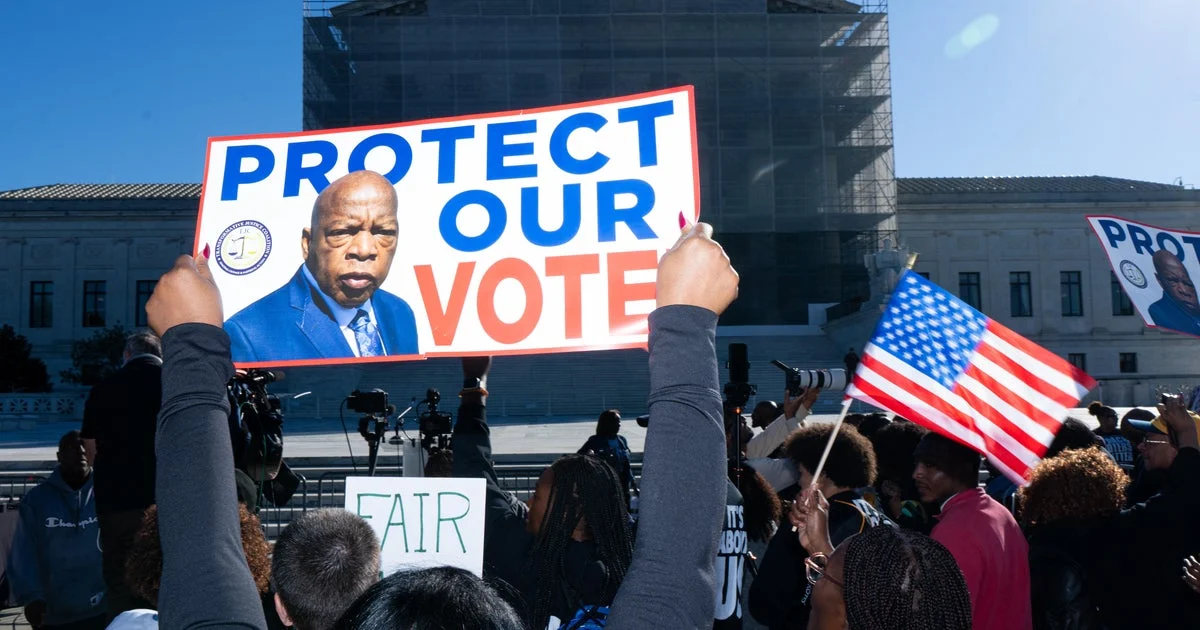
The U.S. Supreme Court on April 29, 2026, invalidated Louisiana’s congressional map, which had established two majority-Black districts. The court’s 6-3 conservative majority ruled that the state’s reliance on race in redrawing districts to comply with Section 2 of the Voting Rights Act was unconstitutional, significantly limiting the scope of the landmark voting law.
Justice Samuel Alito authored the majority opinion, affirming a lower court’s finding that Louisiana’s mapmakers used race too heavily in their 2020 redistricting effort. The court held that the Voting Rights Act did not require Louisiana to create an additional majority-minority district and that doing so without a compelling interest amounted to unconstitutional racial gerrymandering violating the plaintiffs’ constitutional rights.
Alito stated, “Because the Voting Rights Act did not require Louisiana to create an additional majority-minority district, no compelling interest justified the state’s use of race.” The decision alters how courts evaluate vote dilution claims under Section 2, requiring plaintiffs to prove intentional racial discrimination in district drawing, raising the evidentiary standard significantly.
Justice Elena Kagan, joined by Justices Sonia Sotomayor and Ketanji Brown Jackson, strongly dissented. She warned that the ruling effectively renders Section 2 “all but dead-letter,” making it nearly impossible for minority voters to challenge redistricting plans that dilute their electoral power. Kagan emphasized the decision would reduce minority representation and undermine long-established protections against racial discrimination in voting rights.
Implications for Louisiana and Beyond
Louisiana’s map, used in the 2024 election cycle, divided the state into four majority-white districts and two majority-Black districts. After the 2020 Census, the initial Republican-backed map created only one majority-Black district, prompting a lawsuit from Black voters who argued the map diluted their voting strength in violation of the Voting Rights Act. A federal court mandated a remedial map with a second majority-Black district, which Louisiana’s legislature enacted in 2024.
This revised map, intended to comply with the Voting Rights Act, was then challenged by non-Black voters who claimed it constituted an unconstitutional racial gerrymander. The Supreme Court sided with this challenge, striking down the map weeks before Louisiana’s primary elections, although the party primaries and early voting schedule leave little time for further redistricting.
Reactions to the Ruling
The ruling has drawn starkly divided responses. Louisiana Republicans hailed the decision as a victory for equal protection under the law, with Attorney General Liz Murrill calling it a “seismic decision” reaffirming constitutional principles. Republican leaders nationwide viewed the ruling as a restoration of electoral fairness free from race-based mandates.
Democrats and civil rights groups condemned the ruling. The NAACP described it as a “devastating blow” to voting rights that empowers politicians to dilute minority voters’ influence. Democratic National Committee chairman Ken Martin called the decision a “gut punch” that rolls back civil rights progress and undermines racial justice in electoral representation.
Why it matters
The Supreme Court’s decision to restrict the use of race in redistricting under the Voting Rights Act marks a significant curtailment of protections against racial vote dilution. By raising the burden of proof for claims under Section 2, the ruling threatens to reduce minority electoral influence nationwide and complicates the ability of voting rights advocates to challenge redistricting plans deemed discriminatory.
Coming just months before the November midterm elections, the ruling leaves little time for Louisiana or other states to adjust their voting maps, potentially impacting minority representation both in Congress and at state levels. The decision continues a trend of judicial limits on the Voting Rights Act, echoing recent conservative Supreme Court rulings in 2013 and 2021 that have weakened federal oversight of voting rights.
Background
Section 2 of the Voting Rights Act, passed in 1965, prohibits voting practices that discriminate on the basis of race or color. It has historically been used to challenge redistricting plans that dilute minority voting strength. Louisiana’s recent mapmaking efforts reflected attempts to balance compliance with this law and political considerations by state Republicans.
The legal controversy began after the 2020 Census when Louisiana Republicans drew maps with only one majority-Black district despite the state’s nearly one-third Black population. Federal courts required a second such district, but political and racial disputes over district boundaries persisted, culminating in this Supreme Court decision.
Read more Politics stories on Goka World News.
Sources
This article is based on reporting and publicly available information from the following source: