
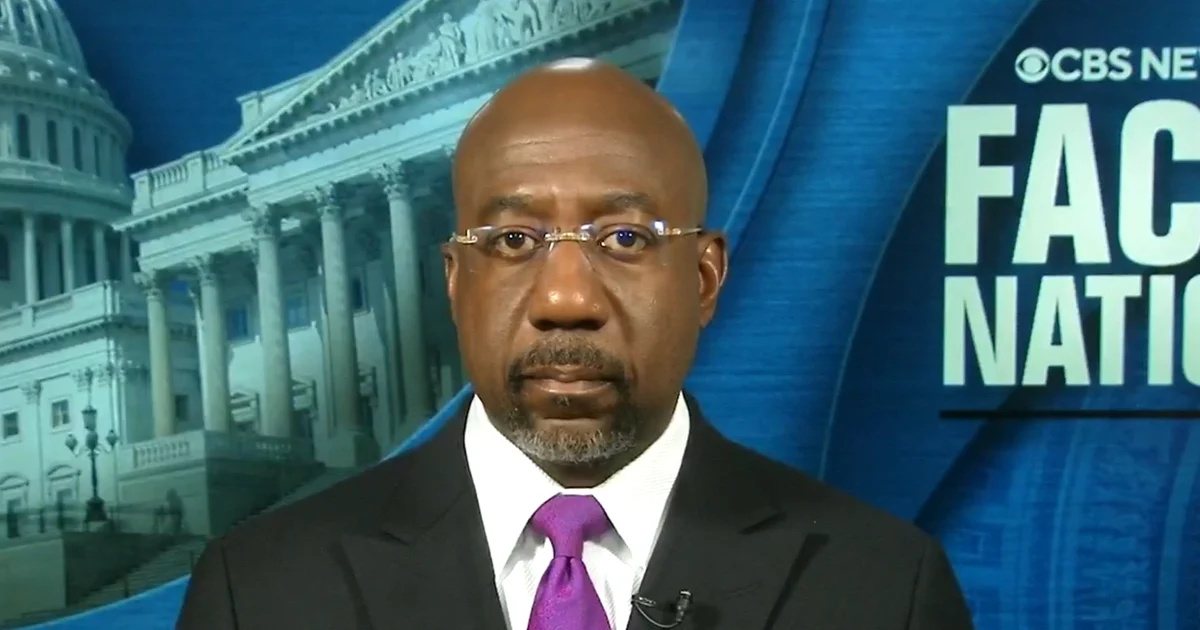
Democratic Senator Raphael Warnock of Georgia condemned the Supreme Court’s recent ruling that struck down Louisiana’s congressional map and narrowed the application of the Voting Rights Act, calling it a “massive and devastating blow” to democracy and minority voters. Speaking on “Face the Nation” on May 3, 2026, Warnock said the court’s decision “poured fuel on this redistricting arms race,” heightening partisan conflicts over electoral map drawing.
The Supreme Court’s conservative majority ruled that compliance with Section 2 of the Voting Rights Act does not justify considering race when redrawing congressional districts. This ruling invalidated Louisiana’s map, which included two majority-Black districts, and is expected to make it harder for minority voters and voting rights groups to challenge discriminatory district maps nationwide.
Warnock traced the intensifying redistricting battles back to former President Donald Trump’s 2021 push for Republicans in Texas to redraw the state’s congressional map to gain additional seats. This move prompted Democrats in California and other states to redraw maps in response. “We could not unilaterally disarm,” Warnock said, emphasizing that current conflicts are a reaction to such aggressive partisan strategies.
Although he opposes gerrymandering, Warnock advocates for banning partisan gerrymandering altogether. He explained that the practice “turns our elections on its head” by enabling politicians to choose their voters instead of voters selecting their representatives.
Warnock also highlighted the broader context of voting rights erosion following the 2013 Supreme Court decision that eliminated Section 5 preclearance protections requiring certain states to obtain federal approval before making voting changes. He noted that states have adapted with what he termed “21st Century Jim Crow tactics,” including relocating and closing polling places in Black and brown communities.
Since the latest ruling, Republican governors in states such as Louisiana and Tennessee have called for legislative special sessions or expressed interest in redrawing congressional maps, indicating prompt political responses to the ruling.
Warnock underscored the personal and democratic consequences, stating that reducing minority representation ignores historical realities and harms democracy itself. “When we create an increasing monolith, we hurt the democracy and make it harder to get policies that embrace all of our children,” he said.
Why it matters
The Supreme Court’s decision constrains the Voting Rights Act’s ability to protect minority voters from racial discrimination in districting. This enhances Republican chances to redraw districts favoring their party, impacting political representation, especially in Southern states. The ruling could lead to broader efforts to alter electoral maps, prompting concerns about voter suppression and reduced minority influence in elections.
Background
The Voting Rights Act of 1965 has been a cornerstone of protecting minority voting rights, including provisions like Section 5 preclearance and Section 2 litigation standards. The 2013 Shelby County v. Holder ruling invalidated the Section 5 formula, weakening preclearance protections. The new Supreme Court decision further narrows Section 2’s reach, limiting the ability to challenge racially biased redistricting based on race considerations. Since these legal shifts, states have increasingly adopted measures that critics say suppress minority voter turnout.
Sources
This article is based on reporting and publicly available information from the following source:
Read more Politics stories on Goka World News.