
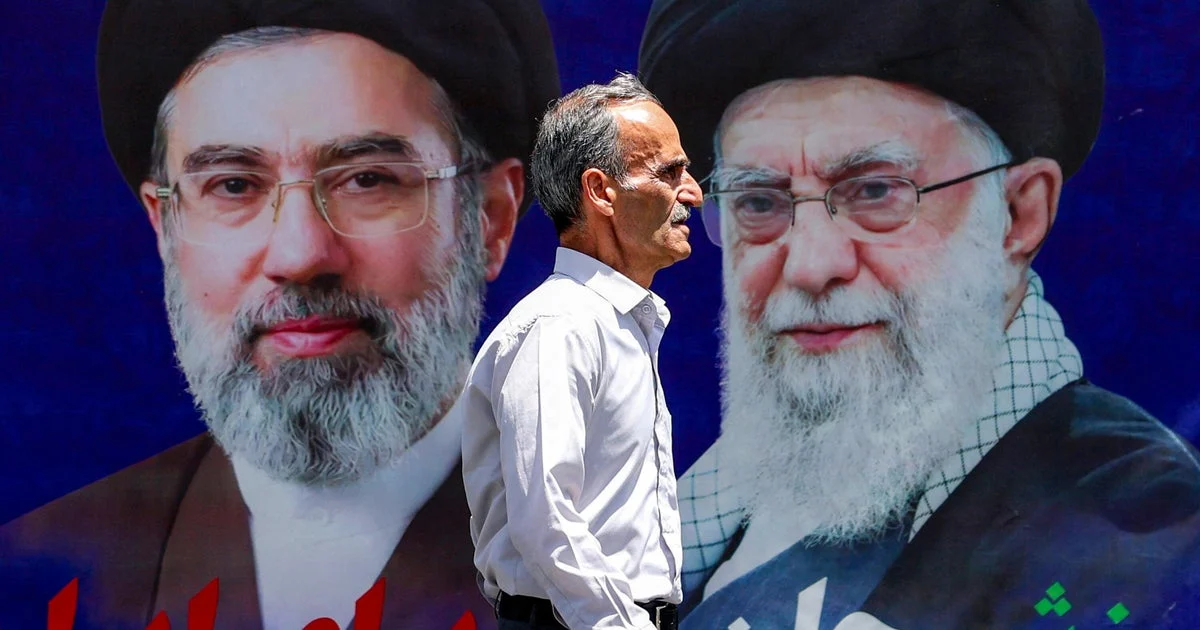
President Donald Trump recently claimed that Iran’s ruling regime is in a “state of collapse” with “tremendous infighting and confusion” hindering diplomatic progress to end the ongoing conflict following U.S. and Israeli strikes. However, analysts and regional experts dispute this characterization, describing the developments as a shift in power dynamics rather than signs of a fractured or failing regime.
Claims of Leadership Vacuum and Supreme Leader Transition
In the initial phase of the conflict that began with U.S.-Israeli strikes on February 28, the death of Supreme Leader Ayatollah Ali Khamenei sparked speculation about a power vacuum. Iran named Ayatollah Mojtaba Khamenei as the new supreme leader, but his near-total invisibility since the transfer of power, along with unconfirmed reports that he was seriously wounded in the strikes, fueled perceptions of uncertainty.
Despite these concerns, the Islamic Revolutionary Guard Corps (IRGC) has emerged as a key stabilizing force. The IRGC, a powerful military, political, and economic institution historically loyal to the supreme leader, appears to have consolidated control over military strategy and political decisions during the wartime period.
Power Shift From Theocratic to Military Influence
Experts note a significant shift in Iran’s power structure, with authority moving from theocratic clerics toward military leadership embodied by the IRGC. Sanam Vakil of Chatham House emphasized that this transition has been underway for decades, with the IRGC expanding its influence through economic holdings and political positions held by former members.
Aaron David Miller of the Carnegie Endowment remarked that Iran’s regime is now more reliant on “hard power” linked to the IRGC rather than purely religious authority. Nevertheless, analysts caution that the IRGC’s legitimacy remains tied to the institution of the supreme leader, which continues to hold the highest authority in Iran.
Factionalism Focused on Negotiation Tactics, Not Regime Survival
Though differences exist within Iran’s leadership regarding negotiation tactics with the U.S., these divisions are characterized as tactical rather than existential threats to the regime. Moderates such as President Masoud Pezeshkian and Foreign Minister Abbas Araghchi favor diplomatic solutions, while hardliners, often linked to the IRGC, maintain a posture of strength and resistance.
Despite some public disagreements and criticisms, including ultraconservative opposition to negotiations, Iran’s parliament overwhelmingly supports the negotiating team. Analysts note that these debates resemble the variety of viewpoints present in Washington rather than indications of regime collapse.
U.S. Analyses and Motivations Behind Trump’s Statements
Observing the evolution in Iran’s leadership and its war stance, some U.S. experts see the Trump administration’s assertions as a strategic narrative aimed at justifying delays and difficulties in peace negotiations. Mona Yacoubian of the Center for Strategic and International Studies indicated that the regime has strengthened under IRGC dominance, adopting a harder line since the initial strikes.
Sanam Vakil suggested that President Trump may have overstated the degree of internal division in Iran to provide an explanation for stalled talks and to shift accountability. She highlighted that Iran’s leadership remains aligned in prioritizing regime survival and securing sanctions relief, while U.S. policy coherence has been less clear.
Why it matters
The accurate assessment of Iran’s internal dynamics is critical for U.S. policymakers, negotiators, and international observers engaged in efforts to resolve the conflict. Mischaracterizing Iran’s leadership as collapsing risks misinformed strategies and expectations in diplomacy, potentially prolonging tensions and instability in the region.
Background
The conflict escalated after coordinated U.S. and Israeli military actions targeting Iranian leadership and infrastructure. Since then, Iran’s political structure has undergone an unusual leadership transition amid a still-unfolding war that has significant global economic repercussions. The IRGC has historically been a central player in both foreign operations and domestic security, now appearing even more influential as Iran navigates wartime challenges.
Sources
This article is based on reporting and publicly available information from the following source:
Read more World News stories on Goka World News.