
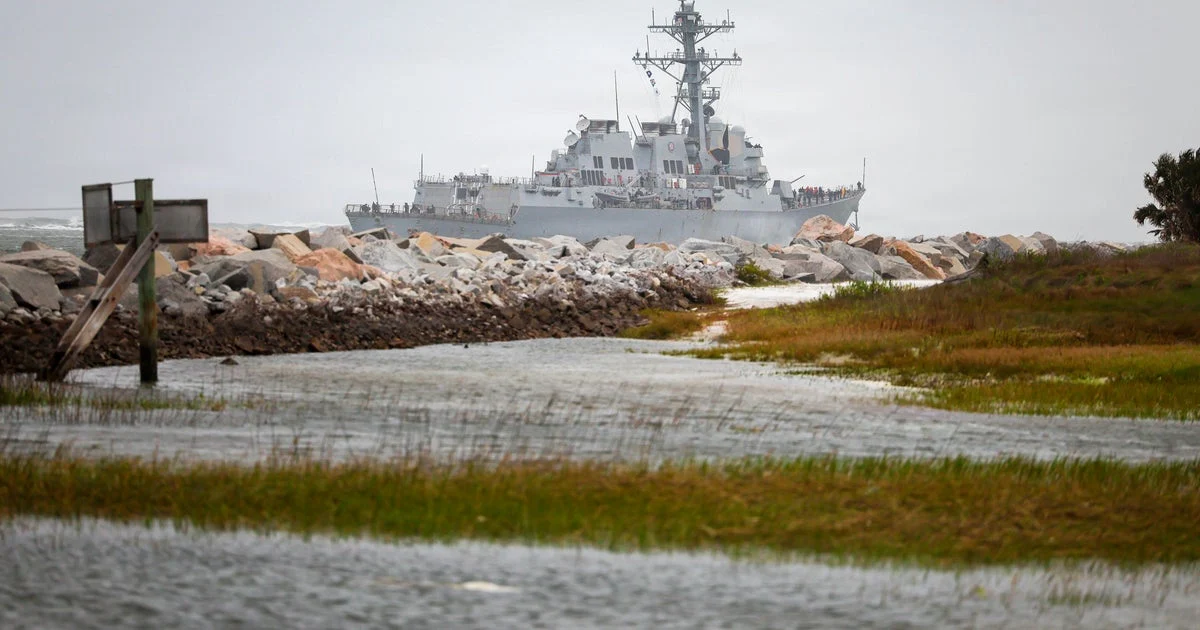
Three U.S. Navy destroyers—USS Truxtun, USS Mason, and USS Rafael Peralta—were attacked by Iranian missiles, drones, and fast-attack boats while transiting the Strait of Hormuz on May 7, 2026, leading the U.S. military to launch retaliatory strikes on two Iranian ports, Bandar Abbas and Qeshm.
The attacks occurred amid a fragile monthlong ceasefire between the United States and Iran. According to U.S. Central Command (CENTCOM), the American warships were not hit during the assault. The U.S. responded with “self-defense strikes” targeting Iranian facilities believed to include drone and missile launch sites. Multiple U.S. officials confirmed the strikes to CBS News.
During the confrontation, Iranian forces engaged the destroyers with coordinated attacks involving small boats maneuvering aggressively close to the U.S. vessels, prompting U.S. forces to return fire. The American ships utilized their five-inch naval guns, close-in weapon systems (CIWS), and small-caliber deck guns. Apache helicopters fired Hellfire missiles, while additional aircraft provided aerial support. Despite the intensity of the attack, there were no reported casualties or damage to the U.S. ships.
President Donald Trump described the strikes on Iranian targets as a “love tap” in comments to ABC News and told reporters that the Iranian forces “should not have done that today.” He also tweeted that significant damage was inflicted on the attackers, likening the destruction of Iranian drones to them “dropping ever so beautifully down to the Ocean.”
This incident marked a sharper escalation compared to an earlier engagement on May 4, when the USS Truxtun and USS Mason faced a separate sustained barrage by Iran involving missiles, drones, and fast boats. CENTCOM reported destroying six Iranian vessels during that encounter, a claim Iran denied.
Why it matters
The attacks highlight ongoing friction in the strategically vital Strait of Hormuz, through which about one-fifth of the world’s oil passes. Despite the ceasefire intended to pave the way for peace negotiations, both the U.S. and Iran continue to assert control over the waterway. The recent strikes risk undermining diplomatic efforts and could further destabilize global oil markets.
President Trump has maintained pressure on Iran by enforcing a blockade of Iranian ports and attempting to reopen safe commercial navigation through the strait. However, after initially launching “Project Freedom” to escort commercial vessels, he suspended the effort pending further negotiation progress. No formal talks have been scheduled.
Background
The United States and Iran entered a ceasefire approximately one month ago following several confrontations in the Persian Gulf region. Prior to these recent events, the two countries had exchanged missile and drone fire near the Strait of Hormuz, a critical maritime chokepoint. The U.S. has aimed to limit Iran’s regional influence and nuclear ambitions through sanctions and military pressure while seeking a diplomatic resolution.
The repeated assaults and retaliatory strikes underscore the tenuous nature of the truce, with both sides engaging in provocative actions. Iranian warnings against unauthorized maritime passage and U.S. naval operations in the area have kept tensions high.
Sources
This article is based on reporting and publicly available information from the following source:
Read more US News stories on Goka World News.