
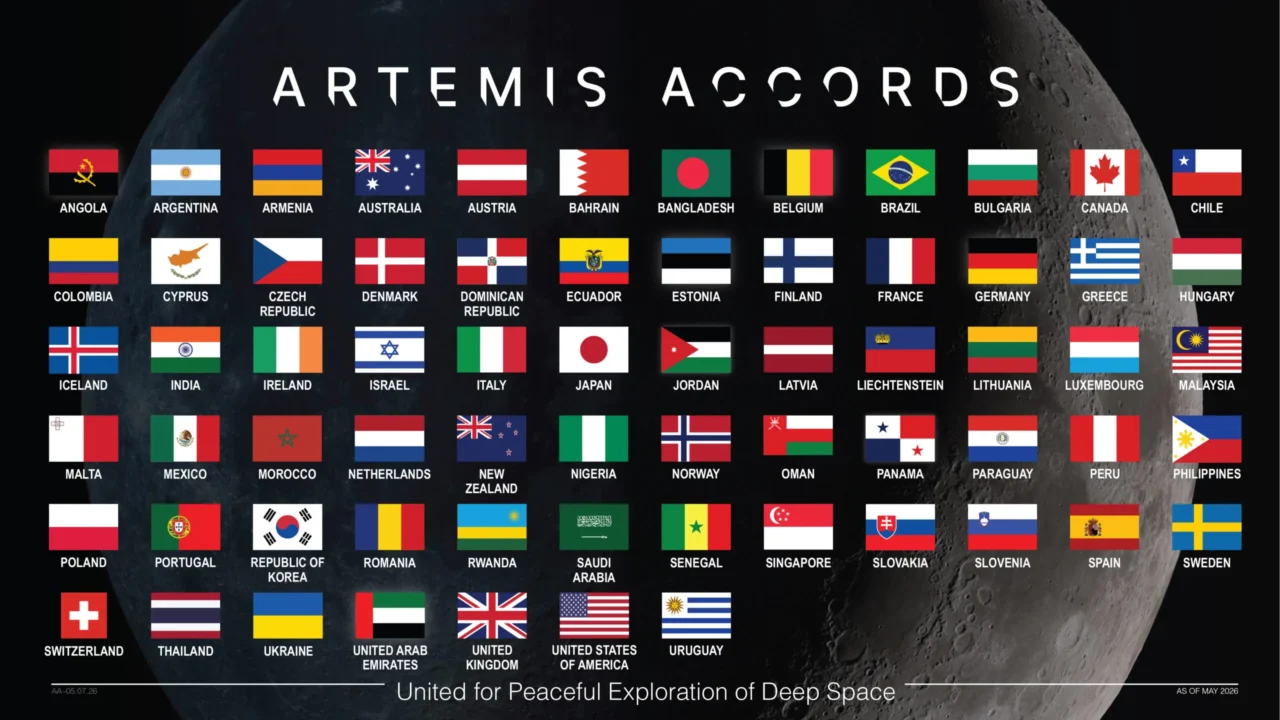
Paraguay officially joined the Artemis Accords on Thursday, becoming the 67th nation to endorse the international framework designed to guide civil space exploration. The signing ceremony took place in Asunción, with the Paraguayan Space Agency’s Minister President Osvaldo Almirón Riveros signing on behalf of Paraguay.
NASA Administrator Jared Isaacman welcomed Paraguay’s accession, highlighting the Accords as a coalition of countries devoted to peaceful, transparent, and responsible space activities. Established in 2020 under the Trump administration, the Artemis Accords lay out principles for collaborative exploration of the Moon, Mars, and other celestial bodies, supporting ongoing NASA missions including the development of a lunar base.
In his remarks, Isaacman emphasized that all signatories, including Paraguay, are invited to participate in lunar surface activities and collective objectives of the Artemis program’s next era of exploration. U.S. Embassy Asunción Chargé d’Affaires Aaron Pratt echoed this support at the event.
Paraguay’s Space Program and Goals
The Paraguayan Space Agency was established in 2014 and has concentrated on building national capabilities in satellite technology and Earth observation through both domestic development and international partnerships. Paraguay launched its first satellite, GuaraníSat‑1, from the International Space Station in 2021.
The country is preparing to launch its second satellite, GuaraníSat‑2, in October aboard a SpaceX Falcon 9 rocket from Vandenberg Space Force Base, California. This mission incorporates collaboration with NASA’s Jet Propulsion Laboratory and other international participants.
Minister President Almirón Riveros described signing the Artemis Accords as a historic milestone that reaffirms Paraguay’s commitment to international cooperation, peaceful space use, scientific progress, and expanding its role within the global space community. He noted that joining the Accords opens new opportunities for research, innovation, and sustainable development.
Artemis Accords Principles
The Artemis Accords establish practical guidelines for signatories to explore space responsibly and with transparency. Key commitments include conducting activities peacefully, providing aid to those in distress, sharing scientific data openly, avoiding interference with other parties’ operations, and preserving sites and artifacts of historic significance.
Initially launched by the United States alongside seven founding nations, the Accords respond to increased government and commercial interest in lunar and deep space missions. NASA continues to promote the Accords as a framework for safe, cooperative, and prosperous space exploration.
Why it matters
Paraguay’s accession reflects the growing global consensus on coordinating space activities through shared principles. As countries and private actors expand their extraterrestrial presence, such agreements promote peaceful use of space, encourage international cooperation, and help prevent conflicts or misunderstandings in new domains like the Moon.
The increasing number of signatories strengthens the Artemis program’s foundation for joint missions, including the planned lunar base, potentially involving diverse participants worldwide.
Sources
This article is based on reporting and publicly available information from the following source:
Read more Space & NASA stories on Goka World News.